Skip to content

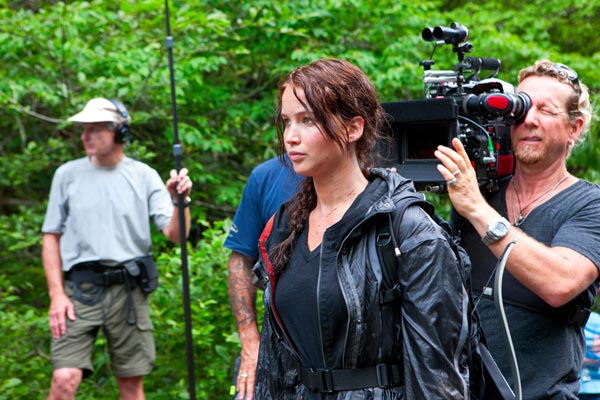
Have you read The Hunger Games trilogy yet? Updates of newly added cast members to the second film in the franchise are speeding up, but we’ve got some great back story on the first movie! Check out this great article by Cara Ellen Modisett on how the movie was filmed in our own local areas of North Carolina to give beautiful forest backdrops as described in the book. We also get a look at other movies filmed in the area–here’s a sneak peek! (To skip ahead for the full article, please click here for the BRC website.)
Our beautiful mountain geography; our small, charming, sometimes frozen-in-time towns; our warm welcome; our reasonable prices for things. They’re all part of what brings Hollywood to the Blue Ridge region – to make documentaries, commercials, features and even blockbusters like “The Hunger Games,” which was filmed in large part in Western North Carolina.

Haven’t read the books or seen the movie? “The Hunger Games” is set in a dystopian, future America, where the population has been divided into districts. Civilization as we know it is no more – there are allusions to a nuclear disaster sometime in the past, and the remade society’s been divided into districts, ruled over by the materialistic, wealthy citizens of the Capitol (somewhere out in the Rocky Mountains). Nearly 75 years back, the poorer districts rebelled, and they’ve been punished – each district must send two young people, tributes, every year, to participate in the Hunger Games, an overhyped, sponsored and live-broadcast fight to the death. One young person survives, and lives the rest of his or her life in bitter luxury.
District 12 is coal-mining country – Appalachia – and it’s not had a champion in years. Its tributes, the bow-and-arrow-wielding Katniss Everdeen (Jennifer Lawrence) and baker’s-son Peeta Mellark (Josh Hutcherson), are the heroes of book and film.
And because the movie was filmed in the general area in which much of the books are set, it’s even bigger news for our region. North Carolina hosted cast and crew, and the filmmakers spent about $60 million in the state while working on the film, a good chunk of the $220 million spent overall in 2011 by film production in the state – a record for North Carolina.
Movie business is big business, and many states are trying to entice production companies. Big-budget feature films such as “The Hunger Games” are a major coup, but independent films, documentaries and commercials are sought after as well.