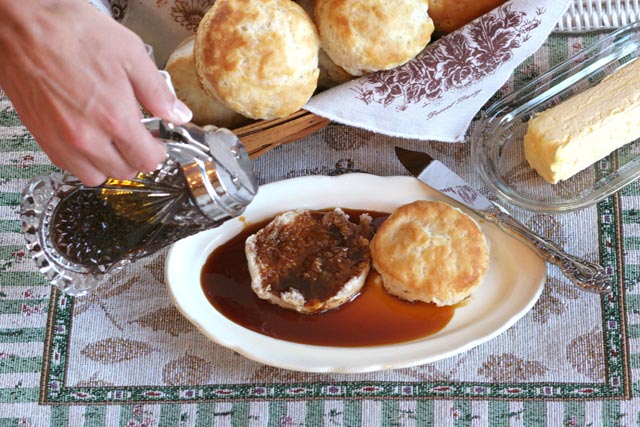
Sit down for a boardinghouse meal at The Farmer’s Daughter in Chuckey, Tenn., and you get an immediate immersion in Southern culinary history. It’s a subtle lesson – a palatable, not a pedantic, one. The instructional tools are a plastic squeeze bottle and an iron skillet.
The contents of those vessels come from cane and stalk: sorghum syrup and cornbread. One is sweet, the other filling. One is imported, the other native. Their flavorful marriage on the plate speaks of survival during economic deprivation.

Cornbreads were being shaped and baked long before white settlement in North America. A member of the grass family, sorghum cane came much later, imported from Africa. By the 1860s, with the scarcity and expense of sugar in the south, sorghum syrup, produced by boiling down the juice of the cane, was a primary sweetener.
During the Civil War, a prisoner-of-war enclave in Columbia, S.C., came to be known as “Camp Sorghum.” Union prisoners were given rations of cornmeal and sorghum syrup.
Today, Kentucky and Tennessee lead the nation in the production of sorghum syrup. Arland Johnson, a retired Eastman Chemical Company maintenance worker, grows the cane every summer and has engineered a boiling operation on his hillside farm in Limestone, Tenn. He supplies the sorghum that sweetens the Farmer’s Daughter’s cornbread.
Making sorghum syrup is hot, laborious, intricate work. Keeping the sugar groups in balance, cooking out the green taste, avoiding scorching and achieving as light a color as possible require constant attention, blending both art and science.
Containing iron, calcium and potassium, sorghum was once prescribed by doctors for nutrient-deficient patients, before the era of vitamins. With a deep and complex flavor, Arland Johnson’s dark amber sorghum syrup is pure, with no additives. It is, as he says, “Mother Nature in a jug.”
And sorghum syrup isn’t simply a historic relic. Dr. Morris Bitzer – retired University of Kentucky plant and soil sciences professor and executive secretary of the National Sweet Sorghum Producers and Processors Association – says the NSSPPA has grown from 110 members in 2001 to more than 550 members today, in 41 states.
“And we are getting new producers every year,” Bitzer says. “Yes, it is exploding, both for syrup and ethanol production.”
Sorghum Corn Muffins
3⁄4 cup sifted flour
1 1⁄4 teaspoons baking powder
1⁄2 teaspoon salt
1⁄3 cup cornmeal
1⁄4 cup prepared, diced apple
1 egg, well beaten
1⁄3 cup milk
1⁄4 cup sorghum
3 tablespoons shortening, melted
Sift flour once; measure and add baking powder and salt. Sift again. Add cornmeal. Wash, pare and dice apple. Combine egg, milk, sorghum and shortening. Add all at once to flour-cornmeal mixture, stirring only enough to dampen all flour. Fold in apple. Bake in a well-greased, two-inch muffin pan at 400 degrees for 20 minutes or until done. Makes eight to 12 muffins.
Sorghum Butter
1⁄2 cup unsalted butter
1 1⁄2 tablespoons sorghum
In a small mixer bowl, beat butter and sorghum until light and fluffy. Serve with quick breads, pancakes, waffles and French toast. Refrigerate leftovers.
Sorghum Foam
Over medium-low, heat about ¼ cup of sorghum in a small saucepan. When the sorghum is hot, sprinkle in about 1⁄8 teaspoon baking soda. The sorghum will foam up and the color will lighten considerably. This is good eaten just as it is, or serve it over cornbread.
Barbecue Sauce
2 tablespoons margarine
1 onion, chopped
1 cup water
1 cup ketchup
2 tablespoons vinegar
2 tablespoons lemon juice
2 tablespoons Worcestershire sauce
2 tablespoons brown sugar
1⁄4 cup sorghum
1 teaspoon prepared mustard
1 teaspoon salt
1⁄4 teaspoon black pepper
1 tablespoon A-1 sauce
Sauté onion in margarine; add remaining ingredients. Simmer for 20 minutes. Use on poultry, beef, pork or whatever you desire.
The three recipes are from “Sorghum Treasures,” seventh printing, August 1999, published by the National Sweet Sorghum Producers and Processors Association through Jumbo Jack’s Cookbooks, Audubon, Iowa.