Old Footage of Sliding Rock in Pisgah Forest, NC

Not far from Asheville, NC lies Pisgah National Forest. With scenic views, hiking trails, and cascading waterfalls, it’s a beautiful spot for both locals and tourists. One of the big selling points is the well-known

Sliding Rock, an awesome spectacle.

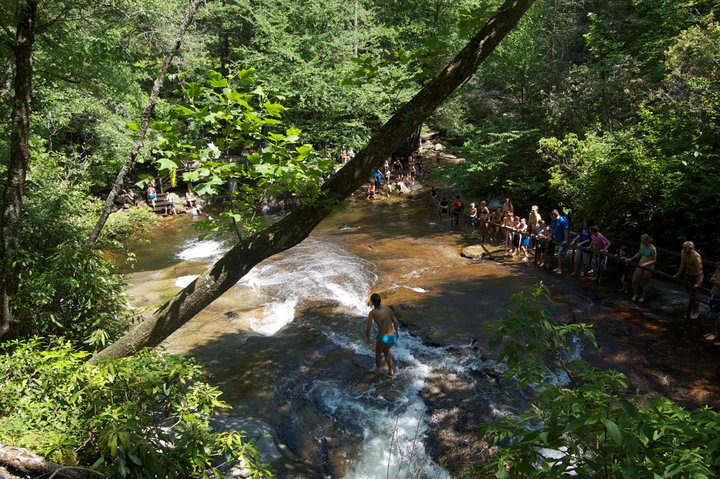
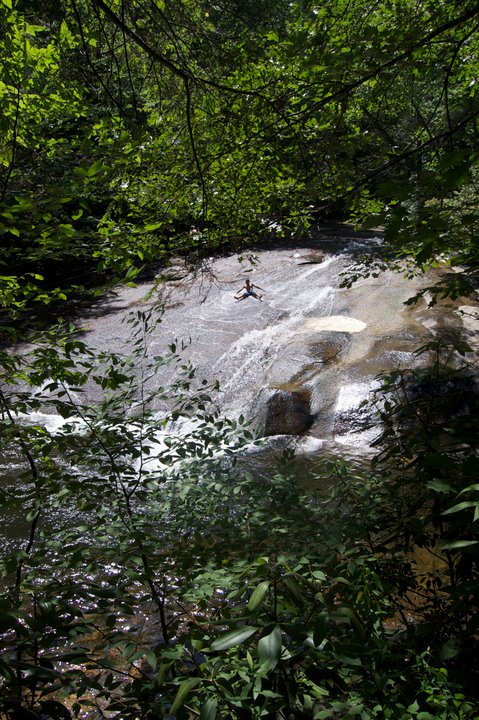
About 60 feet long, with a  gentle slope at the top and a large, deep pool at the bottom, visitors are always present and eager to go down this unique water slide.

My grandmother lives in Brevard, NC. When my husband and I went to visit her last summer, she insisted we take a short drive out to Sliding Glass Rock, a well-known nature venue for tourists and townies alike. It’s the local watering hole–this is the place to be in the summer to cool off and catch up with everyone! My mom used to go out there all the time with her friends when she was in high school, before there were handrails, restrooms, and the occasional lifeguard, but she always said how much fun it was–judging by the crowds we saw, everyone still agrees even thirty years later!

We found a YouTube video of Sliding Rock back in the day! While we’re not sure what year it’s from, it’s definitely several years back as it’s before the man-made handrails and steps were built. It’s amazing to think of the history here and that people have been doing this for so long-just more proof how cool nature can be.

Here’s the 8MM movie of “Sliding Rock” in Pisgah National Forest, NC.
You Might Also Like:

e1b70596-05c8-11f1-92e0-1248ae80e59d-3-2026rueanemone--credit-Joe-Cook

March’s Mountain Wildflower: Rue Anemone

A member of the buttercup family and found in the open woodlands, rue anemone (Thalictrum thalictroides) has long, thin stems that tremble in the slightest of winds—prompting its other common name, windflower.
Pokeweed growing in Floyd County, Virginia.

January’s Wild Edible: Pokeweed

Pokeweed is one of the wild plants that is most associated with the Blue Ridge Region.
A purple-spored puffball growing in a field in Botetourt County, VA.

December’s Wild Edible: Purple-Spored Puffball

The purple-spored typically grows in this region’s fields, often appearing from October through December and into early January.
d289022c-696f-11f0-a179-1248ae80e59d-CGZ_0845-011

Ride the Rails, Explore Rockbridge County: Make a Weekend of the 611 in Goshen!

This fall, one of America’s most iconic steam locomotives is making tracks and memories.
The compound, lancelike leaflets of the bitternut are a good identifier.

November’s Wild Edible: Bitternut Hickory

Frankly, this native species to the Blue Ridge mountains comes by its name honestly.
Mullein growing in Ingram's backyard.

October’s Wild Edible: Mullein

Earlier, this year, a lone mullein plant appeared along the fence that encloses my garden, which made me curious about this plant.
An indigo milk cap growing in Botetourt County, Virginia.

September’s Wild Edible: Indigo Milk Caps

When young, indigo milk caps are one of the most stunningly beautiful mushrooms in the Blue Ridge Mountains.
ec3b964c-5201-11f0-968d-1248ae80e59d-9-2025spottedjewelweed--credit-Joe-Cook-and-Monica-Sheppard

September’s Mountain Wildflower: Spotted Jewelweed

Seek out spotted jewelweed growing beside a stream or along a moist area and you will have a good chance of getting to watch one or more ruby-throated hummingbirds flit from flower to flower.
A black staining polypore growing in Botetourt County, VA.

August’s Wild Edible: Black-Staining Polypore

The black-staining polypore is certainly one of the more fascinating wild edible mushrooms.
Northern Dewberry growing in Botetourt County, Virginia.

July’s Wild Edible: Northern Dewberry

For several reasons, the northern dewberry is often overlooked as a summer berry in the Blue Ridge.

CALENDAR OF EVENTS