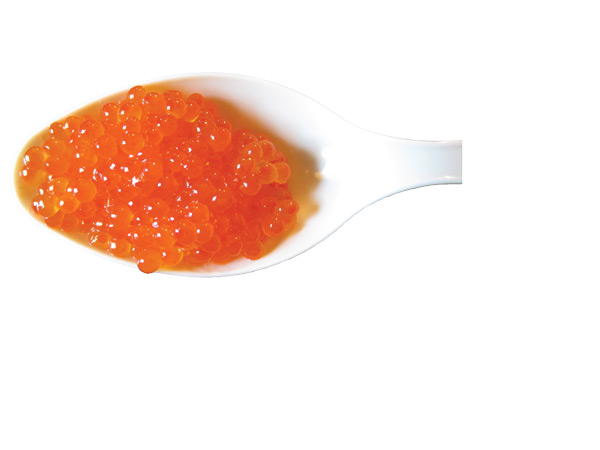
Once seen as a nuisance and thrown away, trout caviar is today treasured by the Jennings and Eason families in western North Carolina. Dick Jennings, now nearing 90, left Pittsburgh to start farming trout in 1948, as a way to feed his mink. Seeing a dim future in furs, Jennings cast his lot with the fish.
Jennings Trout Farm eventually became Sunburst Trout, on property once owned by Canton’s Champion Paper Company, in the Pisgah National Forest. The area was known as the Sunburst logging community, and Jennings’ daughter Sally Eason thought it would be a perfect name for the family business. In fact, she says the color of the trout filets produced in the Haywood County location reminds her of a sunburst.

Filets make up about 60 percent of Sunburst’s business today. Since 1985, the company has expanded to offer some 15 value-added products.
Trout caviar has become a big seller at Sunburst, catching the attention of chefs like Jacques Pepin.
“The egg pops in your mouth, with just the right texture,” he says as he prepares a potato pancake, spreading it with Sunburst trout caviar, spooning sour cream into the middle, and sprinkling it with chives. He cuts the pancake in wedges as a first course, on the PBS show “Chefs A’ Field.”
“I appreciate all farmers and all people like Sally who grow things out of the earth, because too much has been said about the chef and not enough about the farmer,” says Pepin. “We would be nothing without people like this.”
Pepin’s words are especially meaningful to the Jennings and Eason families, who have overcome more than their share of hardships to keep their business going. In 1986, water temperatures reached 73 degrees, lethal for trout, and all the fish at Sunburst perished within 48 hours.
“That’s one more disaster than we’re willing to take on, we thought,” says Eason. “But after about a month, we changed our minds.”
In 2004, two hurricanes hit western North Carolina, 10 days apart. Floods and drought are constant threats. And in 2006, the business fell victim to arson. Yet the family keeps on.
“I think as a farmer that my responsibility is to my customers and to this land so that when I leave it, it’s in as good a shape if not better than when I came,” says Eason.
The water at Sunburst emerges out of the Pisgah National Forest, is channeled into manmade Lake Logan and then piped into the Sunburst system where it courses through a tier of raceways, undergoes purification, and then re-enters the Pigeon River.
“So we borrow the water and then return it,” Eason says. “It’s ultra-pure.”
Adds Dick Jennings: “Because trout is a delicate, sensitive animal just like its taste, it has to have optimum conditions to survive.”
Even in death, Sunburst trout affect Haywood County. The compost system at Sunburst, funded by local Mountain Organics, enriches area gardens.
“We sell it by the backhoe scoop to local farmers,” says Eason. “It grows huge vegetables.”
Dick Jennings’ father once warned him he’d starve if he stayed in the mountains. Instead, Jennings and his family prospered, largely through the persistence and determination they learned firsthand from their neighbors in Appalachia.
Lime-Basil Grilled Trout Filets
Recipe courtesy Charles Hudson, research and development chef for Sunburst Trout
4 Sunburst trout filets
Juice of 1 lime
One handful of fresh basil leaves (about 1 ounce), chopped
2 cloves garlic, minced
¼ cup olive oil
1 teaspoon Lawry’s Seasoned Salt1 teaspoon freshly ground black pepper
Make a marinade by mixing the lime juice, basil, garlic, olive oil, seasoned salt, and pepper. Marinate the trout for at least an hour. Remove trout from marinade and place on a well-oiled, pre-heated grill. Start flesh side down for about 3 minutes and then flip for another 2-3 minutes of cooking. Serves 4.
Sunburst Trout
128 Raceway Place, Canton, North Carolina. 828-648-3010; 1-800-673-3051; sunbursttrout.com