Skip to content

Want to learn more about the Hatfields and McCoys? Check out these great resources!
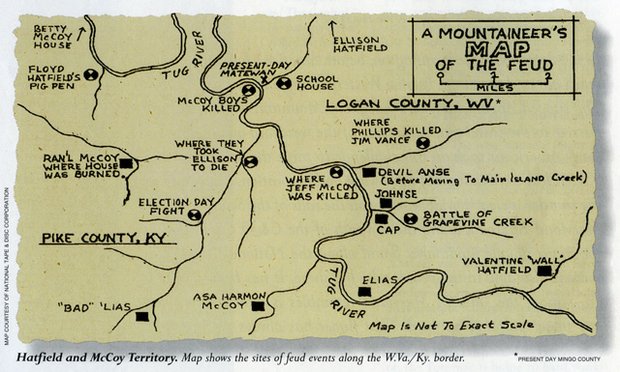
Exciting news for the history lovers! Now that you’ve seen the Emmy-winning actor Kevin Costner in the Hatfields & McCoys mini-series, you might be looking for even more information on this well-known feud. If you’re interested in digging deeper, now you can follow in their footsteps by geocaching on their trail! For more information, read their official press release below and don’t forget to check out our popular articles related to these historic families:

The Hatfield-McCoy Feud: Roseanna, Don’t You Cry
Hatfield-McCoy Feud: A Timeline
Hatfields, McCoys, and Confederates
New Hatfield McCoy Geo Trail Launched
WILLIAMSON, W.Va. – History buffs and adventure seekers now have a new opportunity to explore the story behind the Hatfield and McCoy feud with the recent launch of The Hatfield McCoy Geo Trail. Thanks to the continued surge in interest generated by the History Channel miniseries, geocachers and those who are just plain curious can retrace the footsteps of these famous mountain families with the popular outdoor activity of geocaching following the new Hatfield McCoy Geo Trail.
Geocaching is a modern-day version of treasure hunting, with nearly 2,000,000 caches placed all over the world. On Sept. 1, 2012 the Tug Valley Chamber of Commerce and the Tour Pike County offices hosted 518 travelers from 18 states across the country who attended the kick-off event that became MEGA in the geocaching world.
The trail is a collaborative effort between Williamson’s Tug Valley Chamber of Commerce member Wendy H. Baisden (whbaisden) and Pikeville’s Tour Pike County member Kelly Moore (SpongeBob CachePants). The Hatfield McCoy GeoTrail offers a new destination for geo travelers from across the country and around the world. The Hatfield McCoy GeoTrail includes 15 caches, placed in historic locations relating to the families and their conflicts. Participants use hand-held GPS units or their smart phones to seek the location of hidden objects. These caches can be found in Mingo and Logan counties in West Virginia and in Kentucky’s Pike County.
Baisden and Moore are avid geocachers. Each was named GeoCacher of the month for August and September respectively by GroundSpeak Headquarters. They designed, placed and maintain the caches. In addition, a collectible coin is offered to those who travel to the area and obtain a copy of the passport needed to confirm each find. Visitors must carry the passport to each of the locations and stamp it with a specific stamp found in each of the geocache locations. The beautiful coin depicts the Tug River and the images of the patriarchs of the Hatfield & McCoy Families, Devil Anse and Randall. “The coin is our gift to the caching community,” said Baisden. It is also an honor for us to be able to personally place each coin into the hands of the visitors.”
“Wendy and I worked together to purchase the coins because we felt it was our way of giving back to the geocaching community,” said Kelly. “It also adds to the excitement that visitors feel when coming to the area to geocache.” Plans are already in the works to offer a Labor Day weekend event in 2013 of MEGA stature to continue to showcase the areas rich history. Details for the coming event will be posted as they are available on the Hatfield McCoy GeoTrail website.
The Geo Trail is a great way to experience an intriguing chapter in the history of Southern West Virginia and Eastern Kentucky. To learn more about the Hatfield McCoy Geo Trail, how to begin geocaching or how you can obtain your very own collectible coin, go to www.hatfieldmccoygeotrail.com. You can also email Wendy Baisden at whbaisden@gmail.com or Kelly Moore at cachepants@gmail.com. To plan your next West Virginia vacation visit www.wvtourism.com