The Lazy Baker: Strawberry Icebox No Bake Cake

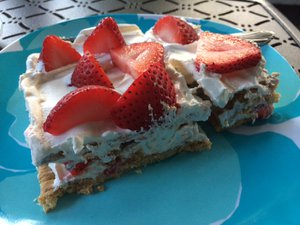
As summer approaches, my taste buds begin to crave lighter meals and brighter flavors. I’m all for rich desserts, too, but luckily I’ve found a no bake “cake” that’s both tasty and easy on your waistline. It was delicious the first day, but I found the second day was even better once the graham crackers had softened and had more of a cake texture.

No Bake Strawberry Icebox Cake

Ingredients

  • 2 lbs. strawberries (halved or quartered)
  • 1 tub Cool Whip
  • 1 box of graham crackers (I used 2 full sleeves from the box)
  • Milk chocolate chips (optional)

Instructions

It couldn’t be easier!

  • Set down a layer of graham crackers on the bottom of your container.
  • Smooth cool whip across the base and layer with strawberries.
  • I recommend putting a bit of whipped topping on the bottom of the next layer of graham crackers so they don’t slide around on top of the strawberries.
  • Put those down, then cool whip, and more strawberries.

Continue until you’re all out! Due to my pan, I had enough room for two layers, though it’s easy to add or subtract based on serving sizes.

You can also melt milk chocolate chips to drizzle some chocolate in between layers – especially the top part! I didn’t do this for my first icebox cake, but you better believe there will be delicious chocolate on the next one.

Cover and set in fridge for at least 4 hours before serving. I’d give it up to about three days – not that it goes bad, but the strawberry juice will begin to mix with the crackers and whip and won’t look as pretty. Then again, you might be surprised at just how fast this dessert gets eaten!
You Might Also Like:

White jelly snow fungus growing in the author’s Botetourt County, Virginia woodlot.

May’s Wild Edible: White Jelly Snow Fungus

“Pass the fungus,” is not common dinnertime conversation in the Blue Ridge Mountains region, but that’s because folks perhaps have not heard of the white jelly snow fungus.
Wild garlic growing in Fayette County, West Virginia.

April’s Wild Edible: Wild Garlic

Fayette County, West Virginia’s Mitchell Dech is one of my foraging mentors, and when he wants me to try an edible new to me … I’m ready to learn about it.
A May apple in bloom in Southwest Virginia.

March’s Wild Edible: May Apple

Sometime this month in the Blue Ridge Mountains, one of these highlands’ signature spring plants will ease from the soil … the May apple (Podophyllum peltatum).
e1b70596-05c8-11f1-92e0-1248ae80e59d-3-2026rueanemone--credit-Joe-Cook

March’s Mountain Wildflower: Rue Anemone

A member of the buttercup family and found in the open woodlands, rue anemone (Thalictrum thalictroides) has long, thin stems that tremble in the slightest of winds—prompting its other common name, windflower.
Pokeweed growing in Floyd County, Virginia.

January’s Wild Edible: Pokeweed

Pokeweed is one of the wild plants that is most associated with the Blue Ridge Region.
A purple-spored puffball growing in a field in Botetourt County, VA.

December’s Wild Edible: Purple-Spored Puffball

The purple-spored typically grows in this region’s fields, often appearing from October through December and into early January.
d289022c-696f-11f0-a179-1248ae80e59d-CGZ_0845-011

Ride the Rails, Explore Rockbridge County: Make a Weekend of the 611 in Goshen!

This fall, one of America’s most iconic steam locomotives is making tracks and memories.
The compound, lancelike leaflets of the bitternut are a good identifier.

November’s Wild Edible: Bitternut Hickory

Frankly, this native species to the Blue Ridge mountains comes by its name honestly.
Mullein growing in Ingram's backyard.

October’s Wild Edible: Mullein

Earlier, this year, a lone mullein plant appeared along the fence that encloses my garden, which made me curious about this plant.
An indigo milk cap growing in Botetourt County, Virginia.

September’s Wild Edible: Indigo Milk Caps

When young, indigo milk caps are one of the most stunningly beautiful mushrooms in the Blue Ridge Mountains.

CALENDAR OF EVENTS