 Skip to content


The story below is an excerpt from our January/February 2018 issue. For the rest of this story and more like it subscribe today, log in to read our digital edition or download our FREE iOS app. Thank you!
Our food columnist, Fred Sauceman, writes of smoky ham, secret sauce, and blue cheese dressing.
The Old Elizabethton Highway winds through and bisects Bullock’s Hollow, revealing beauty around every gentle curve. In some places, the hillsides that hug the highway are almost straight up. The hollow fits the classic definition of the word perfectly. In East Tennessee, we often call them “hollers.” Carter and Sullivan counties are full of them, many named for the families who have occupied the land for generations.

In the flat spaces cradled by those hills, families take advantage of precious sunlight by growing magnificent gardens. Rows of half-runner and Kentucky Wonder green beans, and others bearing the names of families who have nurtured them longer than anyone can remember, grow alongside yellow and white corn and yellow summer squash. Those hill-hugged gardens differ very little from the ones Native Americans planted long before white settlement of the area. Along the gentler sloping hillsides, wild turkeys forage for food and occasionally saunter across the road.
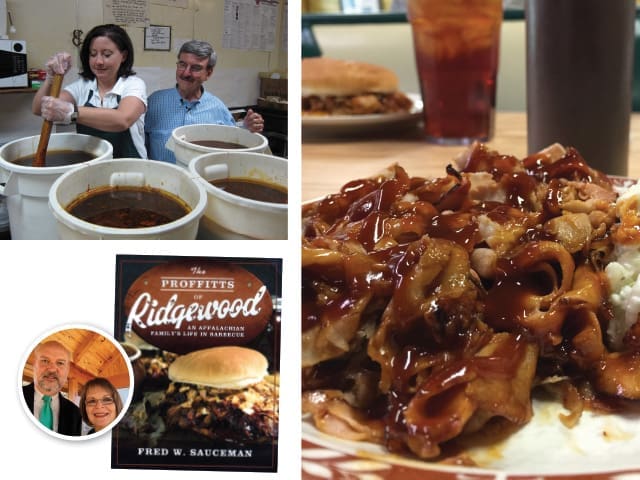
Cross Indian Creek a couple of times and you’re nearing Ridgewood Barbecue. It may have a Bluff City address, but there’s no evidence of a town in sight. You’re in the country, in the hills. Round a curve in Sullivan County and there it is, set tightly against a wooded hillside. On a good day, when the wind is right, hickory smoke gives you a half-mile signal that barbecue is near. Drive a little closer and you hear the crunch of wheels meeting gravel. Vehicles of all descriptions, with license plates from all over America, converge here, no matter the time of day.
As the late Ridgewood matriarch Grace Proffitt once said, “If you have good food, folks’ll find you.”
Ridgewood is known for its barbecued fresh ham, cooked in a pit over hickory wood for about nine hours. But there’s an unusual prelude to a plate of barbecue that is drawing just about as much attention. It doesn’t come to the table in a cruet. It doesn’t come “on the side” in a small plastic cup. It doesn’t come in a squeeze bottle. Blue cheese dressing at The Ridgewood is served in a bowl, lipping full. The sizes are small and large, although large and extra large would be more accurate.
You don’t delicately and slowly pour this blue cheese dressing over a salad. In fact, there is usually no salad. When you order blue cheese dressing at The Ridgewood, the dressing is the focus, not the accoutrement. It’s not intended to be poured over anything. Surrounding that bowl of creamy, sharp dressing is a corona of saltine crackers. Those crackers are your shovels, your tools. You dunk them deeply into that bowl of blue cheese dressing, getting as much of the product on there as you can.




