Skip to content


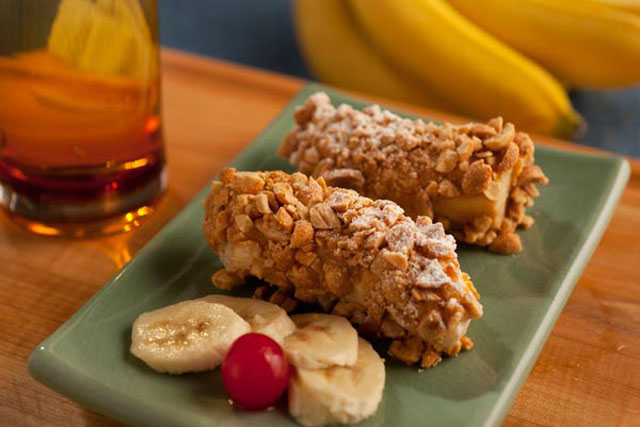
Whether you roll it in peanuts or corn flakes, serve it atop a bed of lettuce or upright with a cherry on top,“banana salad” is one tasty treat.
Contemplate Kentucky food and drink and the flagship products that immediately come to mind are hot brown sandwiches, corn pudding, country ham, and bourbon. But I discovered a latent banana mania in the Commonwealth.

When a Warren County cook spoke to me of banana croquettes in 2006, I envisioned fried patties of mashed banana, something on the order of the tostones of Puerto Rico – deep-fried plantains mashed in a wooden press.
And the fried croquette typically made with salmon or chicken in the South bears absolutely no kinship to the treatment of bananas in the hands of Kentucky cooks. Unless you subscribe to the boiled dressing school, a Kentucky banana croquette is not cooked at all. There’s not a single BTU of heat transfer involved.
For a classic Kentucky banana croquette: Slice bananas, roll them in mayonnaise thinned with a little milk, and then roll them in crushed peanuts. Some call it “banana salad” and serve it on top of lettuce.
Judy Drury of Lexington, a Miracle-Whip-instead-of-mayonnaise activist, claims that very few people under the age of 50 know of banana croquettes.
In Boston, Kentucky, they’re paired with another food product that must travel a long way to get to the Bluegrass State: oysters.
“These (banana croquettes) are on the traditional menu at Boston School’s annual Oyster Supper,” says Judy Richardson Jett. “This is the fall festival held by the PTA on the second Saturday in November to raise funds for the school.”
One Kentucky cook I interviewed uses peanut butter as mortar to reassemble the sliced bananas before applying the dressing. A church cookbook from Williamstown replaces the outer coating of peanuts with crushed cornflakes.
For Christmas 1941, after Linda Ramsey Ashley’s family had moved from Mt. Vernon to Frankfort so her father could lay bricks for a new state office building, Linda’s mother made “banana salad,” stood the bananas on the cut end, and “put a cherry on top,” Linda says, “making rather lopsided candles.”
For the family of Susan Meers Wells of Lexington, banana croquettes meant celebration and ritual.
“First, a grandchild was selected to have the honor of crushing the nuts. Whole peanuts were folded into a clean tea towel and sent to the front parlor hearth where they were then smashed to small chips with a heavy antique iron.”
These two mismatched words, banana and croquette, bring forth food memories all over Kentucky. For a generation of cooks who hit their church supper stride around the middle of the last century, nothing said Kentucky cuisine any better than a dressed banana.