Skip to content


The story below is an excerpt from our July/August 2018 issue. For the complete article and more like it subscribe today, log in to read our digital edition or download our FREE iOS app. Thank you!
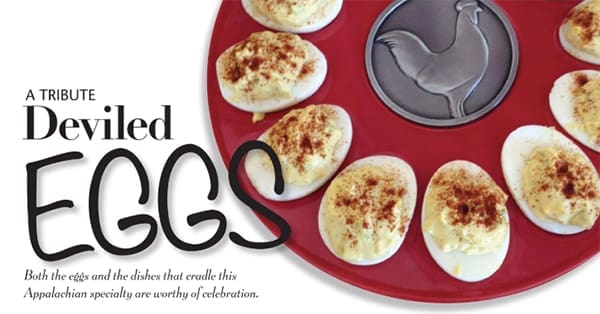
Both the eggs and the dishes that cradle this Appalachian specialty are worthy of celebration.
They are served on beds of waxed paper in cloudy Tupperware containers. Pieces of tape affixed to the bottom announce the names of the owners. They are served on sparkling antique crystal plates handed down through generations. Stoneware and china cradle them, too.

There are as many ways to serve deviled eggs as there are ways to create them. They are symbols of both survival and celebration. They can be piping-bag fancy or spoon-plopped simple. The yolks can be carefully creamed through a food mill or quickly mashed with a fork.
From the frugality of a mayonnaise, mustard, and vinegar-only approach to a sophisticated French riff with tarragon, imported Dijon mustard, and artisanal butter, deviled eggs fit in just about anywhere.The egg is a blank canvas. The creativity it inspires is infinite. We’ve seen them stuffed with Nova lox, Italian prosciutto, Spanish chorizo, and even semi-sweet chocolate.
In our part of Appalachia, a church supper without deviled eggs would be cause for deep disappointment and worry over the future of the region’s cuisine. At our monthly church luncheons in Jonesborough, Tennessee, there may be some shards of meatloaf left over or the green bean casseroles may not be completely cleaned out, but those deviled egg dishes are emptied every time.
Basic Southern Deviled Eggs
• 6 large eggs
• ¼ cup mayonnaise
• 1 heaping teaspoon prepared yellow mustard
• 1 heaping tablespoon sweet pickle relish
• ½ to 1 teaspoon apple cider vinegar
• Salt and pepper to taste
• Paprika
Boil eggs and peel. Cut eggs in half and place cooked yolks in a small bowl. Mash yolks with a fork. Add mayonnaise, mustard, pickle relish, vinegar, salt, and pepper. Mix and stir until creamy. Taste and adjust seasonings, if needed. Fill the hollowed egg white halves with the yolk mixture. Sprinkle each deviled egg with some paprika. Cover and refrigerate.
Billie Van Dyke, owner of The Blue Willow Inn in Social Circle, Georgia, says “Protocol dictates that a true southern lady owns several deviled egg dishes to properly display this southern favorite.” At our church, the dish is as closely identified with the cook as the eggs themselves, be that cook male or female. We know exactly who tops her eggs with chopped dill, and we know who is partial to caper brine.
Like a lot of Southern cooks, Billie adds sweet pickle relish to her egg filling. Sometimes she’ll even double down, deviling eggs with deviled ham. She pours white sauce over them, sprinkles them with breadcrumbs, and runs them into the oven for a few minutes.
Our mothers leaned toward the spartan side, with the always-on-hand staples of mayonnaise, mustard, and vinegar. We often used to upset the symmetry of their crystal deviled egg dishes with early samplings hours before mealtime. . .