Skip to content


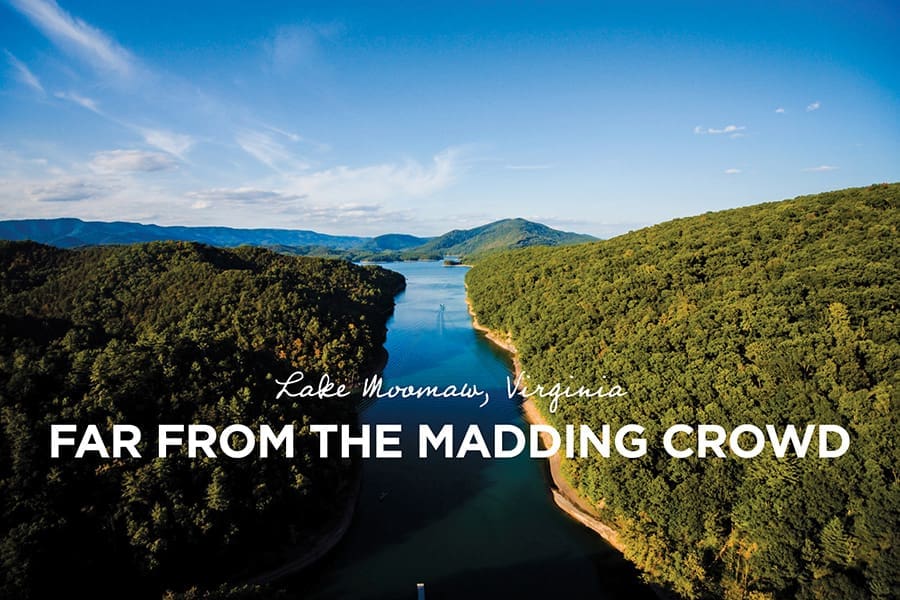
When Lake Moomaw opened in 1982 in Virginia’s Alleghany Highlands, 300,000 visitors were forecast to flock to its shores the next year. Today, Moomaw is a solitary, beautiful place with stories to share. If you’re willing to look closely and listen, they’re yours to savor.
Photo Above: What Lake Moomaw offers today is, at least for one writer, “wildness on its own mountain terms.” ©Tripp Curry / W. Curry Photography.
There’s no straight-line route to Lake Moomaw. You’ll wind up mountain roads past farms and river cabins, a couple churches and closed bait and tackle shops. In the springtime, redbud and blooming dogwoods line the way. You’ll pass nearly empty boat marinas and docks, and overgrown trailheads. The Army Corps of Engineers Visitors Center is locked up tight.

It’s quiet, very quiet, in this quarantine season—a fine time to explore a place once hailed as “the first major recreation area between Washington, DC and West Virginia…expected to attract people from the entire eastern seaboard.”
That’s not what you’ll see at Lake Moomaw now. You’ll see hawks and osprey soaring above the mountain-rimmed water. A few folks fishing from shore and from small boats. Tender-leaved trees greening and wildflowers blooming. Empty campgrounds and locked outhouses.
Standing above the dam—itself a thing of beauty with its clean white angles shining against cutaway red earth and an empty road curving along its crest—you might wonder what this place was before the dam and lake were here, as the Jackson River flowed out of the mountains through the Kincaid Gorge and its long human history. You might wonder what lies beneath the 2,500-acre lake.
So here’s the story of this place. It’s a classic American tale of persistence and political maneuvering worthy of a Sinclair Lewis novel.

The dam’s namesake, Thomas Gathright, spent many years buying up 18,000 acres of mountain land along the Jackson River for his members-only Hickory Lodge Hunting and Fishing Club. It was a place that attracted some of the most powerful politicians, financiers, and media stars: former vice president John Nance Garner, Texas Senator Tom Connolly, Virginia Senator Harry F. Byrd…even radio and television star Arthur Godfrey.
Gathright, a former West Virginia coal mine owner and railroad manager, came to Covington in 1902; he built an electric plant and, in 1928, convinced the board of the Industrial Rayon plant to locate on the Jackson River. In welcoming Gathright home after he procured the coveted rayon plant, local politician Colonel Dick Stokes shouted, “We are not going to stop until our valleys are filled with factories and mansions crown every hill…we are not going to stop until we are all garbed in silks and satins!”

Fortunately, and somewhat ironically, Gathright was also an avid conservationist—he’s said to have “haunted” the Virginia General Assembly until they appropriated money to start a state forest service (now the Virginia Department of Game and Inland Fisheries). After his death, the land was sold to the state, and the plan for the dam (billed as a necessary Jackson River flood control measure for the City of Covington and, most believe, for the area’s sprawling century-old paper mill) was born.
The $82.6 million dam project’s greatest supporter was Benjamin Moomaw, secretary of the local chamber of commerce for 22 years until he left the Alleghany Highlands in 1942 to sell war bonds for the U.S. Treasury. Known as “Mr. Ben,” Moomaw returned in 1959 and went back to work promoting progress and prosperity for the Highlands, his lobbying outreach bringing industry, road construction, a library, a country club and a community college to the area.
But it was the building of the dam that Moomaw was most focused on. And it was a long time coming.
Initially part of Congress’ Flood Control Act of 1946, the dam had been delayed by questions about its necessity. Re-examined in 1957, the project began to creep forward, with land price disputes slowing progress.
In 1972, the EPA and environmentalists took the Army Corps of Engineers to court, charging that important historical and archeological sites would be destroyed by the dam and lake. They lost their case, and dam construction began in 1974.
The entire town of Greenwood was displaced, and 123 graves were moved out of one church and six family cemeteries. Generations-old family farms were submerged.
By the spring of 1982, the lake was full. What lies beneath is history…as this strange pandemic time will be one day.

But now—what is the truth of this beautiful, remote place? Of the deep, clear-water lake shifting from green to blue with the wind, and the hills shadowed by moving clouds? The dense woods surrounding it, fallen trees angled among rocks? The disappearing trails and overgrown tent sites? The eerie, solitary quiet?
Seems to me that what Moomaw offers is wildness on its own mountain terms. It’s a place that has persevered, where wildflowers—wild geranium and mayapple, squawroot and cinquefoil, bouncing bet and bloodroot—grow out of red clay, decaying leaves and cracked pavement. It is remote and lonely in all the right ways, resonant with story and perfect in its ungroomed isolation.
Managed by the National Forest Service, Lake Moomaw is subject to the uncertainties of this time. Will the campgrounds re-open? Will visitors again enjoy the exhibits at the visitor center? Will trails and picnic grounds be groomed? (As we go to press, the property is scheduled to re-open June 12; please check.)
Time will tell. For now, go to Moomaw for the free-moving colors of goldfinches and bluebirds, for clean air and pure water, for the deep layers of last year’s leaves and the new green of this year’s. Remember what was—what lies beneath the water—and hope for what will be.
For the beauty of it, far from the madding crowd.
The story above appears in our July/August 2020 issue.