Skip to content

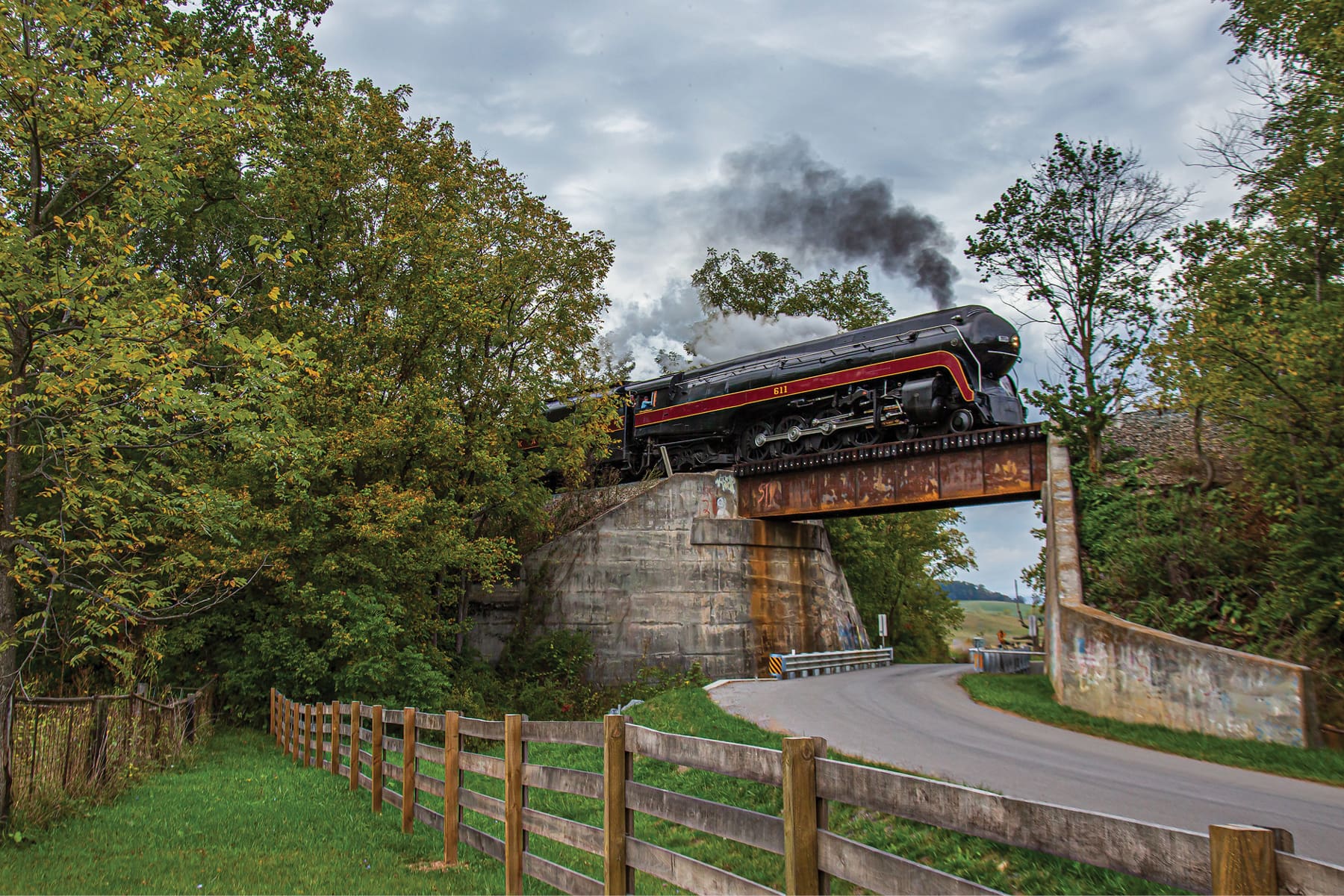
More than 70 years after she first took to the rails, the legendary Norfolk & Western Class J No. 611 continues to inspire both passengers and the volunteers who keep her running.
By Ginny Neil / Photo courtesy of Andrew Maus / Photo Above: Built in Roanoke, Virginia, in the 1950s, the “Queen of Steam” remains one of the nation’s most celebrated steam locomotives.
A plume of roiling black smoke rises above Victoria Station in Goshen, Virginia. I am here to ride the Norfolk & Western Class J No. 611 steam locomotive. Until steam engines were replaced by diesel in the middle of the 20th century, this is the sight that greeted long-distance travelers for almost 150 years.

Everyone associated with this trip, from Bart White, the car host who helps me find my seat, to Alex Siragy, who hands me a boxed lunch, to Zack McGinnis, who has worked on everything from the firebox to the stay bolts, is here because they understand something important best summed up by Scott Lindsay, the chief mechanical officer.
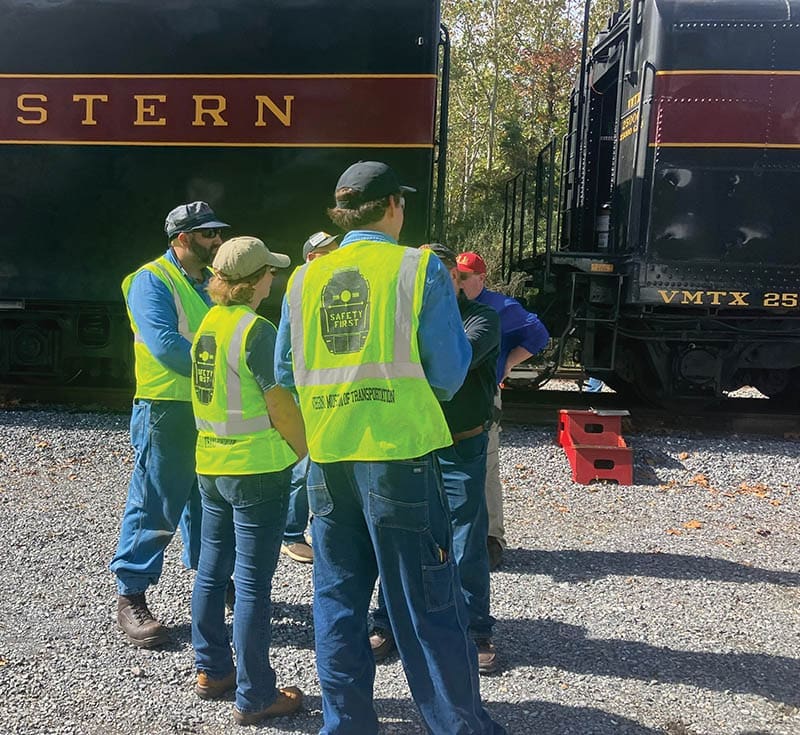
“All the important technologies that are needed to keep the 611 running are no longer being taught. The hands-on learning and different machining techniques will be lost if we don’t continue to maintain engines like this one. We need to remember the important technologies of the 20th century because there were no throwaways back then. Everything was repairable and reusable.”
That’s a powerful reason to keep this legendary locomotive alive. And thousands of people besides the volunteers manning all parts of the ride, from the engine to the arrangements, are passionate about the 611. The legendary “Queen of Steam” has her own Facebook page where fans can bid on a ride in the cab. She is the focus of hundreds of YouTube videos, one with over 4 million views. A Google search yields over 2 million entries related to the locomotive.
I learn all of this after I ride. For now, I am here to enjoy a unique day and way of travel. We pull out of Victoria Station with a gentle lurch, and the whistle announces that we are underway. As we wind down the track to Staunton and back, there are photographers at every crossing, hill, and high porch along our route. One is perched on top of an 8-foot ladder, another races ahead of us in his pick-up truck, photographing the train from at least 10 different crossings. There are families parked along parallel roads who wave and even a drone hovering at window height to get a picture as we huff past.
The 611 is beautiful and musical. She travels with a rhythmic huff, puff, jingle, and rattle. Her whistle is a resonant deep alto. Her face is regal and determined, her sleek exterior a reflection of the Art Deco style. But her beauty is more than skin deep. Built in Roanoke, Virginia, in the 1950s, the “Queen of Steam” was born just as diesel engines were replacing coal-fired trains.

Joseph Radisek, a process engineer from the Midwest who is here representing the American Society of Mechanical Engineers (ASME), tells me that the 611 embodies the pinnacle of steam locomotive engineering and includes all the best practices. He says, “On the 611, things make sense. Convenience is built into its operation. For example, three handles on the left side all stick out where they are most convenient to the operator. They are different shapes so the operator doesn’t need to see them. The 611 puts together all the innovations that had already been invented by the time it was built. It has the right amount of horsepower to go up heavy grades and the extra kick to go 90 to 100 miles per hour on flat land.”
When I ask him why he cares about what seems to be obsolete technology he says without hesitation, “I come to these events so I can take wisdom from the past and apply it to my work.”
Chief Mechanical Officer Scott Lindsay’s parting words say it best. “You can read all the books and look at all the drawings, but in order to understand what the engine is saying, you have to spend a lot of time listening to her talk. She tells you everything you need to know.”
The crowd disperses and I ponder the surreal sight of tourists standing in front of slow technology taking selfies with fast technology. I wonder if they realize that their experience has been brought to them by people willing to invest huge chunks of personal time to ensure that the things an elegantly designed steam engine can tell us will be available to future generations.
Steam Locomotive Fast Facts
The 611 carries an average of 45,000 gallons of water, uses about 200 gallons per mile, and burns approximately one ton of coal every 6 miles to create 300 pounds of steam.
The fireman endures temperatures 30 to 40 degrees hotter than the outside air as he controls the boiler pressure and water level necessary for creating the 5,400 horsepower that powers the train.
All replacement parts from bolts to boilers must be built or machined by hand.
Steam locomotives must be run every day in order to stay lubricated.
A locomotive is the engine in front. A train is the line of cars pulled by the locomotive.
The story above first appeared in our September/October 2026 issue.