Skip to content


Former wildland firefighter Carly Pearson became an accidental advocate for people with disabilities.
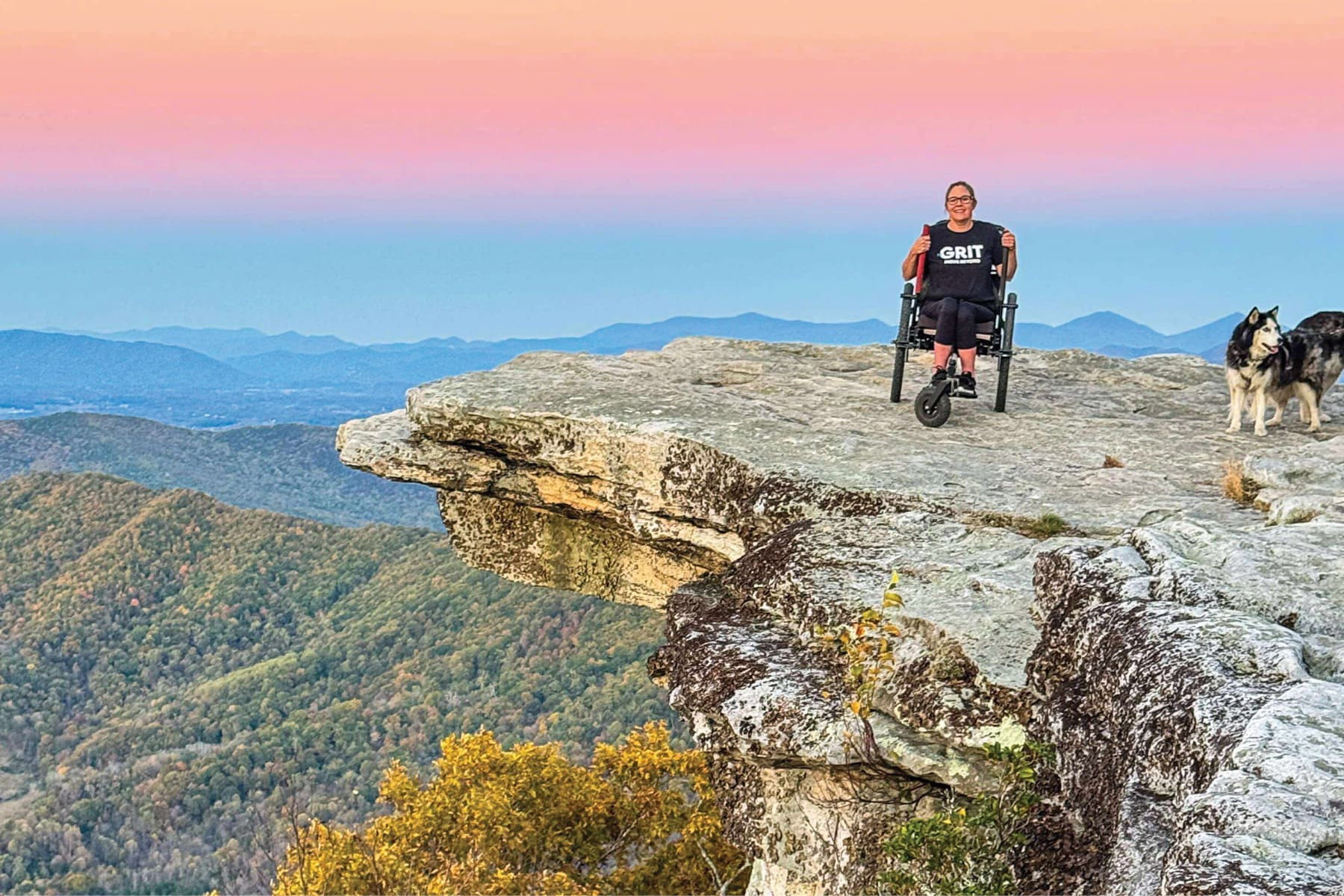
By Nancy Henderson / Photo Above: Carly Pearson smiles at the summit of McAfee Knob in Virginia. / Photo courtesy of Tim Lewis | kingofMcAfee.com
Carly Pearson had only been working as a helicopter manager for the National Park Service in East Tennessee for six months when, while deployed to extinguish a wildfire in Oregon, she fell down a 25-foot ravine, suffered a spinal cord injury, and almost drowned in the river below. “I wasn’t doing anything heroic at the time,” she clarified. “Because of how smoky it was in the area, the FAA [Federal Aviation Administration] wasn’t allowing any aircraft to fly.”

Pearson was quickly transported to a small trauma center, but the accident left her paralyzed from the waist down.
Nearly 25 years later, she now serves as ADA coordinator for Knox County Government and as accessibility advisor for Great Smoky Mountains National Park, and volunteers for regional nonprofits dedicated to adaptive recreation and sports. “My goal in this was to pay it forward because someone paid it forward for me,” she said of her role with GSMNP. “It’s a different pace than what I was used to with racing and competition, but the majority of the people that come to the Park are coming for that connection with nature and to slow down the pace of life. What’s disheartening is to have to plan your family vacation around either hiking or not hiking because someone in your family can’t participate.”
©Courtesy of Carly Pearson
Growing up on a farm in Maryville, Tennessee, Pearson was about as athletic as a kid could get, riding horses, exploring the Smokies, playing basketball and soccer, and running track throughout middle and high school. At the University of Tennessee in Knoxville, she competed on the soccer team while earning her forestry degree, but she had no specific career plans, other than to avoid getting “stuck behind a desk.”
It was during her senior year in college that she took classes on forestry protection and traveled to South Carolina to assist in a prescribed burn operation. “I was like, ‘Okay, I’m in love. This is what I want to do.’ And that’s really how I got into wildland firefighting. The combination of the manual labor, being outside, the adrenaline of firefighting, and wanting to help people—all of those combined is kind of what drew me to it.”
Upon graduating in 1998, she worked for the U.S. Forest Service, moving from Idaho to Minnesota to Texas, where she became the state’s first female regional fire coordinator. Homesick for Tennessee, in 2002 she took a seasonal position at GSMNP.
A few months later, in the aftermath of the accident, Pearson lived in a “total fog” for several weeks under heavy pain medication as she underwent extensive surgery. At first, she was convinced she’d miraculously wake up one day, able to move her toes. When that didn’t happen, anger took hold and she began questioning: Why did this happen to me? “I remember putting on this façade as this strong firefighter by day while I was in therapy [at Patricia Neal Rehabilitation Hospital Ford Sanders in Knoxville]…and putting on this brave face. But then at night, I would cry myself to sleep in the dark of the hospital room.”
Pushing through two years of grueling rehab, she grew determined to resume her active lifestyle. “I was like, ‘Okay, I’m making progress, but I don’t really have a life.’”
After joining her younger sister at the gym in downtown Maryville, Pearson participated in a triathlon with borrowed equipment from the rehab center. “And it really sort of helped me find a purpose. But most of the things that I was doing, from 2004 all the way to even beyond 2015, were pavement sports—climbing, triathlon, and cycling—and there was this void of the nature part.”
She was also antsy to do more outside with her two children than simply play in the yard. “And when I would go to the Park, I would get kind of annoyed at the fact that all I was really doing was the drive-through and the overlook and the visitor centers.”
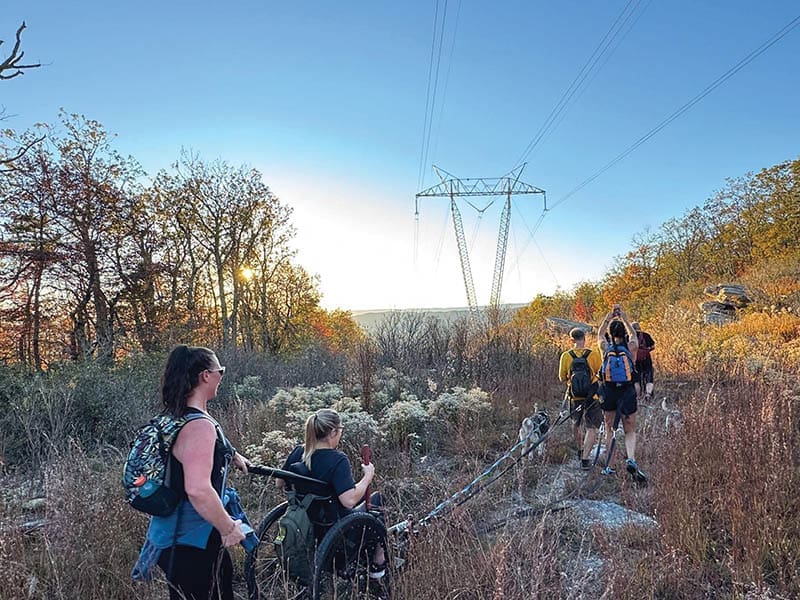
In 2019, she maneuvered an offroad wheelchair on the nearly-70-mile Camino de Santiago pilgrimage trek in Spain. “You can go out on a greenway, but there’s something that draws you further into nature when you’re off the pavement and you’re on the trail and you can look up in the canopy of the forest,” Pearson said. “It really brought me back to thinking, ‘Why don’t we have these opportunities here?’”
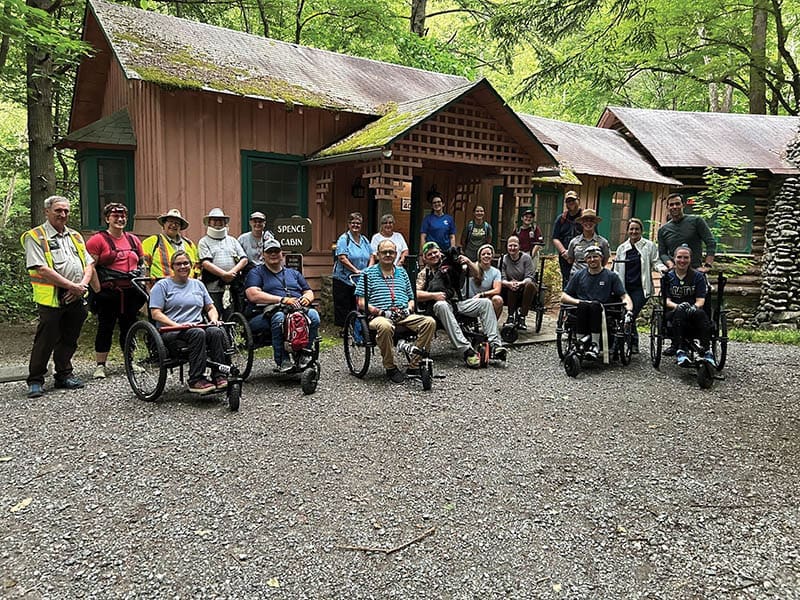
Already promoting adaptive recreation in Knoxville as a volunteer with the nonprofit Catalyst Sports, she soon met Smokies park ranger Katie Corrigan, who shared her accessibility goals. Thanks to a partnership between Knox County, Catalyst Sports, the National Park Service, and the nonprofit Friends of the Smokies, the adaptive program at GSMNP is now in its fourth season. So far, organizers have hosted biking, kayaking, and overnight backcountry events and introduced adaptive equipment for hikers with disabilities. Federal funding cuts have made it difficult to launch additional services, but plans are in the works for an adaptive fishing program.
At 50, Pearson shows no signs of slowing down. She still does adaptive mountain biking, has won the women’s hand cycle division of the Knoxville Marathon, and helps operate—and competes on—the Knoxville sled hockey team.
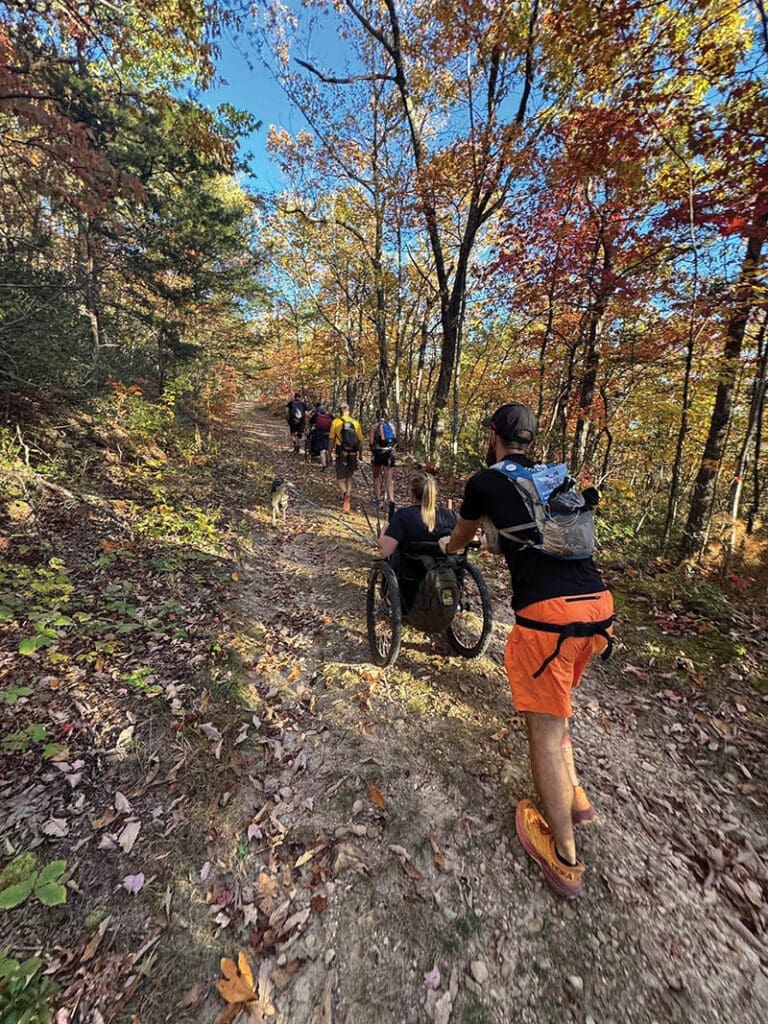
But her greatest thrill, she said, is seeing Park visitors with age-related and other mobility issues enjoy the outdoors, often for the first time since becoming unable to walk the trails.
“We live in one of the most beautiful regions in the country, in my opinion. Of course, this is my home, so maybe I’m rooted here and that’s why I feel that way. But the people that we’re serving maybe have had a stroke or some type of traumatic event and haven’t been out in the middle of the woods. And they cry tears of joy the entire hike because they’re so happy to be out and to be included instead of just going to the restaurants and the drive-through of the mountain. Sitting at the edge of a stream is a lot more exciting than sitting and looking out the window of a car at it.”
3 Ways for People with Disabilities to Enjoy the Smokies
Reserve a hiking chair online or at Sugarlands Visitor Center in Gatlinburg. “We have equipment at Sugarlands that someone can check out at any time and go do the falls behind Sugarlands,” said Carly Pearson, ADA coordinator for Knox County (Tennessee) and accessibility advisor for Great Smoky Mountains National Park.
Find accessible trails and programs at nps.gov/grsm/planyourvisit/accessibility.htm. For starters, Pearson said, “With the chair from Sugarlands, hike the Little River Trail, Middle Prong, Deep Creek. There are 14 or 15 miles of trails that are listed to be able to use the chair on.” Paved wheelchair-accessible paths include those at Mountain Farm Museum, Mingus Mill, and John Oliver Cabin in Cades Cove.
Try something new. “Don’t let the daily grind get you down,” Pearson said. “Step out of your comfort zone and go try new things. Don’t let this [disability] define what you can do.”
The story above first appeared in our September/October 2026 issue.