Skip to content


It’s easy to mistake other orange species for the king of fall butterflies.
By Nancy Henderson
More than once, I’ve spotted a migrating monarch in my backyard, only to discover, on closer inspection, that it was, in fact, not a monarch.

I’m not the only one.
“We have several orange butterflies, including the viceroy, which is very nearly identical to the monarch,” said Rose Segbers, senior entomologist and manager of the Butterfly Garden at Chattanooga’s Tennessee Aquarium. “So it can be pretty easy to get multiple butterflies confused, especially in the fall.”
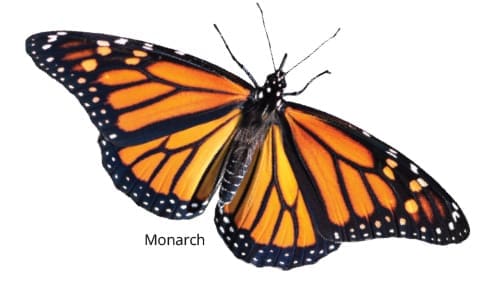
Widely celebrated for its arduous annual flight to Mexico, the monarch is the largest orange butterfly in North America. Others with similar coloring migrate as well, but often fewer than 100 miles. “These butterflies are considered residents, meaning that they are in Tennessee [and other Blue Ridge states] year-round,” explained Segbers. “They’re just different life stages, so you don’t always see them flying around in the middle of winter. They would be pupated in the leaf litter, or they’d be an egg at that point.”
The viceroy, with its black veins, bright orange hue, and stained-glass look, is arguably the best monarch mimicker. But a variety of lesser-known orange butterflies punctuate the sky this time of year, too: the gulf fritillary, the northernmost longwing species (most are found in Central and South America); the question mark, whose underwing sports a silvery-white line of spots shaped like its namesake; and the Eastern comma, with a “punctuation mark” that resembles a comma, or the letter C.
So how do you tell them apart, especially from a distance?
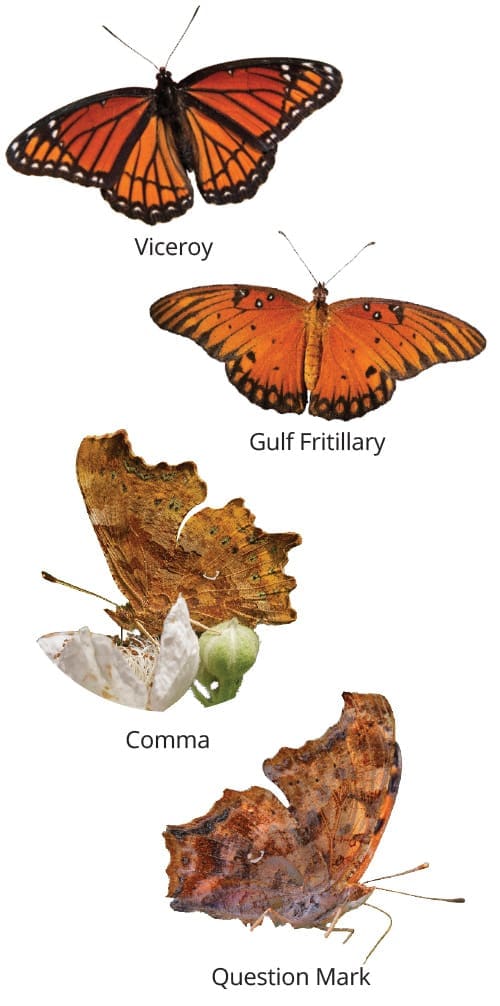
Here are a few tips:
- Viceroys sport a black line across their hindwings; monarchs don’t. They’re also generally a bit smaller; they flit from place to place, while monarchs are more apt to glide; and they live in wetter, marshy areas than monarchs, which prefer gardens and open fields.
- The wings of the gulf fritillary are longer than they are wide and feature a silvery checkboard pattern underneath. “It kind of looks like a crumbled-up piece of foil when they have their wings closed,” Segbers said. “And they normally perch a lot more frequently than monarchs, which tend to fly up high and come down to nectar on flowers.”
- Commas and question marks are so well-camouflaged that the orange color is only visible when they open their jagged-edge wings. Otherwise, Segbers noted, “They very much look like dead leaves.”
From a big-picture perspective, the monarch isn’t the only butterfly worthy of our appreciation. “Monarchs are certainly the face of butterfly conservation in the United States, but there are dozens of native butterflies [in the Blue Ridge] that also play a vital role in pollination and overall ecosystem health.”
Create Respites for Butterflies
- Go light on the herbicides.
- Plant native host plants, such as asters, violets, and maypops (passion flowers) for fritillaries; milkweed and ironweed for monarchs. “Monarchs don’t just lay their eggs on milkweed; they use them as a nectar plant,” said Rose Segbers, senior entomologist and manager of the Butterfly Garden at the Tennessee Aquarium. “So those wind up being good for monarchs year-round.”
- Leave leaf litter alone. “I always love to give people permission to do less yardwork,” Segbers said. “So many species of pollinators will winter in the leaves.” If city codes prohibit leaf piles, push some against a tree to serve as habitat over the cold months.
- Begin planning now. “The fall and winter are honestly a great time to start thinking about what your spring garden will look like,” Segbers advised. “Start looking at things that you can plant that’ll keep through the winter.”
The story above first appeared in our September/October 2026 issue.