Skip to content

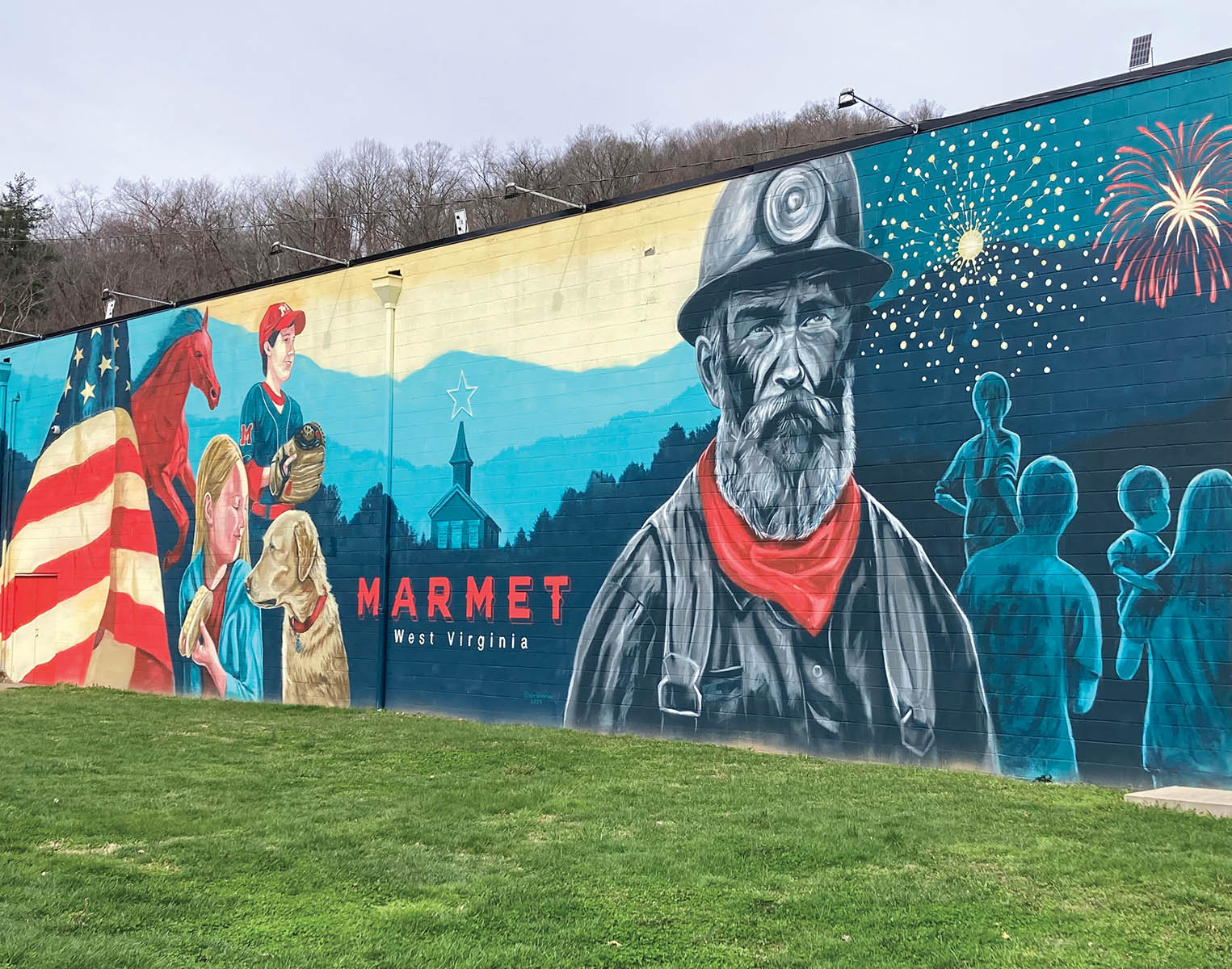
More than a century after the 1921 West Virginia Miners’ March that ended with the Battle of Blair Mountain, the story is being told in new and unforgettable ways.
Text and Photos By Joan Vannorsdall / Photo Above: Mural at the George Buckley Community Center in Marmet, starting point of the Miners’ March.
I’d been to Matewan before, and I knew its history ran deep: the Hatfields and McCoys, railroads, coal mining, the 1920 Matewan Massacre. I’d read Denise Giardina’s novel Storming Heaven and seen John Sayles’ 1987 movie Matewan.

What I didn’t know was that this town of 350 people has a museum that houses the largest exhibition in America of West Virginia Mine Wars history. Or that it’s home base for an ongoing Mine Wars history project with the potential to bring thousands of visitors to southern West Virginia to see and hear the stories lived there.
Courage in the Hollers—funded by the National Endowment for the Humanities, the Mellon Foundation, and the Claude Worthington Benedum Foundation—is creative placemaking at its best, and unlike anything I’d heard about in our mountains.
So I went back to Matewan to better learn the long and hard story of the West Virginia Mine Wars, to drive the roads the miners marched in pursuit of their constitutional freedoms, to stand at Blair Mountain and try to understand what happened there, and to celebrate the Courage in the Hollers art and well-told stories of the 1921 Miners’ March.
First things first. Know that the Battle of Blair Mountain is widely considered to be the largest armed labor uprising in the history of the United States—and the culminating event of the Mine Wars. Its roots reach literally and metaphorically deep into the earth of southern West Virginia’s Kanawha coalfields—in Paint Creek and Cabin Creek, where in 1912 non-unionized miners staged a wildcat strike.
There, mine company guards evicted miners from company-owned houses, destroying their belongings. In winter cold, families lived in tent colonies with little food. The Baldwin-Felts detectives hired by the mine owners built iron and concrete forts in both Cabin Creek and Paint Creek, armed with machine guns. National headlines ensued.
West Virginia Governor William E. Glasscock declared martial law, sending in the state militia to break the strike. Without warrants, soldiers arrested and jailed strikers and their leaders, including the bold labor activist Mother Jones.
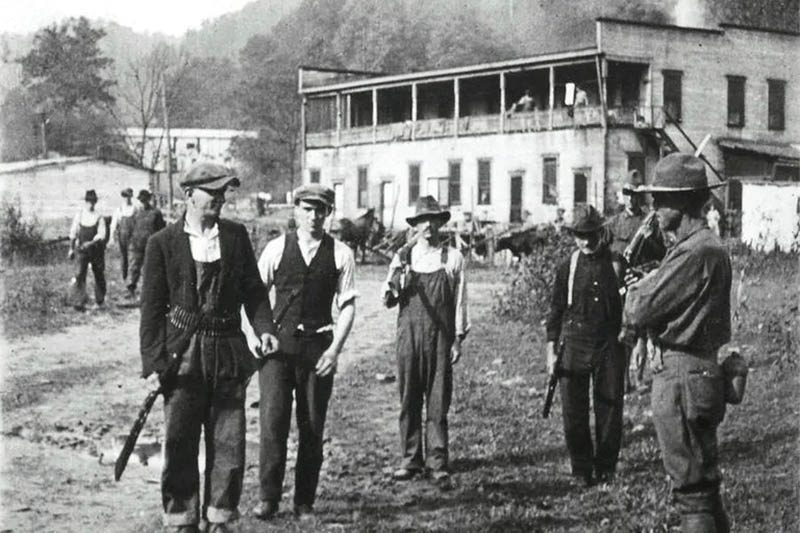
Miners surrendering their weapons at the end of the Battle of Blair Mountain. 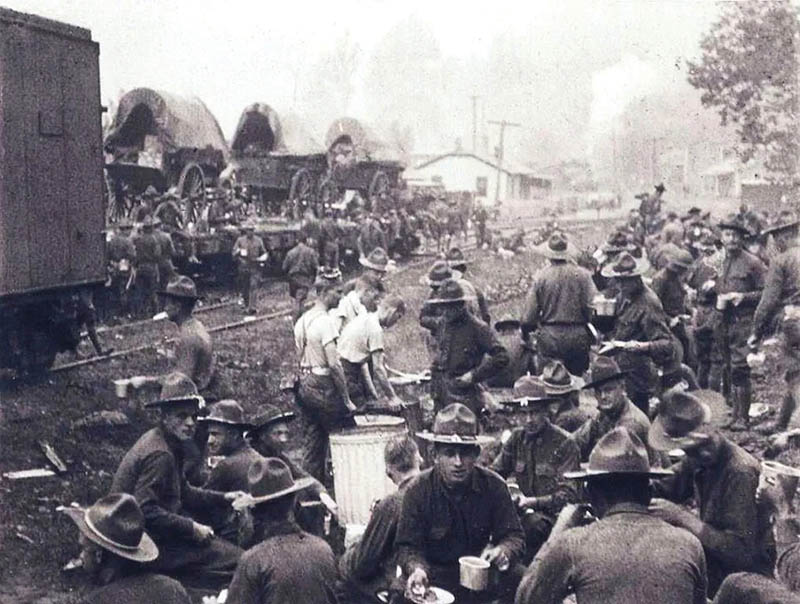
Federal troops sent by President Warren G. Harding arrive by rail to fight the Miners’ Army at Blair Mountain.
As had happened at Paint Creek and Cabin Creek, miners in nearby Matewan declared a strike in the spring of 1920, resulting in their removal from company housing. Coal operators brought in Baldwin-Felts detectives to destroy the miners’ tent colonies near Lick Creek.
On May 19, 1920, pro-union Matewan Police Chief Sid Hatfield and Mayor Cable Testerman confronted the Baldwin-Felts agents, guns drawn. When the Matewan shootout was over, Testerman, seven Baldwin-Felts agents, and two residents were dead. And by the end of the year, under the leadership of Frank Keeney, head of United Mine Workers (UMW) District 17, 90 percent of Mingo County miners had signed the union oath.
But 10 weeks later, on August 1, 1921, miners’ hero Sid Hatfield and deputy Ed Chambers were shot dead on the steps of the McDowell County Courthouse by C.E. Lively, Baldwin-Felts detective and labor spy.
Enraged, miners throughout southern West Virginia came together and demanded justice. They sent a list of grievances to Gov. Ephraim Morgan, demanding that Baldwin-Felts detectives be removed, that martial law be lifted in Mingo County and union miners released from jail, and that the coal companies improve living conditions in the camps.
Governor Morgan refused all requests.
And the miners of UMW District 17, which covered a good part of the southern West Virginia Kanawha coalfields, gathered to fight for their basic constitutional rights.
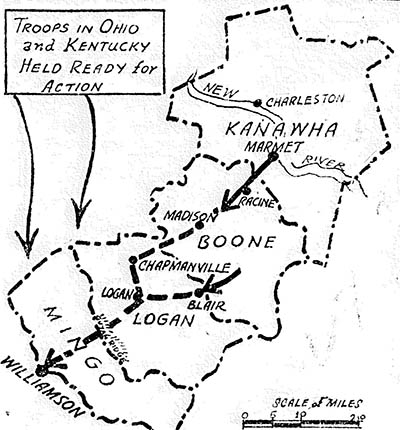
“On to Mingo” became the slogan that brought thousands of miners in late August to Marmet, 8 miles south of Charleston. Setting up camp at Lens Creek, the miners planned a 70-mile march south to free jailed miners and get miners in Mingo, Logan, and McDowell counties unionized.
But between the miners and Mingo lay Logan, home base for Sheriff Don Chafin, “the czar of Logan County.” Chafin was on the coal operators’ payroll and was committed to crushing all union efforts. “No armed mob will cross Logan County,” he proclaimed.
With state support, Chafin built an army of 3,000 armed citizens with a well-stocked arsenal (including machine guns and three planes equipped with bombs and chemical weapons) and posted his “Logan Defenders” along a 10-mile stretch of Blair Mountain to await the miners’ approach.
Back at Lens Creek, sensing the danger that lay ahead, Mother Jones met with miners on August 24. She waved a telegram she claimed had been sent by President Warren G. Harding, promising to resolve their grievances if they would disband and go home.
According to James Green’s account of the rally in his book, The Devil is Here in These Hills, Keeney tried to take the telegram from Mother Jones to verify its source. “Go to hell. None of your business,” she told him. Jones left West Virginia that night and never returned.
The Miners’ March was on. The next morning, 10,000 miners moved south toward Mingo, led by 28-year-old Bill Blizzard, a veteran of the Paint and Cabin Creek strikes. Many wore blue bib overalls and signature red bandanas around their necks as identification: the Redneck Army. Their countersign phrase—used to distinguish friends from enemies—was “I come creeping.” Most accounts suggest the miners were well trained and marched like the soldiers that many of them had been in World War I.
There’s a wonderful story about how the battle got underway, worth knowing both for its historical detail and the courage displayed. Baptist minister and part-time miner John Wilburn had heard about a state police raid on the marching miners in Clothier, and he’d had enough. “The time has come for me to lay down my Bible and pick up my rifle and fight for my rights,” he told friends.
Wilburn and 70 miners moved up Blair Mountain late on August 30. The next morning, through early fog, Wilburn saw three men, rifles across their chests. He asked them for the countersign. They responded with “Amen,” rather than “I come creeping.” So he drew his gun and fired, killing Sheriff Chafin’s right-hand man. And the Battle of Blair Mountain was underway.
For four days, the shooting went on. But on September 3, President Harding sent four U.S. Army regiments to Blair, and the miners stepped back. It was the mine owners and West Virginia state government that they were fighting, not Uncle Sam, they said. Over the next few days, most of the miners laid down their weapons and started home.
Things went downhill for union miners in the years after Blair Mountain. The State of West Virginia and private coal companies indicted over 500 of the marchers on treason and murder charges. Nearly all of them (including leader Bill Blizzard) were acquitted at the trials a year later in Charles Town, West Virginia.
Union membership fell precipitously in the southern West Virginia coalfields over the next decade. It wasn’t until Roosevelt’s 1933 New Deal policies went into effect that the United Mine Workers of America (UMWA) was allowed to organize in southern West Virginia.

For many years, the story of Blair Mountain was obscured, forbidden by the State of West Virginia to be taught in public schools (it was also specifically excluded from the Federal Writers’ Project WPA Guide to West Virginia). In 2008, the site was listed on the National Register of Historic Places, then removed less than a year later as coal companies pressured the state to open Blair to mountaintop removal mining. After a decade of legal action, the site was returned to the Register. But still, Blair Mountain preservation is in jeopardy, with two-thirds of it owned by private landholding companies.
Today, riding north from Matewan on the Blair Mountain Highway (Highway 17), you won’t see much at Blair other than the official National Registry sign. But find a place to pull off the road and honor the multicultural/multiethnic labor history made there. Know that buried deep in the Blair soil are bullet shell casings, weapons, and personal items—testaments to the battle fought there.
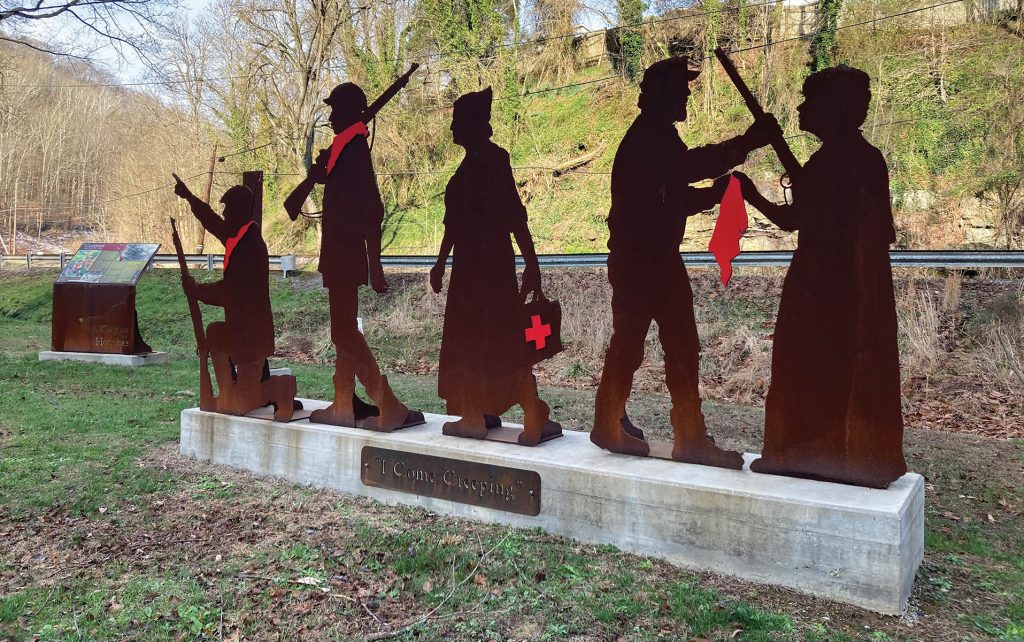
Continue north to Clothier/Sharples, where you’ll find one of the two standing Courage in the Hollers monuments. Situated outside the UMWA Local 2935 union hall on Coal Valley Road, the Corten steel sculpture of five Mine War figures stands on a stone base labeled “I Come Creeping.” Surrounding it are narrative interpretive signs, rich with detailed information about the Miners’ March and the Blair Mountain battle.
The Clothier/Sharples monument and its partner monument in Marmet were the result of a highly competitive grant process through MonumentLab. “We were one of just 10 projects funded nationally—the only Appalachian organization, and the only organized labor organization,” said Kenzie New Walker, executive director of the West Virginia Mine Wars Museum.
Walker came to the museum in 2018, straight out of Marshall University. She’s the daughter, granddaughter, and great-granddaughter of West Virginia miners, and she’s committed to telling their story fully.
“Ten years ago, when the museum first opened, people came in and said they didn’t know about the Battle of Blair Mountain,” explained Walker. “‘We didn’t learn about this in school,’ they told us. We’ve missed a couple of generations’ worth of stories…the ones shared on front porches and around kitchen tables. The museum is setting out to fill in those gaps.
“With the first phase of the Courage in the Hollers project, we initially thought we’d just do markers. We never dreamed we’d do public art and creative placemaking. We listened to the communities, and that made all the difference.”
What’s especially interesting about the two sites already in place is that the sculpted monument figures are shaped from actual people—citizens who stepped forward with their stories and a willingness to become models.
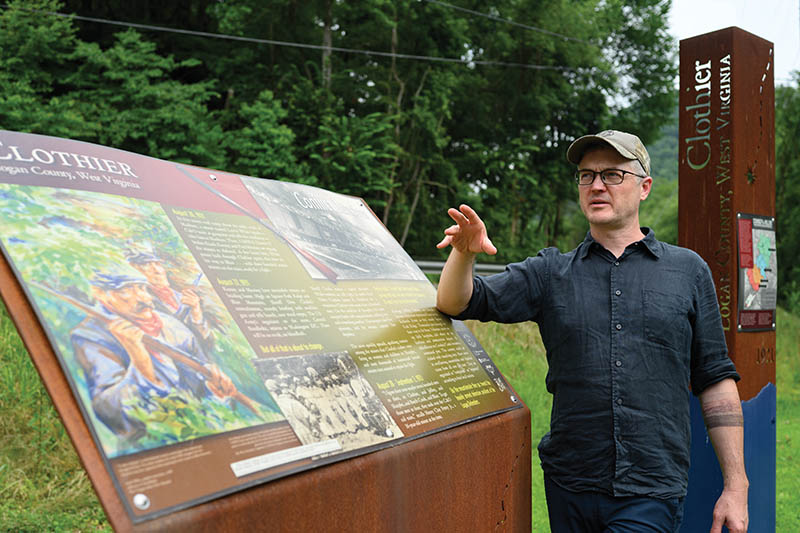
A new phase of the Courage in the Hollers project is about to get underway. Museum staff will hold community listening sessions in six new monument sites: Charleston, Racine, Madison, Clothier, Logan, and Matewan. By May Day 2028, the monuments will be standing, extending the Miners’ March route to its full historic length. The result will be the largest labor history driving trail in the United States, complete with detailed maps, murals, audio ecoposts, an interactive website, and a companion podcast.
Lead designer Shaun Slifer put it like this: “We’re developing a series of community-created public monuments within the rural Appalachian landscape that memorialize a history that was explicitly removed from educational curricula and that rarely appeared in history books.”
Can the new phase of Courage in the Hollers—with its monuments and murals and interpretive signs, its driving podcast and interactive website—make the southern West Virginia coalfields a heritage tourism destination? Know that the Battle of Blair Mountain is often referred to as “Labor’s Gettysburg” for its large significance in labor and union history. That’s how big the battle was, in spite of its being untold for many decades.
Having grown up in Gettysburg, I know what it means to live in a history-changing place that tells its complex truth well. While Blair Mountain may never draw the hundreds of thousands of visitors that Gettysburg does each year, Courage in the Hollers is telling the Mine Wars stories in visually and verbally beautiful ways—stories that are finally beginning to be shaped in ways that matter deeply to those whose ancestors told them.
“Facts don’t change people’s minds—stories do,” Walker said. “We’re building a place where people can see themselves in the story—an extraordinary story about ordinary people who knew that they had more to gain by working together than alone.”
It’s a story worth seeing, hearing, and knowing.
The story above first appeared in our July/August 2026 issue.