Skip to content

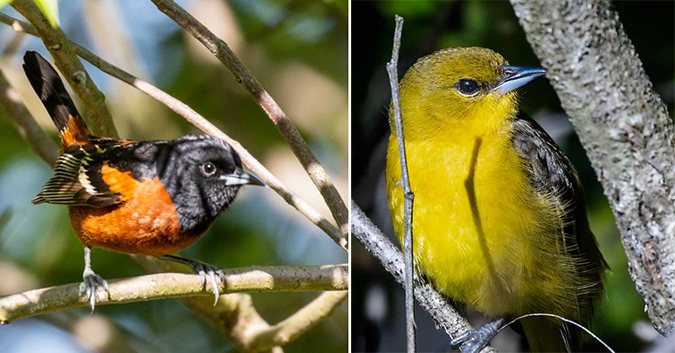
A friend sent me a beautiful snap of a jumble of healthy nestlings and asked if I knew the species. I leaned into a (mis)identification – goldfinches. Happily, she continued her research, noticed the woven construction of the nest, watched the adults, and correctly determined their true identity – orchard orioles.
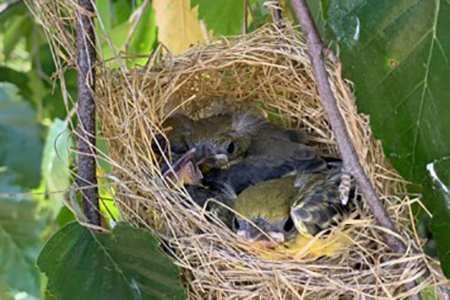
Our smallest oriole species arrives in the U.S. in late spring, raises (generally) a single brood, and makes an early return flight during mid to late summer to Central and South America for the winter season.

The males have a deep chestnut color underneath on the rump, and females are a muted greenish-yellow with two white wing bars.
I’ve yet to see these breeding season migrants in the Blue Ridge.
So… sometimes it’s fun to be wrong when you’re a birder!
Baby bird update: All fledged successfully.
Bird Bits
Fun Facts: While the seed feeders are of no interest to the orchard oriole, they will drink at a hummingbird feeder, eat from orange slices and appreciate a bit of fruit jelly.
Habitat: The orchard oriole prefers a smattering of trees, the edges of forests and groves. They are less territorial than some other species, and may even share a well-appointed tree during nesting season. In its southern U.S. regions, 20 nests have been counted in a single live oak.
Conservation Note: While these birds have seen a 35% cumulative decline over the past 50 years, they’re making tentative adjustments by spreading further north and into the prairies. Like many species, habitat loss (along with the specific challenge of cowbird parasitism) continues to threaten their long-term success.
Cornell Lab needs your citizen science help to transcribe historical nest record cards (the paper and pencil kind!). And, they’re currently working on the orioles with Nest Quest Go! at Zooniverse – Click HERE to read and record this interesting and important bird data.
ABOUT THIS SERIES:
“Birds of the Blue Ridge” showcases frequently seen and rare birds across the southern Appalachian region. For over three decades, Angela Minor has traveled with binoculars and field guides across the continental U.S., Alaska, the Caribbean, and seven European countries. She is a travel and nature freelance writer for several regional and national print magazines, and also created and authored the state park birding series for Bird Watcher’s Digest.
Read More by Angela Minor: BlueRidgeCountry.com/AngelaMinor