Skip to content

These time-tested recipes speak of community, connection and tradition.
Have you ever seen a pig back up? Apparently going in reverse is not a part of the animal’s genetic programming. We’ve never raised pigs, but we’ve only observed them in forward mode, rooting ahead. Because of that behavior, pigs have become a symbol of new beginnings and progress.

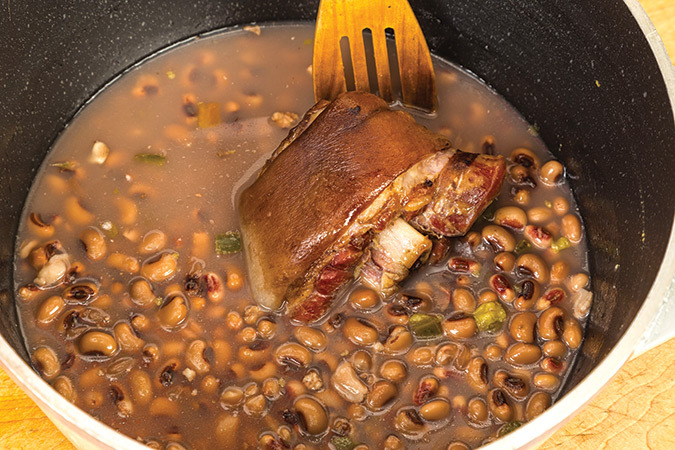
Mostly in the form of hog jowl, pig meat has been part of New Year’s Day meals in the South for generations. But on our first-day-of-the-year table, you’ll more likely find hunks of pork hock—the ankle of the pig and the very antithesis of the oft-repeated phrase “eating high on the hog.”
Whereas ham is high, hock is low—almost as low as you can get on the pig. Yet as African cooks soon discovered shortly after the pig was introduced into the American South by Europeans, those lowly cuts can pack the most flavor if you know how to prepare them.
In that same pot in our kitchen, you’ll find black-eyed peas. Our friend the late John Egerton wrote in his classic book Southern Food that “black-eyes are often associated with a mystical and mythical power to bring good luck.” African in origin, they have been eaten in the South for well over 300 years. They hold an exalted place on the Kwanzaa table as well as in the New Year’s repast.
But before we go on, here’s a confession: We both came to appreciate black-eyed peas later in life. As children, we were served black-eyed peas cooked by themselves, and our parents insisted that we choke down at least 12—one for every month. Marrying black-eyed peas with ham hocks changed all that. And there’s an extra bit of symbolism in the pot, if you think about it. Whereas collard greens or turnip greens or mustard greens appear on New Year’s tables to signify the promise of wealth, we add home-grown green bell peppers to this stew.
We have given a total of 268 public presentations on food, and we served this dish at the very first one in 1990, to illustrate the concept of history in a pot.
Recipe: Black-eyed Peas and Ham Hocks
- 2 or 3 smoked ham hocks
- Half a pound of dried black-eyed peas, soaked in water for about 4 hours
- 1 large onion, coarsely chopped
- 1 green bell pepper, coarsely chopped
- 2 stalks celery, coarsely chopped
- Salt and pepper to taste
- ½ teaspoon crushed red pepper flakes
Place ham hocks in a large pot and barely cover with water. Bring to a boil, covered, and simmer until the meat is done—about 90 minutes. Add black-eyed peas, drained, and remaining ingredients. Cook for another hour or so until peas and vegetables are tender. (Peas should not be mushy.) Remove the ham hocks and pull the meat off the bone. Add the meat to the pot. Remove the lid from the pot and reduce the liquid until it is slightly thick.
Ants Climbing Trees
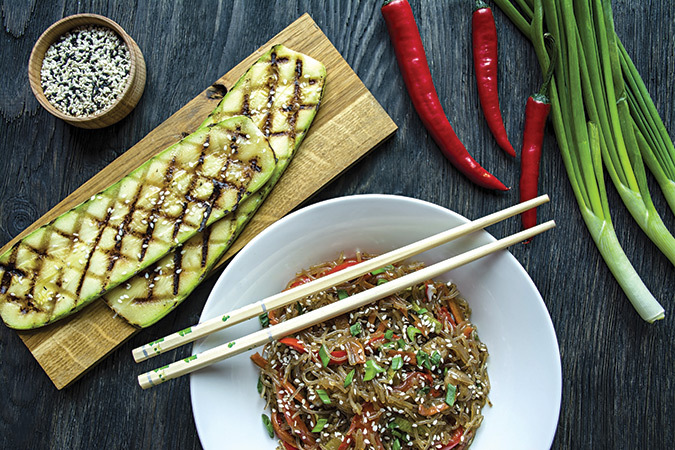
This next dish is one we have served both on January 1 and during the Chinese New Year. It, too, relies on pork, which is highly valued in China. Noodles are often served during Chinese New Year meals as a symbol of the hope for a long life. We were first introduced to the recipe by Dr. Thomas Huang, who taught chemistry for many years at East Tennessee State University. He says, “This is a very common dish from Chungking, Szechuan, China, where I was born.”
It’s also a fun one to make. Children especially love it because of the name: Ants Climbing Trees—the ants being the ground pork and the noodles the trees.
A friend from Hawaii, Eloise Swain, who tended bar at The Cottage in Johnson City, Tennessee, into her 90s, advised us on the right kind of bean thread noodles to buy. She prefers the ones in a bright pink mesh bag. Eloise, by the way, uses them in another dish we love, Hawaiian Chicken Long Rice.
Recipe:
- 2 bundles of bean thread noodles (sai fun), available in Asian markets or in the international section in most large supermarkets
- 1 tablespoon peanut or vegetable oil
- 1 tablespoon fresh ginger, finely minced
- 2 tablespoons Chinese black bean sauce
- 4 ounces ground pork
- 2 cups chicken stock
- ½ teaspoon sugar
- 2 teaspoons dark soy sauce
- 2 teaspoons regular soy sauce
- ¼ cup chopped green onions
Soak the noodles in cold water for about 15 minutes. Rinse and drain them. Heat the oil in a wok or large frying pan over medium heat. Stir in ginger and cook briefly. Add the black bean sauce and cook for about a minute. Add the pork and stir-fry until meat is thoroughly done. Add the chicken stock, sugar, and soy sauces. Bring to a boil. Then add noodles and green onions. Stir until noodles have absorbed most of the liquid.
Hotel Roanoke Peanut Soup
Finally, we were curious to find out whether peanuts have ever served as a pathway to good luck. For over 56 years, we learned, NASA scientists have passed around peanuts for every major mission event. “Good-luck peanuts made their first appearance at the Space Flight Operations Facility at NASA’s Jet Propulsion Laboratory in 1964 during the Ranger 7 mission. ‘I thought passing out peanuts might take some of the edge off the anxiety in the mission operations room. The rest is history,’” said Dick Wallace, Mission Trajectory Engineer.
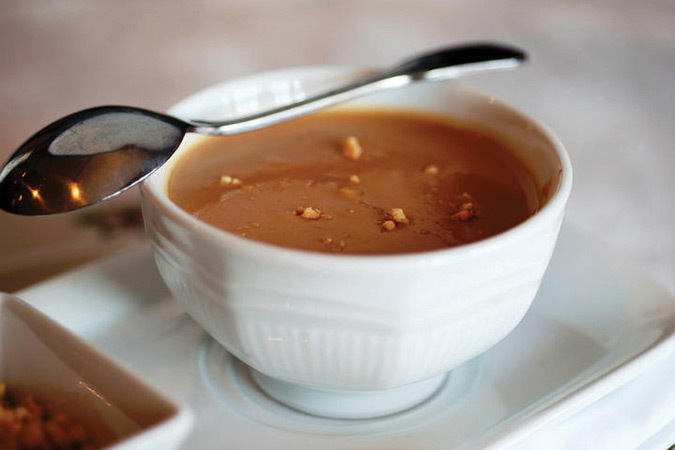
This gives us a reason to share the recipe for one of Virginia’s most historic dishes, peanut soup, as served by the Hotel Roanoke. It was created in 1940 by Chef Fred Brown.
Recipe:
- ¼ pound butter
- 1 small onion, diced
- 2 stalks celery, diced
- 3 tablespoons flour
- 2 quarts chicken broth, heated
- 1 pint peanut butter
- 1/3 teaspoon celery salt
- 1 teaspoon salt
- 1 tablespoon lemon juice
- ½ cup ground peanuts
Melt butter in cooking vessel and add onion and celery. Sauté for 5 minutes but don’t brown. Add flour and mix well. Add hot chicken broth and cook for 30 minutes. Remove from stove, strain, and add peanut butter, celery salt, salt, and lemon juice. Sprinkle ground peanuts on soup just before serving. Serves 10.
Fred and Jill Sauceman study and celebrate the foodways of Appalachia and the South from their home base in Johnson City, Tennessee.
The story above appears in our January/February 2021 issue.