Skip to content



Fred and Jill Sauceman study, celebrate and write about the foodways of Appalachia and the South from their home base in Johnson City, Tennessee, and have been covering food for this magazine for decades. Who better to provide a set of food favorites in three realms: Restaurants, Products and Recipes.
Our parents and grandparents rarely used cookbooks. Their recipes were instinctual, inherited or improvisational. And sometimes a combination of all three. As children, we were careful kitchen observers. About 25 years ago, we started committing those techniques to paper as best we could. And as we tasted dishes prepared by friends, we were quick to ask for their recipes, too—sometimes learning that they had never been documented before. We are now writing a cookbook of our own that will be filled with flavors shared by family and friends over the years.

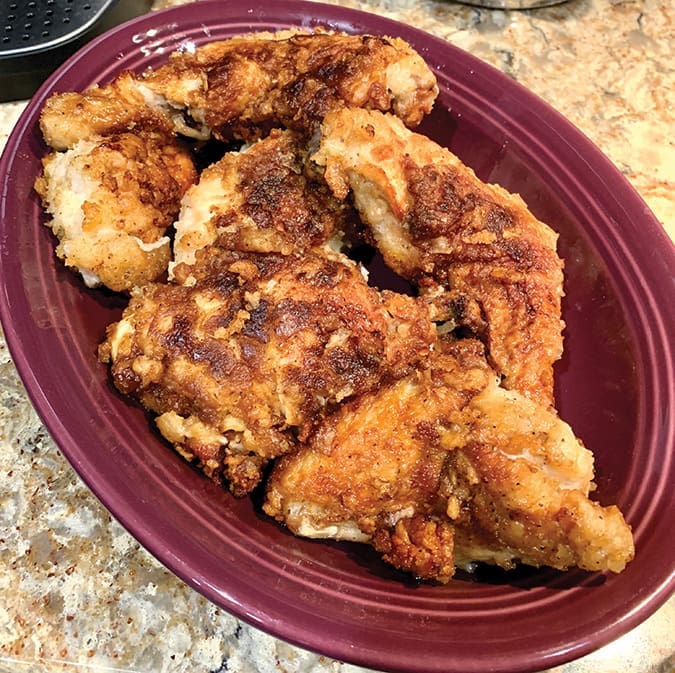
Black-Iron Skillet Fried Chicken and Gravy
This is how our grandmothers fried chicken.
- 3 ½ -4-pound whole chicken, cut up
- ¼ cup whole fat buttermilk
- 1 ½ teaspoons salt
- 1 teaspoon pepper
- ½ to ¾ cup either all-purpose flour, self-rising flour, or a mixture of both (We do a mixture)
- Oil for frying
Gravy:
- 2 to 3 tablespoons pan drippings and oil
- 2 to 3 tablespoons flour
- 1 ½ to 2 cups 2% or whole milk (if gravy is too thick, add more milk)
- Salt and pepper to taste
Place chicken pieces in a large bowl and drizzle with buttermilk, turning pieces until all are lightly coated. (The buttermilk helps the flour to adhere to the chicken.) Cover and let rest in the refrigerator for ½ hour or until ready to fry.
When ready to fry, place about ⅛- to ¼-inch of oil in a 10” or 12” black-iron skillet (enough to coat the bottom of the skillet). Remove chicken from the refrigerator. Sprinkle top of chicken pieces with half the salt and pepper, then turn the pieces and sprinkle with the other half. Next, sprinkle the chicken with the flour, tossing until all pieces of chicken are coated. The chicken should look more dry than wet and sticky. If sticky, add more flour.
Heat the oil on a medium high setting. Let floured chicken rest in the bowl while the oil heats in the skillet. It’s ready for frying when a few sprinkles of flour sizzle in the skillet. Place chicken pieces in skillet skin side down and fry for 10 minutes. Turn the pieces, using a metal spatula to scrape the bottom of the skillet just in case the chicken should stick. (If properly browned, it shouldn’t stick.) Cover and reduce heat to medium low. Continue to fry about 30 minutes. Uncover and fry an additional 5 to 10 minutes. Using an instant-read food thermometer, check for doneness. Chicken should be done at 170ºF for breasts and 180ºF for thighs and legs. Remove to a paper towel-lined platter.
There will probably be lots of big pieces of the chicken coating left in the skillet. We like to brown these until crispy and then remove to a paper towel to eat with the chicken. Leave any tiny pieces of coating in the skillet.
For gravy: Remove oil in skillet until there are only 2 to 3 tablespoons left. Have flour, milk, salt and pepper ready since you shouldn’t leave the skillet when cooking the gravy. With the oil heated to medium/medium high heat, add 2 to 3 tablespoons of flour and constantly stir and scrape until well-blended with the oil. Continue stirring and scraping until the flour is lightly browned. Gradually add milk and continue stirring and scraping until it comes to a boil and thickens. Add salt and pepper to taste. Serve gravy over mashed potatoes, biscuits, rice, or the chicken itself.
Allan Benton’s Redeye Gravy

We have written often about our admiration for Allan Benton, proprietor of Benton’s Smoky Mountain Country Hams in Madisonville, Tennessee. Using curing techniques inherited from his grandparents, who were subsistence farmers in Scott County, Virginia, Benton cures country hams for as long as 14 to 16 months. Despite modern-day pressures, he refuses to take shortcuts. His hams and bacon are among the best in the world. And in the spirit of mountain frugality, when Benton fries a black-iron skillet full of ham, the drippings aren’t wasted. They become the basis for this highly concentrated redeye gravy.
- Pour ¼ cup of brewed coffee into an iron skillet and sprinkle in one tablespoon of brown sugar.
- On medium heat, fry two or three slices of country ham for about two or three minutes per side. Remove ham and add 1/3 cup more coffee to the skillet.
- Increase heat to medium-high and stir, loosening the browned particles from the bottom of the skillet.
- Reduce the liquid to the point where you added the second measurement of coffee. Serve gravy over biscuits or grits.
Shirley Sharpe’s Cornbread Salad
There are two restaurants near where we live that serve boardinghouse style food and do it very well: The Farmer’s Daughter in Chuckey, Tennessee, and Shirley’s in Hampton, Tennessee. Both serve cornbread salad.
- 1 cup mayonnaise
- 1 cup ranch dressing
- 2 tablespoons apple cider vinegar
- ¼ cup sugar
- 1 teaspoon celery seed
- 1 large cucumber
- 1 onion
- 2 tomatoes
- 1 green pepper
- 1 stalk celery
- 2 tablespoons sweet pickle juice
- 1 pan baked cornbread
Mix mayonnaise, ranch dressing, apple cider vinegar, sugar and celery seed in a bowl. Chop up cucumber, onion, tomatoes, green pepper and celery and add to bowl. Add pickle juice and mix. Crumble cooled cornbread and pour mixture over it. Slightly mix without stirring.
Looking for more mountain flavor? Click here for a list of our all time favorite Mountain Recipes!
The story above appears in our March/April 2021 issue.