 Skip to content


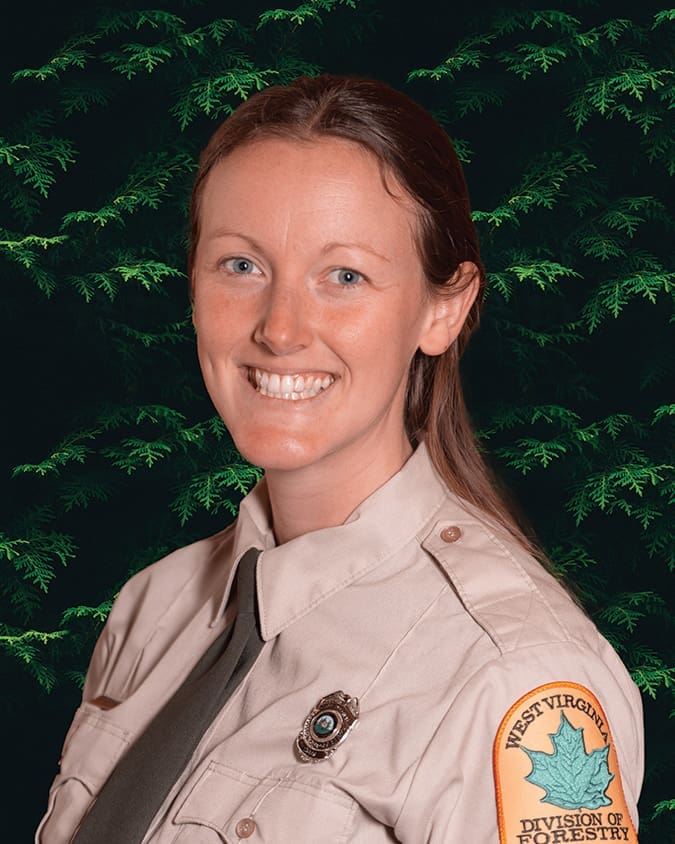
Rosey Santerre is the Pendleton County Service Forester with the West Virginia Division of Forestry. Her work includes forest fire prevention and suppression, implementing West Virginia’s Logging Sediment Control Act and assisting private landowners with forest management. While not working, she enjoys spending time with her family, growing food and playing in the woods.
I moved to West Virginia to work for the Mountain Institute as a field instructor for youth programs. I got to teach kids about biology, ecology, teamwork and resilience, while on a myriad of trips, from day adventures to overnight backpacking and canoeing trips. I had just finished my bachelor’s degree in Forestry from Paul Smith’s College, and like many new graduates I was ambitious and ready to change the world. I imagined West Virginia would be my first stop in a cross-country adventure, working in the outdoors, seeing the nations parks and forests. But here I am 11 years later, with a family, home and career, sinking in deeper roots by the year.

It is easy to love the Appalachian Mountains and their diverse, lush forests. That is especially true after more than a year where being outdoors was one of the only escapes available from life during the pandemic. As a forester, I am lucky to work in the woods almost daily, so even while office and meeting protocols changed, my work has not been too different from normal. One of the best parts of my job is helping private landowners reach their forest management goals. Wildlife management, timber production and recreation are some of the goals that are common for landowners in this area who are seeking forest management assistance.
Forest management planning is an art and a science. We collect data on the current condition of the forest and use models and projections to guide our management prescriptions. The art is balancing present versus future needs from the forest, making it economically feasible while trying to leave a better stand for future generations. When I am trying to develop a prescription for a stand, I try to think about how the stand would arrive to the desired condition in nature. I think about how I can mimic this natural process to achieve the goals for the stand. For example, if I want to concentrate growth in desirable trees, I can give them more sunlight by cutting a few of the adjacent trees. This happens naturally in forest succession; a young forest will have lots of small trees and as they grow, the fastest growing trees will shade out their neighbors.
After an especially harsh winter for the area, this spring was abundant with the hopeful flowering of dogwoods, serviceberry and redbud in contrast to the vibrant greens of newly emerging tree leaves and lush pasture fields. Starting around this time of year, trees are putting on the largest amount of “early wood,” the wood in the growth ring that is produced earlier in the growing season. When you look at the growth rings of trees, the early wood is usually lighter and distinctly visible.
This spring as I observed the rich reawakening of the land, I wondered if perhaps we should think about mimicking nature in more of our actions. Perhaps growth comes on best after dormancy. Maybe we can come out of this quieter time and spring forward into a more vibrant future.
The story above first appeared in our July/August 2021 issue.




