Mountain Garden: Holy Moly! It’s a Castor Oil Plant

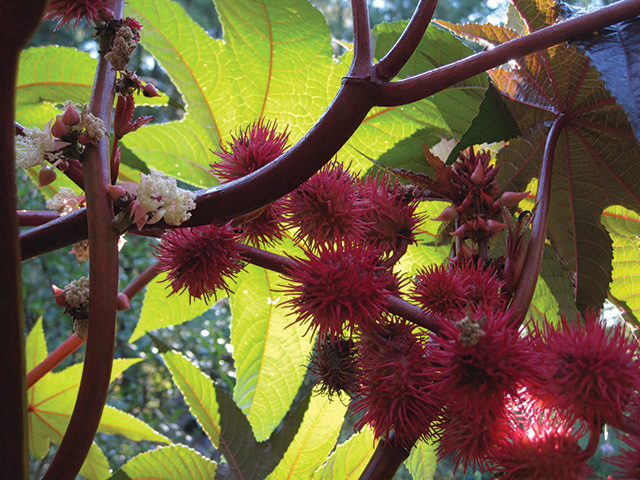
The white flowers, clumped along the stem, are easy to miss. They expand into clusters of spiky scarlet seedpods containing ricin-laced “beans.”

The story below is an excerpt from our July/August 2014 issue. For the rest of this story and more like it subscribe today, view our digital edition or download our FREE iOS app!

The plant’s poisonous seeds don’t preclude growing “something out of maurice sendak’s imagination.”

In my sun-challenged garden, I don’t have space for large plants. And yet, I have a weakness for them, for their exuberant growth. I admire their assertiveness, the way they draw the eye. A poke plant made itself at home in the flower bed below my deck a year or two ago. I could take my mattock (and that’s what it would take to get rid of it) to the root; so far, my response has been to prune what gets in my way so we can coexist.

For those who prefer plants that make a statement for a season rather than a lifetime, there is an array of architecturally interesting annuals to chose among: skyscraping sunflowers, tithonias (Mexican sunflowers) that grow like Christmas trees. And then there’s the castor oil plant, a giant whose recommendation comes with a caveat. Do not plant castor bean seeds if your garden is visited by small children, particularly those of an age whose exploration of the world involves popping objects of interest into their mouths.

Castor beans aren’t legumes, so they’re not really beans. Their seed, though, is bean-sized. What makes them dangerous is the ricin they contain, a poison thousands of times more toxic than cyanide or rattlesnake venom. No one who knows what an engorged dog tick looks like will be tempted to taste a castor bean; the resemblance is unmistakable. (The plant’s genus name is Ricinus, Latin for “tick.”) You can plant castor beans without ill effect; the water-soluble poison is concentrated in the interior membrane. They are the only members of their genus but are members of the large spurge family; they’re distantly related to poinsettias, cassava, Chinese tallow tree, and crown of thorns.

“What in the world is that?” I asked a neighbor the first time I saw a castor oil plant.

The story above is an excerpt from our July/August 2014 issue. For the rest of this story and more like it subscribe today, view our digital edition or download our FREE iOS app!

You Might Also Like:

f694340e-0373-11f1-ba61-1248ae80e59d-3.26_Main

Singing in the Garden: Drip! Drip! Drip!

In winter, unless there’s a blizzard roaring down the chimney and shaking the tin roof, the farm is mostly quiet.
7dbc050a-eb42-11f0-b253-1248ae80e59d-1.26_Main

Singing in the Garden: A Song for Living

In winter, unless there’s a blizzard roaring down the chimney and shaking the tin roof, the farm is mostly quiet.
6bbe4454-9f92-11f0-93fd-1248ae80e59d-11.25_Main

Singing in the Garden: Dam, Dam, Dam

"An adult beaver may consume … roughly the amount of bark and smaller branches obtained from a two-inch diameter tree every two days." — Jim Parkhurst, Virginia Cooperative Extension
ac749f9c-6e15-11f0-9181-1248ae80e59d-9.25

Singing in the Garden: One Small Fawn

The biggest act of rebellion ... is remaining defiantly hopeful. —Rupert Dreyfus
4960b88c-42c3-11f0-ae25-1248ae80e59d-7.25_Main_Art

Singing in the Garden: Chasing Chickens

Why did the chicken cross the driveway? To get to the salad bar on the other side.
8822e358-206b-11f0-811e-12163087a831-5.25

Singing in the Garden: Telling the Truth

"If you tell the truth, you don't have to remember anything." ーMark Twain
88a95912-f5f8-11ef-b6a8-12163087a831-3.25_Main

Singing in the Garden: Mud

March is mud mucking, slop, sucking, streams flowing, grass growing, calves running, colts sunning, redwings singing, "Winter's gone, and spring is springing." ~Ginny Neil
b543fec4-cec4-11ef-9129-12163087a831-1113

Singing in the Garden: Beauty and Terror

"Let Everything happen to you, beauty and terror, just keep going, no feeling is final." ~Rainer Maria Rilke
7e53a66a-9afa-11ef-9413-12163087a831-112

Singing in the Garden: Tasting the Future

"There’s no such place as ‘away.’ When we throw anything away, it must go somewhere." ~Annie Leonard
634a0c76-7136-11ef-9f77-12163087a831-9

Singing in the Garden: The Grass on the Other Side

"The variety of all things forms a pleasure." —Euripides

CALENDAR OF EVENTS