Skip to content


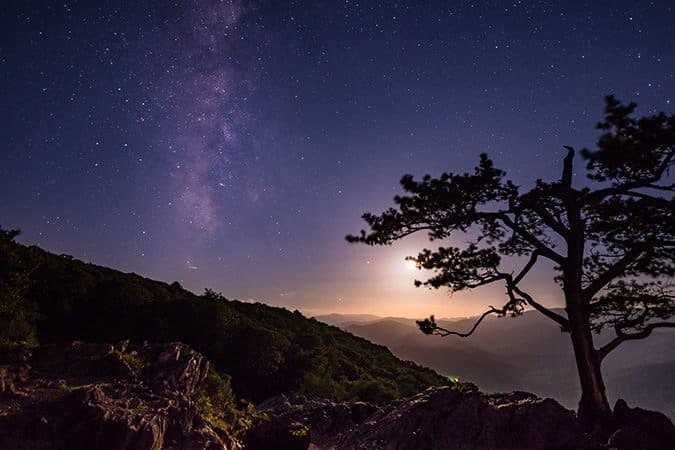
The early sunsets of November and December make it convenient to gaze at the stars on a cold, clear evening. From a dark location, such as at a state park or at an overlook along the Blue Ridge Parkway, something can be seen that will make you feel incredibly small — if you know where to look.
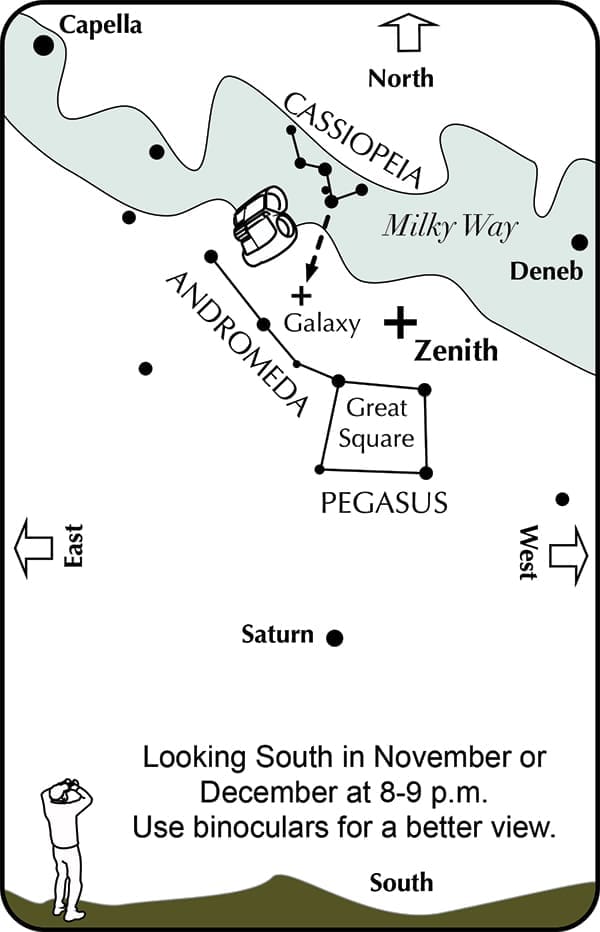
Nearly overhead between 8 and 9 p.m. lies not a single star, nor a pretty cluster of a few dozen twinkling stars, but the combined light of over 200 billion stars — the Andromeda Galaxy. It appears to the unaided eye as a very dim elongated smudge hovering at the edge of visibility, but binoculars clearly reveal it as an unmistakable soft glow.

Look high overhead for the “w” configuration of the five stars of Cassiopeia. Draw a line from the three western stars pointing south. Make its length the same as Cassiopeia is wide. That line lands on the Andromeda Galaxy.
Have a go at it. If your eyes are good and the skies are dark enough, you will be staring at an astrophysical object lying 2.6 million light-years away. In more familiar terms, that is 15,000,000,000,000,000,000 miles. That’s a lot of zeroes!
Now, do you feel small?
The story above first appeared in our November / December 2025 issue.