Skip to content


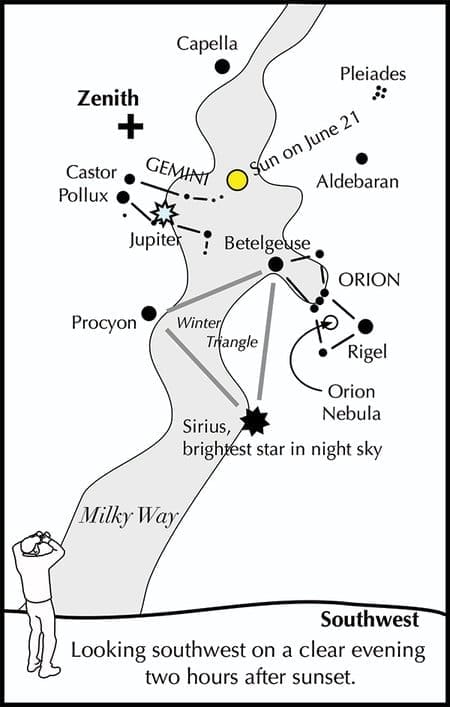
Late winter skies are filled with almost too many celestial attractions. Since December, we’ve seen magnificent Orion — along with its two brightest stars, Betelgeuse and Rigel, its fascinating, fuzzy star-forming nebula and its three belt stars — march across the sky. Now they all lie high in the south-southwest two hours after sunset.
For folks learning their way around the sky, the stars Procyon to Orion’s east and Sirius to Orion’s southeast are good sky guides. Those two bright stars and another, Betelgeuse (Orion’s northeastern star), form the Winter Triangle.

Look above the Winter Triangle for bright Jupiter — brighter than any other object except the passing moon — shining nearly overhead. It lies close to Castor and Pollux, the twin stars of the constellation Gemini. This constellation actually consists of two lines of medium-bright stars stretching to the west and, more or less, toward Orion. Each line is headed by either Castor or Pollux. Pollux is the brighter of the twin stars. At the western end of the upper (Castor’s) line is the “foot of Gemini,” which happens to closely mark the position of the sun on the first day of summer, June 21. Keep that in mind on a warm, sunny day in June!
The story above first appeared in our March / April 2026 issue.