Skip to content



The two planets that, at times, dominate the early evening sky are slowly heading toward each other for a dramatic showdown in early June.
By John Goss
As May begins, you can’t miss them both shining in the west less than 60 minutes after sunset.

Bright Jupiter stands high in the west accompanied by Castor and Pollux, the twin stars of Gemini. As the nights proceed, the mighty planet with the twins in tow drops closer to the horizon.
Brilliant Venus, on the other hand, first appeared very low above the western horizon in late February. It is now found higher and easier to spot as twilight darkens. It continues to climb, albeit slowly, through May and June.
On May 18, the thin crescent moon joins the planetary duo by floating directly next to Venus. The following evening, it splits the Venus-Jupiter difference. And on May 20, it hangs directly above Jupiter.
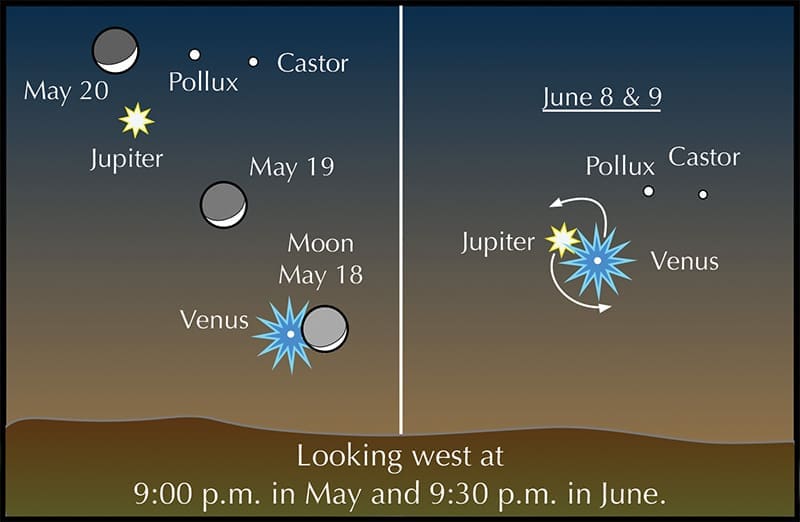
For the next two weeks, the two planets inch closer together. Finally, on the nights of June 8 and 9, when Venus and Jupiter are at their closest, they switch places. The moon again catches them on June 16 and 17 while they slowly continue drifting apart.
Because they are so bright, this can all be seen in the city as well as in the country. Just look toward the west an hour after sunset to catch this dazzling planetary dance!
The story above first appeared in our May/June 2026 issue.