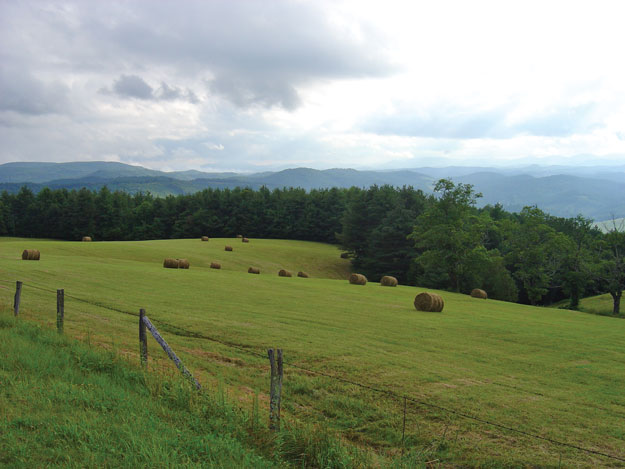
The Conservation Trust for North Carolina is “a land trust that focuses mostly on the Blue Ridge Parkway, although we also help the 23 other land trusts that exist all over the state,” says CTNC executive director Reid Wilson. “We lobby for them, manage their contracts with foundations and government agencies, and have a donor-established $4.3 million loan fund for mountain land trusts.”
A viewshed parcel prioritization analysis conducted by CTNC land protection specialist Richard Broadwell and Appalachian State University student Carl Anderson will help CTNC identify high priority land for protection along the parkway in North Carolina. “We send letters to landowners we’d like to talk to, and follow that up with a phone call,” Wilson says.

The Western Virginia Land Trust uses a different approach. “Educational outreach is our first priority,” says WVLT Executive Director Roger Holnback. It schedules spring meetings in the 10 counties it serves (Botetourt, Roanoke, Floyd, Carroll, Patrick, Bedford, Franklin, Montgomery, Henry and Craig) to explain conservation easements to landowners. Although WVLT “never targets land for protection” it sends mailings to landowners with enough land to qualify for conservation easements. Fifty acres is a “realistic minimum”; 100 or more acres would “almost automatically qualify.” (Only a fraction of that land is along the parkway.)
WVLT has “worked hard along the parkway. It’s one of our principal focus areas, though we’ve never had money in Virginia, the way they do in North Carolina, to solicit land for purchase.” Even “the conservation easement idea is relatively new here. Easements began in Virginia in 1978, but as recently as 14 years ago, there was only one west of Lynchburg. Where there are few wealthy landowners and little development pressure, easements aren’t viable or attractive. The numbers have to reach a certain threshold,” he says. Conservation easements have become more attractive in western Virginia recently because the region has undergone a “pretty significant demographic shift,” he says. In the last 15 years, WVLT has secured conservation easements on about 60,000 acres in the 10-county area.
What gave easements a real boost was a 2004 change Virginia made to its 1999 tax incentive program. Virginia is one of only two states where landowners who donate conservation easements can sell or transfer the state income tax credits associated with the donation. (The credit represents a percentage of the difference in the value of the property before and after an easement has been attached to its deed.) Transferability made the credits valuable to out-of-state landowners – and to farmers who had little income and who wanted to protect their land but needed to realize some income from the easements they donated. (North Carolina also offers income tax credits, but they are non-transferable. Conservation easement donors in both states are also eligible for reduced property and estate taxes, and federal income tax deductions.)