Skip to content


Charleston natives bring this three-year-old West Virginia restaurant from the stresses of COVID to the acclaim of the James Beard Awards.
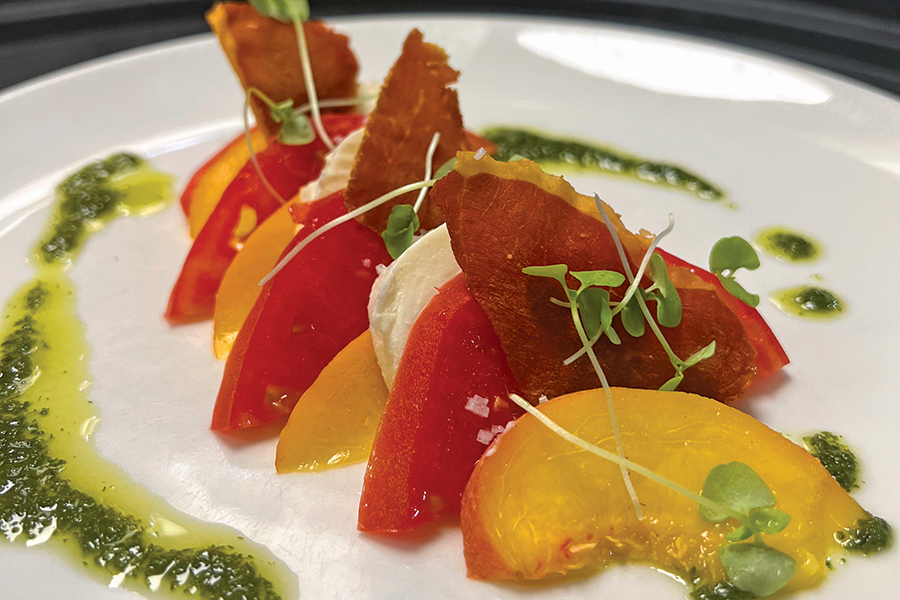
Photo Above: Local tomatoes, peaches, fresh mozzarella, prosciutto and basil make up a summertime salad at 1010 Bridge. Courtesy of 1010 Bridge.
A sign board just inside the front door at 1010 Bridge proclaims, “Love Where You Live.” Aaron and Marie Clark certainly do. In July of 2020, in their hometown of Charleston, West Virginia, high on a hill overlooking the Kanawha and Elk rivers, they opened 1010 Bridge in the South Hills section of the city, using the street address as the name of the restaurant.

That sign board lists sausage makers, microgreen growers, trout farmers and coffee roasters. They are the regional purveyors who provide the foundation for the restaurant’s menu.
© Jill Sauceman
Chef Paul Smith loves where he lives, too. His Charleston childhood shines through in his cooking just as strongly as his hard-earned education at the Culinary Institute of America (CIA). Five months after 1010 Bridge opened, despite the difficulties of the COVID-19 pandemic, it was already topping statewide “best of” lists in West Virginia. In the spring of 2023, Smith was recognized as one of the best chefs in the Southeast by the James Beard Foundation. The James Beard Awards have been compared to the Oscars in cinema and the Heisman in college football.
Aaron Clark points out that, in addition to Smith, there are five trained chefs in the 1010 Bridge kitchen. “There is more experience in this little restaurant than you would find in one three or four times the size,” he tells us.
A graduate of Charleston Catholic High School, Chef Paul Smith went on to study hospitality management at Virginia Tech and earned a bachelor’s degree from West Virginia State University before enrolling at the CIA in Hyde Park, New York, where the curriculum demands seven-day-a-week training.
Smith learned about wines and pastries in the Napa Valley of California, completed a CIA-sponsored externship at the Ritz-Carlton in Naples, Florida, served as pastry chef at the Biltmore in Asheville, North Carolina, and cooked at a small country club in Vero Beach, Florida. Those experiences allowed him to fill his dossier with impressive credentials, but he always wanted to come back home to Charleston, a place that has captivated him ever since he stood on a milk crate to stir gravy for his coal miner grandfather on Friday nights as a child.
“You come into a West Virginia home, an Appalachian home, and you’re instantly not a stranger,” Smith says. “I tell people that once you get here, and you meet the people, and you feel that comfort that comes over you, then you’re automatically like an honorary West Virginian.”
Smith doesn’t describe himself as a farm-to-table chef or a fine-dining chef. Instead, he views himself as a community chef. And he still washes dishes.
© Jill Sauceman
“Food and community are synonymous,” he declares. “At 1010 Bridge, we give you a fine dining experience, but without pretense. It’s approachable fine dining. We look at this like it’s our home. The vibe here is fancy restaurant, but it’s comfortable. It may be a little loud, but that’s cool. I’m glad there’s enough people in here for it to be loud.”
Virtually every menu item features a regional connection. Appalachia’s fascination with pimento cheese is reflected in the bar snacks section of the menu. Smith’s version of the sacred spread is served on spiced saltine crackers, with Fresno chile pepper, red pepper jelly and candied pecans.
Nashville’s heralded hot chicken, in the hands of Paul Smith, is transformed into a hot oyster starter. The out-of-the-sleeve light bread that cushions the chicken at blue-collar Nashville hot chicken joints becomes toasted brioche at 1010 Bridge. Traditional dill pickles are replaced by grandmother-worthy bread and butter ones. And, departing a step more from the Nashville tradition, 1010’s hot oysters are served with a buttermilk-herb dressing. Translate that as ranch, which, Smith says, is a favorite in West Virginia.
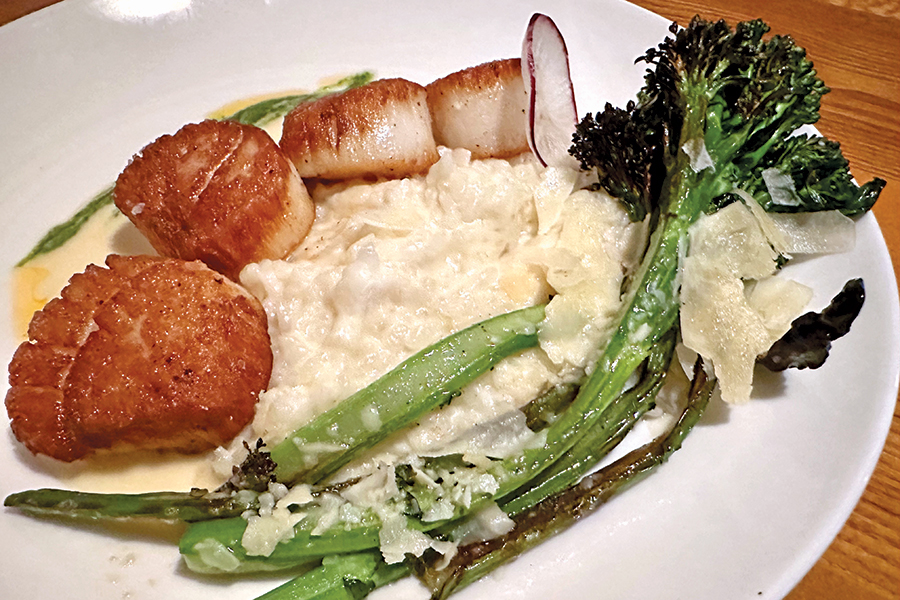
On the 1010 Bridge entrée menu, seared day boat scallops from far away get a local accompaniment of ramp pesto when the wild mountain leeks are in season in West Virginia.
© Fred Sauceman
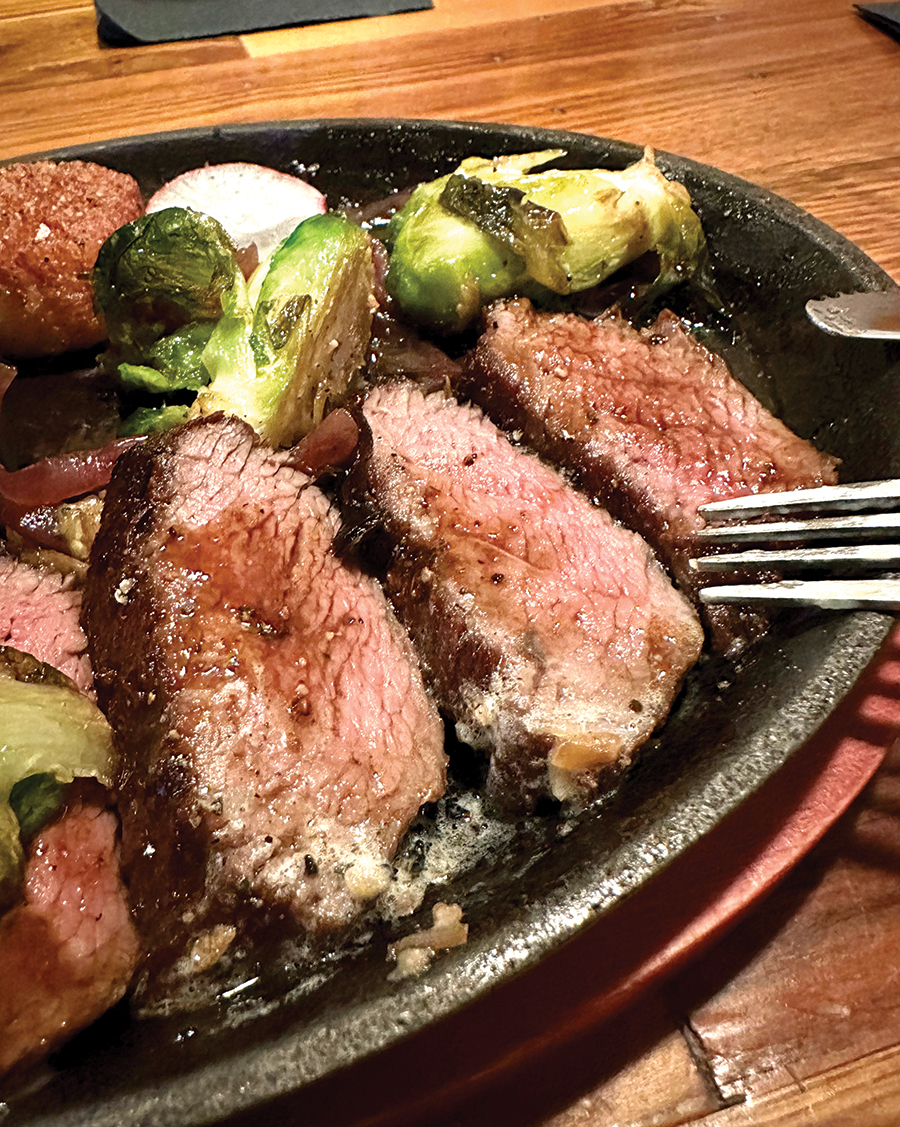
Chef Smith says it’s easy to find a good eight-ounce filet in Charleston. Instead, for its Cast-Iron-Seared 1010 Cut, 1010 Bridge uses meat from the shoulder of the cow and serves it with a Cabernet bordelaise sauce and foie-gras shallot truffle butter. On the side are lobster macaroni and cheese and Brussels sprouts with candied onion.
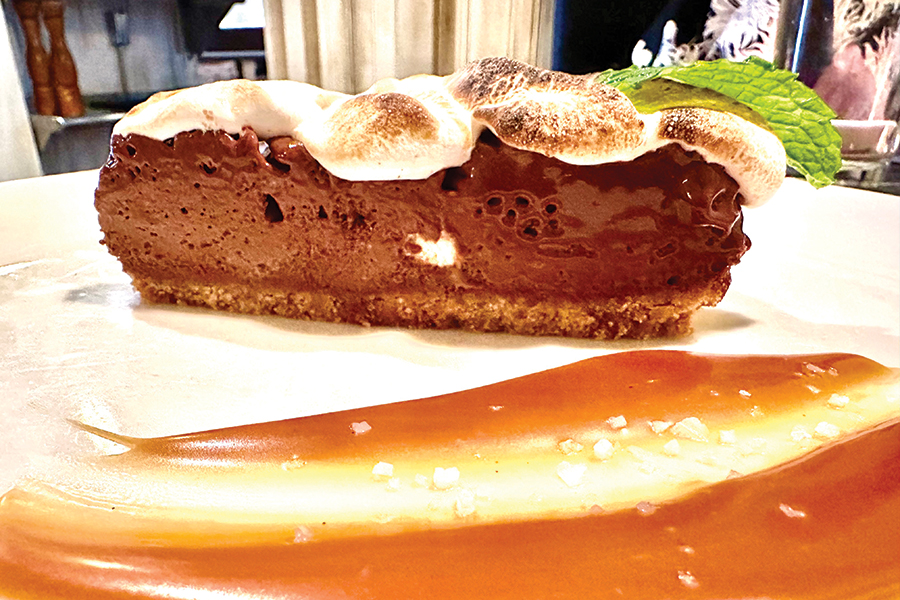
For the dessert menu, a former 1010 Bridge chef from El Salvador created Bananas Foster Bread Pudding, patterned after a dish he watched his grandmother make back home. That dessert inspired him to be a chef.
“We treat guests here with respect and kindness,” says our server, Chris Ferris. It wasn’t an example of corporate mission-speak. 1010 Bridge doesn’t operate that way. His comment was spontaneous and clearly from the heart.
“West Virginia hospitality is second to none,” adds Chef Paul Smith.
Would we drive three and a half hours again just to have a meal at one restaurant? If that restaurant is 1010 Bridge, absolutely.
Fred and Jill Sauceman study and celebrate the foodways of Appalachia and the South from their home base in Johnson City, Tennessee. Fred served for several years as a judge for the James Beard Awards, in the restaurant and cookbook categories.
The story above first appeared in our July / August 2023 issue.