The Wannabe Chef: Baked Alaska

I attended Longwood University (Longwood College for the majority of my years there), and some of my favorite memories are based around the school’s many traditions. One of the best is the annual Thanksgiving dinner held the week before students head home for the holiday.

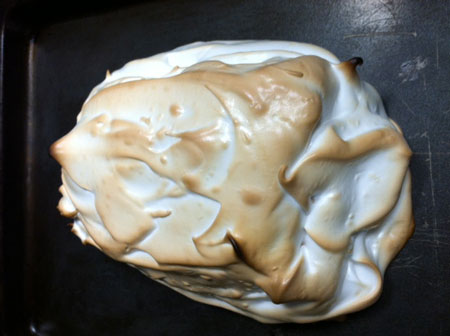
Students reserve a table in the dining hall with their friends and are served a real Thanksgiving meal, complete with turkey and all of the trimmings. But the best part was dessert…Baked Alaska. My freshman year, I had never had it before, but when the yummy cake and ice cream covered in meringue hit the table, my friends and I couldn’t wait to dig in. The coolest part about Baked Alaska is the fact that it’s baked. Ice cream in the oven? Yep. Apparently, the meringue serves as insulation, so while it browns in the oven for a few minutes, the ice cream doesn’t melt.

I decided to reminisce a little and make the dessert as a pre-Thanksgiving treat. I cut a few corners to make it easier (like not making the cake from scratch), but it was still as delicious as I remembered. Thanks, Longwood!

Baked Alaska

Note: I pulled from several recipes I found online to put this together and make it my own, including www.foodnetwork.com and www.justapinch.com

  • 1 loaf pound cake (I used store bought)
  • 1 brick of ice cream (I used Neopolitan and just cut out a brick to fit)
  • 6 egg whites
  • ¼ tsp. cream of tartar
  • 1 cup sugar

Preheat oven to 500 degrees.

Put plastic wrap in a loaf pan. Cut a brick of ice cream a little bit smaller in width than the cake and place on bottom of loaf pan. Cut pound cake in half horizontally and place on top of ice cream. Put cake and ice cream in freezer until the ice cream is firm.

Mix egg whites and cream of tartar until foamy. Beat in sugar until soft peaks form.

Get cake and ice cream out of freezer and transfer to an oven-safe plate or cookie sheet, flipping it so the ice cream is on top. Cover the cake and ice cream with meringue, making sure it’s covered completely.

Put in lower portion of oven for 3-5 minutes, or until meringue is browned. Serve immediately.
You Might Also Like:

e1b70596-05c8-11f1-92e0-1248ae80e59d-3-2026rueanemone--credit-Joe-Cook

March’s Mountain Wildflower: Rue Anemone

A member of the buttercup family and found in the open woodlands, rue anemone (Thalictrum thalictroides) has long, thin stems that tremble in the slightest of winds—prompting its other common name, windflower.
Pokeweed growing in Floyd County, Virginia.

January’s Wild Edible: Pokeweed

Pokeweed is one of the wild plants that is most associated with the Blue Ridge Region.
A purple-spored puffball growing in a field in Botetourt County, VA.

December’s Wild Edible: Purple-Spored Puffball

The purple-spored typically grows in this region’s fields, often appearing from October through December and into early January.
d289022c-696f-11f0-a179-1248ae80e59d-CGZ_0845-011

Ride the Rails, Explore Rockbridge County: Make a Weekend of the 611 in Goshen!

This fall, one of America’s most iconic steam locomotives is making tracks and memories.
The compound, lancelike leaflets of the bitternut are a good identifier.

November’s Wild Edible: Bitternut Hickory

Frankly, this native species to the Blue Ridge mountains comes by its name honestly.
Mullein growing in Ingram's backyard.

October’s Wild Edible: Mullein

Earlier, this year, a lone mullein plant appeared along the fence that encloses my garden, which made me curious about this plant.
An indigo milk cap growing in Botetourt County, Virginia.

September’s Wild Edible: Indigo Milk Caps

When young, indigo milk caps are one of the most stunningly beautiful mushrooms in the Blue Ridge Mountains.
ec3b964c-5201-11f0-968d-1248ae80e59d-9-2025spottedjewelweed--credit-Joe-Cook-and-Monica-Sheppard

September’s Mountain Wildflower: Spotted Jewelweed

Seek out spotted jewelweed growing beside a stream or along a moist area and you will have a good chance of getting to watch one or more ruby-throated hummingbirds flit from flower to flower.
A black staining polypore growing in Botetourt County, VA.

August’s Wild Edible: Black-Staining Polypore

The black-staining polypore is certainly one of the more fascinating wild edible mushrooms.
Northern Dewberry growing in Botetourt County, Virginia.

July’s Wild Edible: Northern Dewberry

For several reasons, the northern dewberry is often overlooked as a summer berry in the Blue Ridge.

CALENDAR OF EVENTS