Skip to content


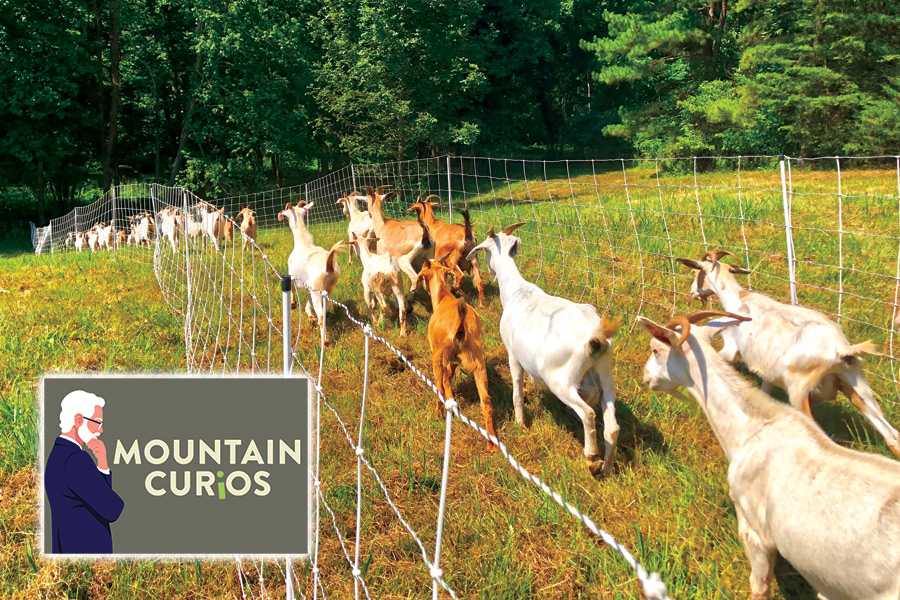
Eager goats race toward their next meal on private property in Cismont, Virginia. Courtesy: Jill Devine
Goats eat between 3 and 9% of their body weight each day, and put on a bit of a show while they do it.

No, Goat Busters isn’t a movie (yet!), but the spectators are gathering. In fact, one Buckingham County (Virginia) family plans its annual vacation around what one goat farmer is calling agri-tainment.
That’s right, the family sets up chairs and other party supplies at the old family farm to watch Jace Goodling’s herd of cloven-hoofed stars do what they do best: chomp their way through poison ivy, bittersweet, thorny bramble and most any other green thing that stands in the way of naturally cleared land.
“Heck, I’ve even seen some folks set up a moon bounce,” laughs Goodling, who owns Afton-based Goat Busters in the foothills west of Charlottesville.
What makes goats so perfect for the job? Besides being off-the-charts adorable, goats are amazingly efficient at obliterating dense underbrush, leaving not a leaf from the ground up to about six feet in as little as 24 hours.
“A goat lives its life in two-hour cycles, ‘round the clock, seven days a week—they don’t take the night off,” says Goodling. A goat eats between 3 and 9% of its body weight in wet vegetation every day.
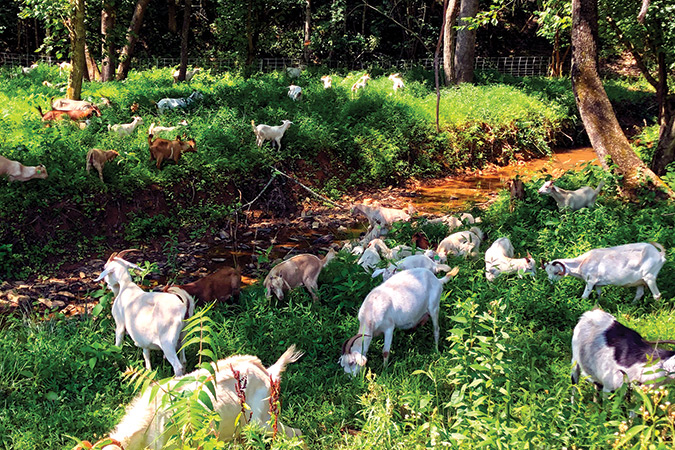
“It’s a win-win for everyone: We don’t use chemicals, and the goats leave free fertilizer everywhere they go,” points out Goodling. If that’s not enough, agile goats can climb where machines cannot in hilly, rocky terrain.
It’s true that goats will eat almost anything. That’s why Goodling scopes out every site before accepting a job. Some species are poisonous to goats.
“Wisteria and English ivy independently are fine, but a goat that eats them together will bloat and die in one hour and 15 minutes—hard lesson learned,” he sighs.
What a hoot to watch Goat Busters in action one July morning on private land near Charlottesville. After wrapping about 1.5 acres with electric fencing, Goodling unlatches the gate on his trailer, releasing dozens of goats that leap out in slow, nursery-rhyme fashion, followed by two guardian Anatolian Shepherds.
“Like kids in a candy store,” shrugs Goodling. Every size and color, the goateed herbivores race to the nearest branch and begin munching before vanishing into the foliage. “By morning, all you’ll see are tree trunks,” says Goodling. “Then we’ll move them to the next acre.”
“I was the only one in the area doing this when I started, but now there’s a goat company within spitting distance anywhere you go along the Blue Ridge,” says Goodling. “There’s plenty of work for us all.”
A custom home builder by trade, Good- ling formed Goat Busters when the housing bubble burst in 2008. “One day I’m producing more than $3 million in custom homes, and the next day I can’t find a screen door to fix,” he says.
Raising Kiko breeding stock was a side business for Goodling, so he decided to follow the example of a goat colleague in California who was already using her Kikos in large brush clearing projects.
“I had the goats, truck and trailer,” he says. “All I needed was fencing and a charger to be in business.”
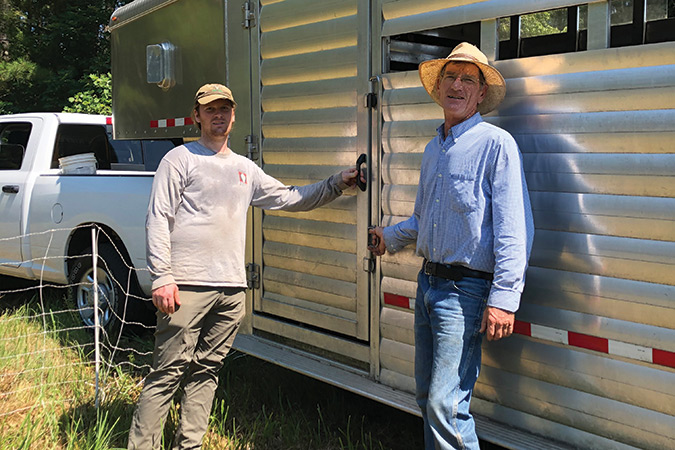
Goodling’s first job was to clear the densely tangled woods surrounding a vineyard in Ivy, Virginia.
“The biggest threat to grapes is mildew and fungus, so the goal was to promote air flow,” says Goodling. “We saved them a fortune in grape crop value.”
Goodling’s goats have chewed their way through private and municipal jobs along the Blue Ridge, including the University of Virginia’s Birdwood Golf Course and Virginia Department of Forestry clearing projects at Lesesne and Paul state forests.
Katlin Mooneyham DeWitt, Forest Health Specialist for VDOF in Charlottesville, describes goat grazing as “the cutest form of vegetation management.” The VDOF recently led two projects studying the use of goats for controlling invasive plants, combining grazing with targeted herbicide applications. “Goats are great at clearing land that needs a reset,” she says.
“This is so much different than construction business,” says Goodling. “It’s not as lucrative, but the karma is so much better—and I sleep well,” he says. “With Goat Busters, everything is good—the customers can’t wait for us to get there, and they never want us to leave.”
The story above appears in our January/February 2021 issue.