Skip to content

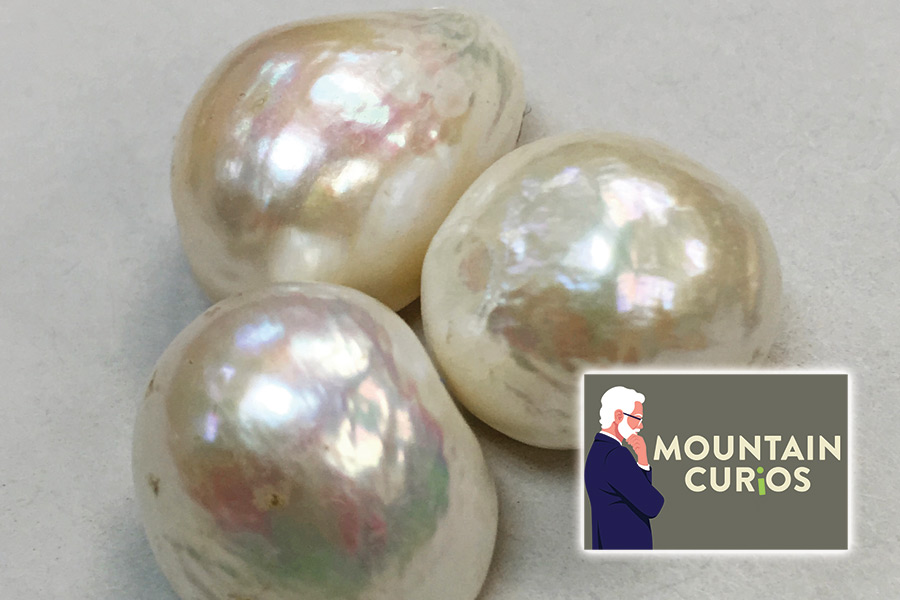
The promise of pearls was strong on the Clinch River for about 40 years, until the advent of hydroelectric dams and plastic buttons brought it to an end.
At the forefront of the 1895-1935 harvest was a young man without sight, who used his feet to feel for pearl-holding mussels.

Barefoot and pushing against the swift currents of the mountain waters, Joseph Gossett reads the bottom of the Clinch River with his toes, searching for treasure— freshwater pearls.
This is the mid-1890s, and Gossett is using his toes to feel for mussels because he is completely blind, having lost his vision to malaria. But despite his handicap, Gossett is dedicated to his craft, using his sense of touch to accurately rate the size, quality and value of his finds, and depending upon his sister to describe subtleties of color to him.
Gossett was one of the first to discover this east Tennessee bounty and take his place as a famous “pearler” among hundreds who worked the river.
Known as the “Queen of Gems,” these pearls sparked a “rush” in the streams and mountains of the Blue Ridge. The center of prosperity was the small town of Clinton, Tennessee which soon earned the moniker, “City of Pearls.” For the locals, husbandry quickly became secondary to this new industry. And as it grew, buyers arrived regularly from around the country layering the culture with a distinctly cosmopolitan atmosphere.
By the turn of the 20th Century, these little beauties of varying sizes, shapes and colors took their place on the world stage. Resting quietly amongst the displays of newfangled talking pictures, flying machines, a 5000-light Palace of Electricity and the golden-yellow Eiffel Tower at the Paris Exposition of 1900 (attended by 50 million visitors) were brooches and rings made from the Clinch River freshwater pearls of east Tennessee.
Contemporaneous stories, like this excerpt from the 1908 book, “The Book of the Pearl: The history, art, science, and industry of the Queen of Gems,” paint a picture of life during the river’s heyday:
Vivid and picturesque accounts published in local papers reported hundreds of persons as camping at various points along the stream, some in tents and some in rough shanties, and others going from shoal to shoal in newly-built house-boats. They were described as easy-going, pleasure-loving people, the men, women, and children working hard all day, subsisting largely on fish caught in the same stream, and dancing at night to the music of a banjo around the camp-fire.
Through the years, every part of the freshwater pearl harvest was utilized. The mussels were eaten and also fed to livestock. And, tons of shells with their iridescent interiors were crafted into Mother of Pearl buttons. The final chapter was written for this pearling industry when hydroelectric dams cooled the water temperatures (making the river habitat largely unsuitable for the mussels) and plastic became the material of choice for buttons.
The freshwater pearl, crafted by nature’s ancient mysteries and revered for its variations of beauty for thousands of years, was a star on the world stage during this bookended period from 1895 to 1936 on the Clinch River.
The story above appears in our January/February 2021 issue.