Skip to content



Since 1909, a beautiful tract of land near Front Royal has carefully guarded a varying set of not-so-public identities.
Photo Above: Circa 1938 postcard shows the Front Royal Army Remount Depot. ©Courtesy Warren County Historical Society.
Less than four miles from the northern entrance to the Skyline Drive near Front Royal, Virginia, lies a 3,200-acre tract of pretty Shenandoah Valley land that has a lot of stories to tell.

Some of which can actually be told.
Today, the site is home to the Smithsonian Conservation Biology Institute (SCBI), where scientists conduct research in animal behavior, reproduction, genetics, migration and ecology to save wildlife species from extinction.
Not that you can see it first-hand. Because, while a few university students live on the property and actually wake, dine and study amid the likes of clouded leopards, cheetahs, mountain zebras, red pandas and other threatened species, the former one-day-a-year public visitation has not been resumed since COVID stopped it.
That restricted status has been true of the site for most of the years since its first iteration, in 1909, when the U.S. Army began purchasing what became almost 5,000 acres to build equestrian facilities including stables, barns and other buildings and to provide fresh supplies of horses and mules to the military. From the vast pastures, animals were delivered via rail from Front Royal through WWI and WWII.

The Front Royal Quartermaster Remount Depot, as the facility was known, pioneered breeding practices that included some 18,000 mares a year, and yielded the Olympic Champion Thoroughbred Jenny Camp and several Kentucky Derby winners as well as Man o’ War—generally regarded as the greatest racehorse of all time.
During WWII, the property was also used as a War Dog Reception and Training Center; an animal cemetery still exists on the property, with gravesites for noteworthy steeds and canines.
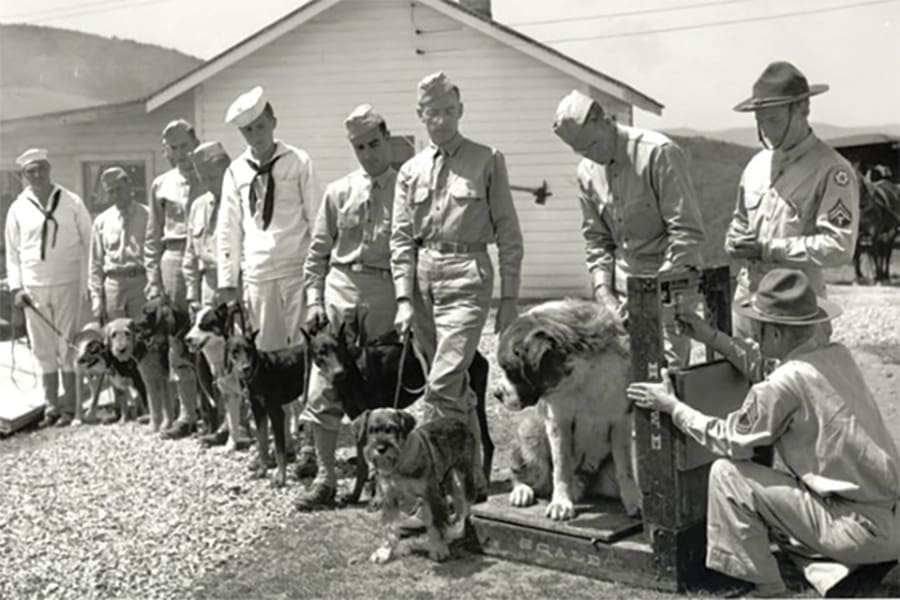
©Courtesy US Army Signal Corps
©Courtesy US Army Signal Corps
The next identity for the land was relatively short-lived: In the war years until 1946, it served as a camp that housed some 600 German and Italian prisoners of war, who worked as laborers on Shenandoah Valley farms. Only a few foundations remain from the temporary structures where they were held.
By 1948, the property had been taken over by the U.S. Department of Agriculture which, in conjunction with Virginia Tech—then more often known by its full name of Virginia Polytechnic Institute and State University—carried out research on Angus, Hereford and Shorthorn cattle toward the improvement of meat production. The culmination of those efforts may well have been the 1972 status as the state’s largest—and the nation’s fourth largest—Shorthorn registry.
Meanwhile, beginning in 1952, the Department of State began renovating some abandoned structures for a program with the code name RABBIT—a relocation site and communications station for continuity of government (COG) in the event of a national attack. A 2017 book, “Raven Rock: The Story of the U.S. Government’s Secret Plan to Save Itself – While the Rest of Us Die,” tells of more than 50 fully stocked buildings ready to welcome 1,200 State Department employees.
The State Department halted activities at Front Royal in 1963, and by 1972 all that was left was the communication station. In the winter of 1973, the USDA closed down the cattle research station.
The abandoned facilities presented an opportunity for Dr. Theodore H. Reed, then-director of the Smithsonian National Zoo, who had searched for more than a decade for the perfect location for a captive-breeding facility. In 1975 the Smithsonian received title to the land and launched the Smithsonian Conservation and Research Center, the precursor to the current SCBI.
Except for part of the original 5,000-acre Remount Depot that is now occupied by the Northern Virginia 4-H Educational and Conference Center, most of this vast and beautiful tract continues its legacy of much going on with very little chance to see it.
The story above first appeared in our January / February 2023 issue.