September’s Wild Edible: Indigo Milk Caps

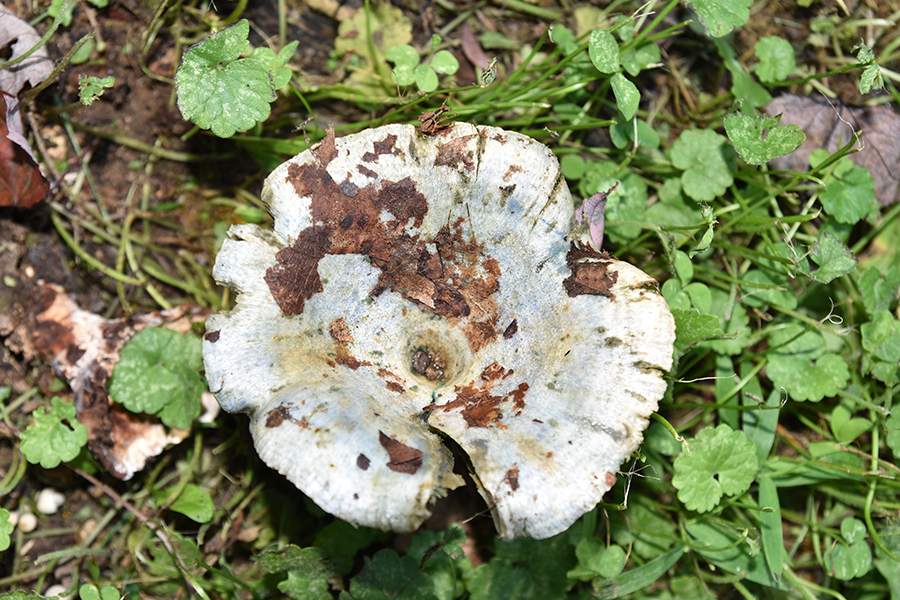
An indigo milk cap growing in Botetourt County, Virginia.

When young, indigo milk caps are one of the most stunningly beautiful mushrooms in the Blue Ridge Mountains. Lactarius indigo flaunts a deep blue convex cap that is typically 2 to 4 inches wide. As the indigo ages, the cap hue turns to a grayish blue and flattens. The stem is 2 to 3 inches high and indigo blue as well, and the white flesh becomes blue when cut … then green. This species typically grows in oak forests, but also occasionally in pine glades.

Jeff Huffman, my mushroom mentor and a member of the New River Mushroom Club, recommends cooking milk caps in butter until they become “brown and a little crispy,” which gives them a pleasant nutty flavor. As is the case with the vast majority of edible mushrooms, indigos should not be consumed raw as they emit a foul, fishy odor then.

Indigo milk caps release a blueish liquid when cut, which is part of the identification process. Unfortunately, there are some poisonous lookalikes …specifically members in the Cortinarius family.

“Cortinarius mushrooms can be confused with the indigo,” Huffman says. “However, they don’t exude the milky substance when cut, and the indigo has a different color spore print … creamy.

Always consult field guides and expert sources before consuming a mushroom new to you. New River Mushroom Club: https://sites.google.com/site/newrivervalleymushroomclub/home.


Bruce and Elaine Ingram will profile a different wild edible every month. For more information on their book Living the Locavore Lifestyle, contact them at bruceingramoutdoors@gmail.com.


You Might Also Like:

The Giovanni is an Italian-American creation born in West Virginia.

Discovering the West Virginia Giovanni

This flavorful sandwich is a product of the rich Italian heritage of the Mountain State.
e1b70596-05c8-11f1-92e0-1248ae80e59d-3-2026rueanemone--credit-Joe-Cook

March’s Mountain Wildflower: Rue Anemone

A member of the buttercup family and found in the open woodlands, rue anemone (Thalictrum thalictroides) has long, thin stems that tremble in the slightest of winds—prompting its other common name, windflower.
Pokeweed growing in Floyd County, Virginia.

January’s Wild Edible: Pokeweed

Pokeweed is one of the wild plants that is most associated with the Blue Ridge Region.
The pawpaw version of Ale-8-One debuted in the summer of 2025, in a limited edition.

Ale-8-One: Welcome to ‘Tropical’ Kentucky

This 124-year-old soft drink company continues to innovate and thrive.
Arkansas Black apples sport an attractive reddish black color.

December’s Blue Ridge Mountain Apple Profile: Arkansas Black

Originating in the 1870s in, obviously, The Natural State, this variety is reputed to be a part of the Winesap family, which includes such esteemed members as the Black Twig, Stayman, and, of course, the Old Fashioned Winesap.
A purple-spored puffball growing in a field in Botetourt County, VA.

December’s Wild Edible: Purple-Spored Puffball

The purple-spored typically grows in this region’s fields, often appearing from October through December and into early January.
The Fork and Plough name reflects the professions of the owners — chef and farmer.

Fork and Plough: Neighborly and Nimble

At this Greenville, South Carolina, eatery, the menu changes literally every day, based on what’s available locally.
d289022c-696f-11f0-a179-1248ae80e59d-CGZ_0845-011

Ride the Rails, Explore Rockbridge County: Make a Weekend of the 611 in Goshen!

This fall, one of America’s most iconic steam locomotives is making tracks and memories.
The compound, lancelike leaflets of the bitternut are a good identifier.

November’s Wild Edible: Bitternut Hickory

Frankly, this native species to the Blue Ridge mountains comes by its name honestly.
Mullein growing in Ingram's backyard.

October’s Wild Edible: Mullein

Earlier, this year, a lone mullein plant appeared along the fence that encloses my garden, which made me curious about this plant.

CALENDAR OF EVENTS