More Fall Magic: Braving Bell Mountain

It once took a lot more huffin’ and puffin’ and hikin’ to see Lake Chatuge and the surrounding mountains from atop Bell Mountain, near Hiawassee, Georgia.

Why, just ask Jerry Hamilton.

“Whenever I was younger, you had to earn it,” says Hamilton, 62. “But now you can drive up there. And some of the pictures that you’ve seen of the lake were taken from Bell Mountain.”

Here, on a Monday evening in June, sunset-seeking spectators clamored to climb the wooden steps of the new Hal Herrin Overlook and take in the view. One lady set up a camera on a tripod at the wooden platform below an American flag; others trekked to the top and snapped selfies with cell phones.

What’s unique up here: all the white rocks at the top, painted with decades of artful graffiti.

Historically, Bell Mountain’s white rocks are evidence of the Hiawassee Stone Company, which blasted “The Bell” to mine quartzite during the 1960s. This short-lived venture faced several obstacles, however, and ultimately proved financially unfeasible to ship materials to the nearby railroad at Murphy, North Carolina.

So Bell Mountain grew quiet – except for the folks who wanted to make their way here in Jeeps. And they loved the challenge of driving over the mud-rutted, rocky road to the top, says Candace Lee, the president of the Towns County Chamber of Commerce.

Now, that road is paved. And the view is on parade at the Hal Herrin Overlook of the Bell County Park and Historical Site.

To get there from the Hiawassee Town Square, follow U.S. 76 east for 1.3 miles. Turn left onto Shake Rag Road, go 1.5 miles to Bell Mountain Road, then turn right and follow one mile on the narrow road to the summit.

WANT MORE? townscountyga.org/bell-mountain-park—historical-site.html

You Might Also Like:

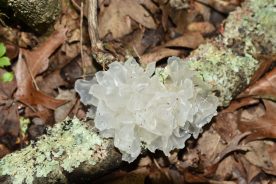
White jelly snow fungus growing in the author’s Botetourt County, Virginia woodlot.

May’s Wild Edible: White Jelly Snow Fungus

“Pass the fungus,” is not common dinnertime conversation in the Blue Ridge Mountains region, but that’s because folks perhaps have not heard of the white jelly snow fungus.
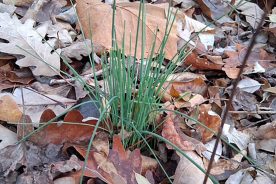
Wild garlic growing in Fayette County, West Virginia.

April’s Wild Edible: Wild Garlic

Fayette County, West Virginia’s Mitchell Dech is one of my foraging mentors, and when he wants me to try an edible new to me … I’m ready to learn about it.
A May apple in bloom in Southwest Virginia.

March’s Wild Edible: May Apple

Sometime this month in the Blue Ridge Mountains, one of these highlands’ signature spring plants will ease from the soil … the May apple (Podophyllum peltatum).
e1b70596-05c8-11f1-92e0-1248ae80e59d-3-2026rueanemone--credit-Joe-Cook

March’s Mountain Wildflower: Rue Anemone

A member of the buttercup family and found in the open woodlands, rue anemone (Thalictrum thalictroides) has long, thin stems that tremble in the slightest of winds—prompting its other common name, windflower.
Pokeweed growing in Floyd County, Virginia.

January’s Wild Edible: Pokeweed

Pokeweed is one of the wild plants that is most associated with the Blue Ridge Region.
A purple-spored puffball growing in a field in Botetourt County, VA.

December’s Wild Edible: Purple-Spored Puffball

The purple-spored typically grows in this region’s fields, often appearing from October through December and into early January.
d289022c-696f-11f0-a179-1248ae80e59d-CGZ_0845-011

Ride the Rails, Explore Rockbridge County: Make a Weekend of the 611 in Goshen!

This fall, one of America’s most iconic steam locomotives is making tracks and memories.
The compound, lancelike leaflets of the bitternut are a good identifier.

November’s Wild Edible: Bitternut Hickory

Frankly, this native species to the Blue Ridge mountains comes by its name honestly.
Mullein growing in Ingram's backyard.

October’s Wild Edible: Mullein

Earlier, this year, a lone mullein plant appeared along the fence that encloses my garden, which made me curious about this plant.

CALENDAR OF EVENTS