Skip to content



Innovative projects and initiatives are underway across the seven-state coverage area, all focused on protecting natural resources, strengthening communities and shaping a more sustainable future.
Photo Above: At Hayfields State Park in Highland County, Virginia, easy-to-moderate trails wind through quiet forests and past historic structures.
Photo Courtesy of the Virginia Department of Conservation and Recreation.
Across the Blue Ridge, governments, businesses, nonprofits and more are finding new ways to care for the land — and for the future. Singular efforts and vast endeavors are moving forward to conserve natural resources, preserve biodiversity, address climate challenges, build renewable energy options and improve quality of life. Some are innovations born of necessity, others a reorganization of how we think about the value of our shared spaces. Still others require a reimagining of what a new picture might look like and then repurposing the puzzle pieces to bring that vision to life. Let’s explore some of the inspiring operations designed to create a healthier, more sustainable future for all.

West Virginia

Summersville Lake State Park (Nicholas County). For more than 30 years, West Virginia did not create a new state park. That all changed in the summer of 2023 with the establishment of this one, located on the largest lake in the state. With a surface area of 2,700 acres, 60 miles of shoreline, 327-foot maximum depth and clear water, this 177-acre park on the northern shore was already a popular destination for generations of families. Swimming, boating, fishing, hiking, biking and scuba diving in the depths have long been popular activities. This location also boasts world-class rock climbing with 220 routes across miles of cliffs with some that rise 70 feet above the water.
In 2025, the state park celebrated another momentous occasion: the official grand opening of its new campground. More recent additions include full hook-up RV sites, day-use picnic tables, ADA-compliant restrooms and primitive campsites. There are also plans to construct cabins, improve trails and enhance climbing and bouldering experiences with education and opportunities for all skill levels.

Richard Mine Treatment Plant (Monongalia County). Abandoned since the 1950s, the Richard Mine still discharges “an average of 400 gallons per minute of toxic runoff” (wvu.edu). The greatest volume of this pollution enters the last few miles of Deckers Creek, which flows into the Monongahela River. For 10 years, passive systems (like using limestone and wetlands to reduce acidity and heavy metals) have been in place and continue to experience levels of success thanks largely to the work of nonprofits.
In 2024, a new treatment plant began operating to address acid mine drainage — the toxic soup that ruins groundwater and kills aquatic life. And it’s working. Streams are clearing. Aquatic species are returning. And local residents are forming coalitions to once again return to Deckers Creek to build parks, trails and eventually swim and fish.
Virginia

Hayfields State Park (Highland County). In October of 2025, Virginia officially opened its 44th state park. This 1,034-acre section of protected lands between the Jack Mountains and Bullpasture is a mix of valleys, forested mountains and historic structures, including an 1840s cabin where a doctor once practiced and an 1800s farmhouse where the park office is located.
Visitors can enjoy 4 miles of hiking and biking trails in the easy to moderate range. Take a peaceful stroll on River Loop Trail and Bear Pond Trail or wander into the woods on Laurel Loop Trail. Each of these roughly 1-mile routes offers opportunities for wildlife viewing. The Eagle’s Rest Trail is a bit more challenging and features an overlook of the valley and Bullpasture River, which is famous for its flyfishing.
Explore Park (Roanoke County). Sometimes the way we reimagine, improve and move toward a new greener future begins with a change behind the scenes. This was the case in August of 2025, when Roanoke County took full ownership and responsibility for its signature recreational area, Explore Park.
The 1,060-acre location next to the Blue Ridge Parkway was purchased from the Virginia Recreational Facilities Authority for the sum total of $1. This change is more than administrative; Explore Park will now be fully integrated into the county park system, allowing for local input and potentially opening opportunities for expanded amenities, additional trails and a new approach to event planning. Visitors currently enjoy zip lines and obstacle courses, a host of camping options from primitive to cabins and yurts, historic buildings, a visitor center with an on-site museum, 14 miles of trails, concessions and water fun on and in the Roanoke River.
Kentucky

Limestone Gap Preserve (Bell County). Located on the north face of a mountain within “some of the most biodiverse temperate forests on the planet” lies a newly protected section of wilderness — the 204-acre Limestone Gap Preserve. Adjacent to Kentucky’s first state park — the 13,000-acre Pine Mountain State Resort Park — the forested habitats here are “home to thousands of plant and animal species [of which] more than 200 are considered rare or endangered.” These lands are also critical to the health of the headwaters of the Cumberland River whose “streams and rivers … are [part of] the most biodiverse temperate freshwater ecosystem in the world” (atiraconservation.com).
The new preserve lies within the Appalachian Highlands Wildlands Corridor, an interconnected linkage of wild spaces crucial for wildlife movement, preservation of biodiversity and climate resilience. Specifically, this area is critical for migratory birds and two species of endangered bats. The lands are currently undeveloped with plans for nature study and the addition of hiking trails in the future.
BrightNight Starfire Solar Project (Knott, Perry and Breathitt counties). Stretching across these three counties was once one of the largest coal mines in the country. The vast, 27,000-acre disturbed landscape that was left after Starfire’s closure became a reclamation research site. Now it is the location of the state’s largest proposed renewable energy project — a $1 billion solar farm.

The first of four construction phases received the go-ahead in 2025 for the initial 210 megawatts of power of the 800-plus projected megawatts for the project. The farm will be built on 7,000 acres, making it one of the largest in the nation to be constructed on former mine lands. It is expected to generate power for hundreds of thousands of homes, create jobs, improve tax revenues for local economies and be a standard-bearer for a “green way” forward at similar sites.
Tennessee

Urban Wilderness Gateway Park (Knox County). What began as a modest plan to create a linear park as a “wilderness initiative” in the city of Knoxville in 2008 has grown into a “spectacular outdoor adventure area where you can hike, bike, climb, paddle or just wander in the woods” (visitknoxville.com/urban-wilderness). It is reported that the “wilderness” area totals 1,000 acres with 60 miles of trails and greenways, five city parks, a nature center and quarries, historic sites, lakes and a 618-acre wildlife management area, along with other nature preserves.
Following the trail and greenway extensions of Phase 1 in 2020, Phase 2 was completed in 2024, creating visitor spaces like parking, a pavilion, comfort stations and more. Phase 3 is currently underway with an eye for future phases going forward. Detailed trail maps, information on fishing and water-sport rentals, and locations for family fun are available online.

Solar farms (Jefferson, Hamblen, Blount and Greene counties). In May of 2024, the innovative White Pine Solar Farm came online, “delivering 2.8 megawatts of clean, renewable energy to the electric grid.” Located in the picturesque mountain town of White Pine, population 2,500, this public/private initiative is “expected to prevent [more than] 162 million pounds of carbon emissions … over its lifetime” (tn.gov). In addition to creating cost-effective, renewable energy for 400 homes, the project is “donating 1,600 renewable energy certificates each year for [the next] 40 years, [distributed] evenly” across both [Jefferson and Blount] county school systems. This makes the public schools in this rural area among the first green-powered schools in the Southeast.
May of 2025 saw the construction of four additional solar farms in the eastern portion of the state. Blount County, sitting beside the Great Smoky Mountains, welcomed three locations generating a total of 10.3 megawatts, and historic Greene County opened its solar farm, which has a 4.3-megawatt capacity. All are operating, and more clean, green solar projects are in the works for the area.
North Carolina

Solar-powered microgrids (multiple counties). Following the catastrophes wrought by Hurricane Helene, specifically those related to failed power infrastructure, innovative steps were taken to create localized energy systems known as microgrids. Nonprofits in the solar energy sector responded with mobile trailers that provided electricity for emergency response, communication, water filtration and other critical needs. These independent power sources acted as “resilience hubs” via their placement at schools, churches and other locations post-disaster.
Since that time, solar microgrids have also found permanent homes in the community center in Yancey County and the fire departments in Yancey and Buncombe counties. Operating with main grids throughout the year while retaining the ability to continue operations (called “island mode”) after power outages means cost savings, sustainable energy and stable power supplies. In addition to the availability of emergency mobile response microgrids, there are reportedly plans to build 24 permanent installations in six western North Carolina counties.
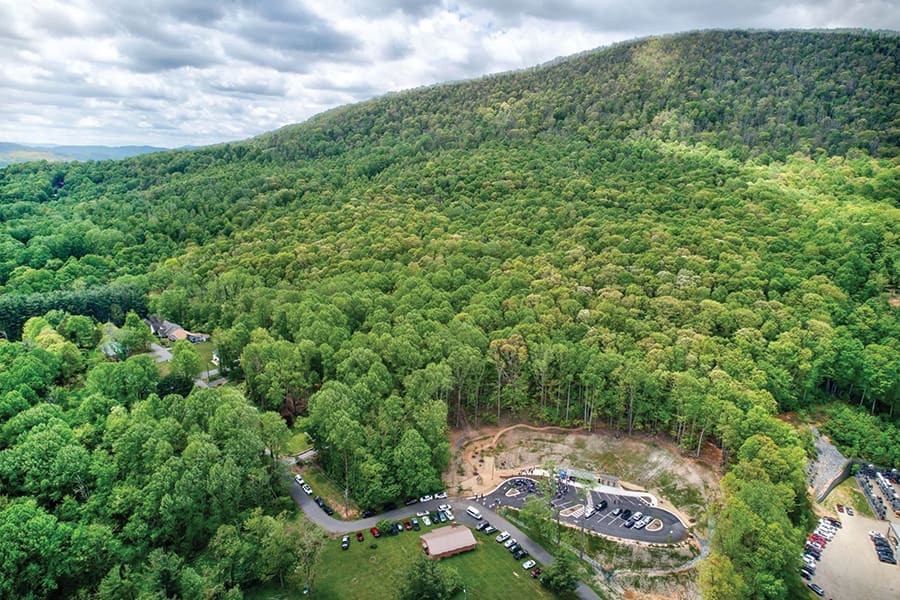
Paddy Mountain Park (Ashe County). The scenic backdrop of downtown West Jefferson is 152 acres of now-protected land, habitats, flora and fauna, including oak, maple and hickory that were once eyed for timber harvesting. The lush forests in this mountain region are due in part to the presence of amphibolite rocks that create nutrient-rich soil — one of the many reasons for conservation at this location. Another involves the connectivity of protected lands. This park will serve as an access point for the Northern Peaks State Trail and offer hiking opportunities from Ashe County to downtown Boone in adjacent Watauga County.
Currently, visitors can explore the solitude of this new park via a 3.6-mile trail system of loops arranged in a figure eight. A pavilion, restroom facility and picnic tables are on-site. The park is open from dawn to dusk, foot traffic only. Leashed pets are welcome to bring their humans for a hike.
South Carolina

Conestee Nature Preserve (Greenville County). Following the devastation of Hurricane Helene, the community banded together to restore and repair the infrastructure that allows visitors to experience the rich ecosystems at this preserve. The sandy paths and elevated, wooden walkways of the iconic West Bay Boardwalk are shining examples of post-storm recovery. “It means reopening a doorway into the heart of our wetlands,” says Executive Director Erin Knight. This area is considered the “cornerstone of Conestee’s educational programming,” which includes hands-on science programs, conservation workshops and field trips for all ages (conesteepreserve.org).

The nature preserve, now a thriving, 640-acre nonprofit wildlife sanctuary, was once an industrial site. Today, its green spaces welcome hikers with an extensive trail system, including paved sections for all mobility levels. Also welcome are picnickers, special-event participants, students for the innovative Nature Playscape program and birders in search of some 223 species recorded at this Important Bird Area.
Glendale Nature Park (Spartanburg County). The establishment and opening of this new 945-acre heavily wooded park in 2025 became the “largest conservation acquisition in the history of Spartanburg County” spartanburgconservation.org). With an eye toward a balance of responsible development and protection of natural habitats, this project represents “the county’s commitment to conservation, environmental stewardship, outdoor recreation and community well-being.”
Located only minutes from downtown in the historic mill village community of Glendale, this green space is adjoined to Glendale Shoals Nature Preserve and Tyger River Foundation Land to create a 1,200-acre contiguous nature corridor. More than 3 miles of trails are now ready for visitors with more in the planning stages, including a connection to downtown via the Daniel Morgan Trail Network. For the future, a conservation easement will protect this property from development in perpetuity.
Georgia

Sugar Creek Hollow Preserve (Murray County). What has been called a “once-in-a-generation opportunity to safeguard a large, intact Blue Ridge ecosystem” came to fruition at the end of 2025 with the acquisition of an additional 241 acres by the Southern Conservation Trust at its Sugar Creek Hollow Preserve (sctlandtrust.org). With a total of 594 acres strategically connected to the Chattahoochee National Forest and other protected lands, this successful endeavor “secured a contiguous corridor of forests, streams and wildlife habitat … [protecting] clean water, healthy soils, biodiversity and climate resilience.”
Long-term ecological stability requires the connectivity of wildlands, a challenge to accomplish under the pressures of development. “Nearly 80% of the preserve is classified as a ‘Highest Priority Area’ … with an additional 15% designated as ‘High Priority,’ reflecting its critical role in regional biodiversity and watershed protection.” Now the flora, fauna and topography are secure and ideally suited for research, environmental education and low-impact recreation going forward.
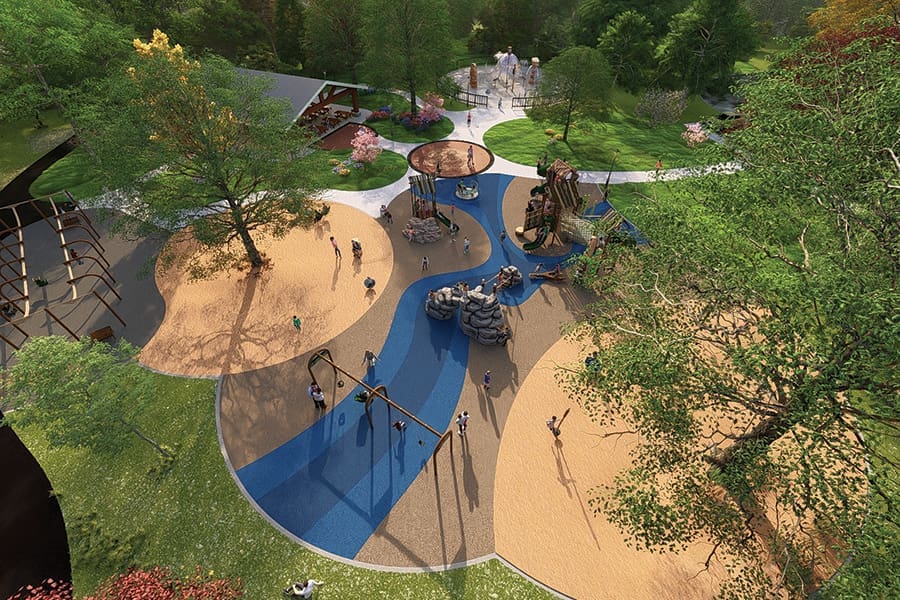
Adventure Acres (Walker County). The new green initiative in this north Georgia county focuses on families sharing fun, adventure and outdoor time together. The 8-acre site will offer a variety of activities for all ages, including “a nature-themed playground, splash pad, quarter-mile surfaced walking trail, green space for non-organized play and a pavilion with restrooms.” The nature-themed playground is a combination of 60 components, including freestanding climbing boulders and a treehouse adventure section. Over a dozen features keep the water spraying at the splash pad, and the pavilion is perfect for picnics.
This project recently received a grant from AARP’s Livable Communities Initiative to offer digital connectivity at the park. Chosen as one of only 383 recipients from a pool of 3,450 applicants across the country, the park’s goal is to provide “an internet hotspot [and public charging station to] help those who struggle economically to get online, while also providing older adults a free connection point” while they enjoy the outdoors (walkercountyga.gov).
The story above first appeared in our March / April 2026 issue.