 Skip to content

With the likes of Douglas Fairbanks, Duke Ellington and Louis Armstrong performing live, the little city with the highest per capita income in the U.S. was a national hotspot for entertainment.
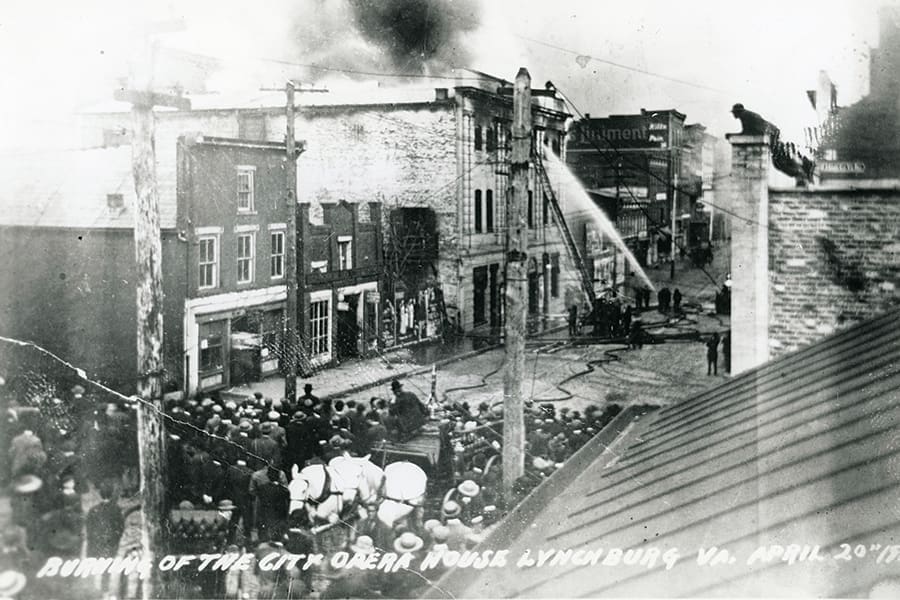
Photo Above: The original Academy burned in 1911.
Photos Courtesy of Academy Center of the Arts.
It’s a Friday evening in 1920 and Lynchburg, Virginia’s Little Broadway entertainment district is about to come alive. Along the hilly, cobblestoned streets of downtown, the setting sun offers golden views of the lower warehouse district and James River. The sumptuous smell of dinner-rush restaurants mixes with the thrum of live music as you round a Main Street corner to find a bustling corridor of nine theaters lined with extravagant façades, glowing marquees, barkers and chicly dressed patrons.

Nine fancy theaters in downtown Lynchburg?
Thank the major transportation mode of the day, the luck of geography and manufacture of cigarettes.
Railways are the king of travel and Lynchburg happens to be on the rough midpoint of the route between the bustling entertainment centers of New York and New Orleans.
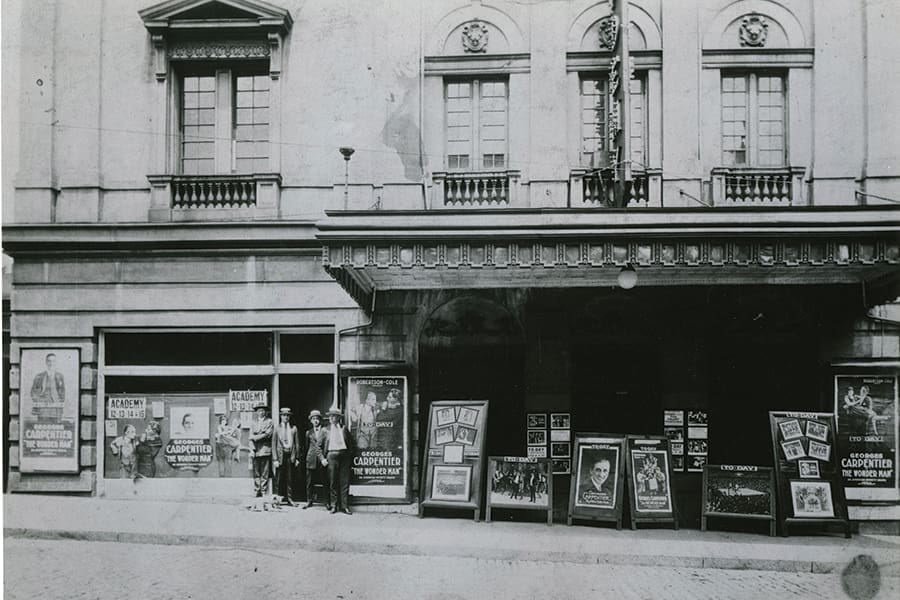
Add in the flourishing industries of tobacco and manufacturing along with Lynchburg’s status as the gateway to Richmond and the greater Chesapeake Bay, and you have the wealthiest per capita city in the U.S.
And thus a ready-made market for top-tier performances. The city attracts stopovers from a hit parade of elite-level thespians, dancers, lecturers and musicians. A given night could bring megastars like actor Douglas Fairbanks, legendary American-born French ballerina Josephine Baker or up-and-coming jazzers like Duke Ellington and Louis Armstrong.
The enclave effectively grew out of a turn-of-the-century pet project taken on by a small group of wealthy Lynchburg businessmen who knew an opportunity when they saw one, according to Academy Center of the Arts historian and curator, A’Nyeja Adams, who collaborated with The Lynchburg Museum on a past exhibition that told the district’s story and showcased the peak of its glory.
The city had fared well compared to most in the South after the Civil War and the group wanted to make major metropolitan talent available at home. Problem was, they didn’t have a flagship theater, so streetcar tycoon, Richard B. Apperson, suggested they band together to build one. The result was the stunningly state-of-the-art Academy of Music, which opened in 1905.
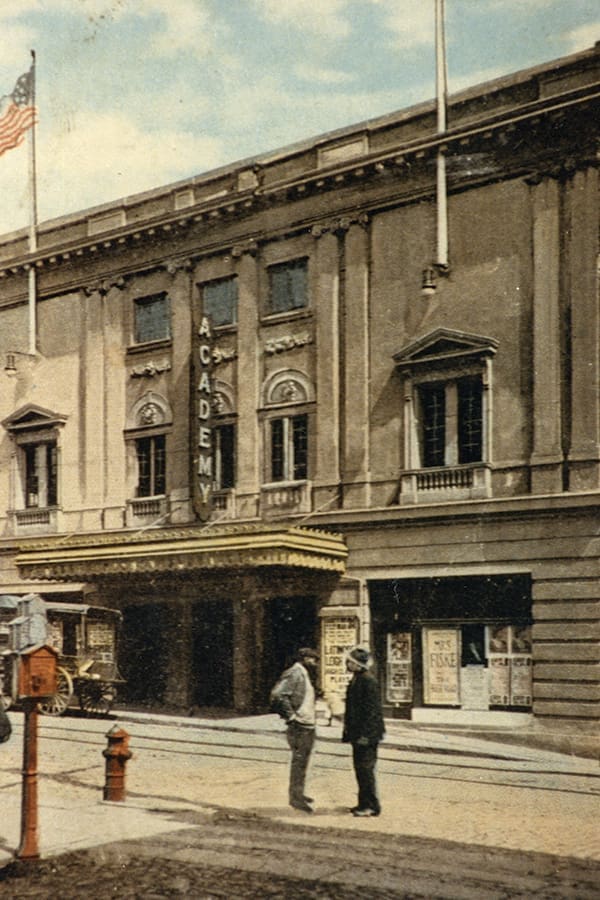
The new, electrified theater boasted an ornate Beaux Arts style façade, Neoclassical interior, perfect sightlines, pristine acoustics that rivaled the finest in New York and Chicago. Its finery and an aggressive marketing campaign quickly convinced titans like comedian Will Rogers to visit. Renowned symphony orchestras also made appearances. Subsidized ticket prices brought packed houses and a flood of stayovers from out-of-towners.
Within five years, The Academy had become one of the most popular entertainment destinations in the state. And a belle époque commenced.
Chic restaurants and hotels opened to house and feed affluent guests. New theaters — like the wild and regal Neo-Moorish-style National which opened in 1916 — sought to capitalize on demand, expanding offerings and fueling further growth. Downtown transformed into a poster child for Southern urban renaissance.
The Golden Age of Vaudeville and Roaring Twenties brought more and more venues. By the time The Paramount opened in 1930, Lynchburg was home to a vibrant entertainment district centered by nine grand theaters.
Then came the full-bore cinema revolution — which saw movies replace live performances — followed by the impositions of World War II and television. Decline set in and, while some theaters survived by transitioning to motion picture houses, others shuttered.

Automotive advances, improved highway systems and the rise of mass aviation killed the rail passenger lines, strangled Lynchburg’s dominance as a shipping hub and — along with suburbanization — ultimately pitched downtown into a spiral of decay. By 1958, all of its once-prominent historic theaters had closed.
Over the ensuing decades, all but one of the architectural landmarks were demolished. And while the spotlight Academy endured, the building fell deeper and deeper into disrepair. More than a half-century had passed when the Main Street revitalization movement of the early 2000s swept across the nation and inspired an ambitious project to bring it back.
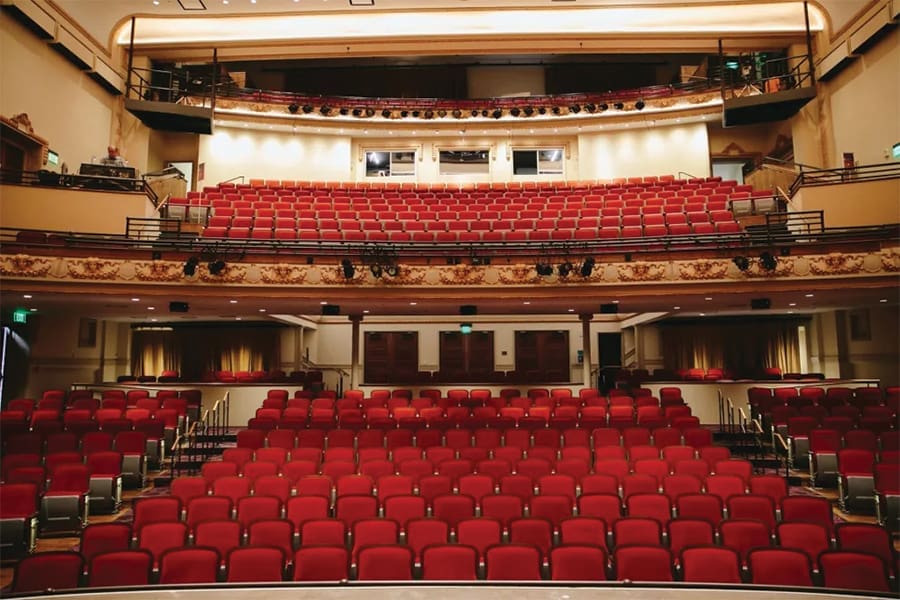
Nearly $50 million in renovations, additions and beautification over a 15-year span restored the destitute structure to its former glory and reclaimed its status as the city’s artistic epicenter. The Academy Center of the Arts reopened its doors to a sellout inaugural crowd in December of 2018. It now holds studios for local and visiting artists, a learning center, children’s theater and second stage area in addition to the inspiringly revived, 835-seat original historic theater. The latter hosts a weekly performance schedule studded with acclaimed contemporary stars like Lyle Lovett, Wynton Marsalis, Blind Boys of Alabama and Alison Krauss.
The stars have returned to Lynchburg, Virginia, a century later.
The story above first appeared in our January / February 2026 issue.




