Skip to content

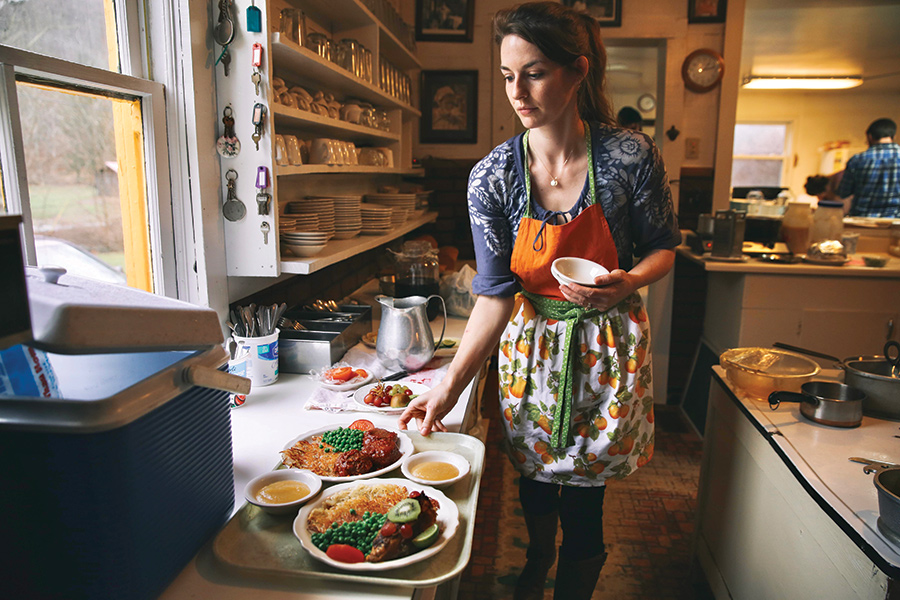
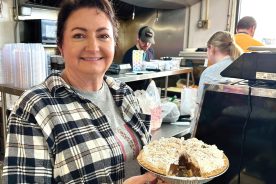
Clara Lehmann proudly serves dishes from the menu her grandmother created. Courtesy the Hütte Restaurant
A restaurant owner’s mission to honor her ethnic heritage continues, now for more than half a century.

Dreams. You’ve got to have dreams. And you’ve got to go after them. You can’t just dream them.”
The dream of Eleanor Fahrner Mailloux was to create The Hütte Restaurant in Helvetia, West Virginia. Eleanor died in 2011 as she neared 94. But as her granddaughter Clara Lehmann says, “She lives in the walls and in the people at the restaurant.”
Clara and her husband Jonathan Lacocque tell her grandmother’s life story in their documentary film “Born in a Ballroom,” finished in 2019. Eleanor’s family members all agree that she led a charmed and a charming life. Soon after Eleanor’s mother went into labor at their home in Virginia in 1917, the house caught fire. Eleanor’s mother got out of bed and walked to the plantation house where Eleanor was, indeed, born in the ballroom.
“And I have never stopped dancing since,” she says in the documentary. Eleanor danced and sang and yodeled into the hearts of the citizens of tiny Helvetia, a community settled in 1869 by Swiss immigrants. Almost 100 years later, after a career in the Red Cross, Eleanor opened The Hütte, and it remains today the soul and centerpiece of the community.
The fresh flowers that grace each table at The Hütte, the collection of black-iron skillets purchased over the years at estate sales and the meticulously waxed floors are all testament to the enduring lessons and influence of Eleanor, who insisted on being called “Mütter,” to honor her father’s family heritage and her adopted hometown’s reason for being.
“She went whole hog about everything,” recalls Eleanor’s daughter Heidi Mailloux Arnett, who runs the restaurant. “She loved the riches of life—food and wine and nature,” adds Clara.
Although the population of Helvetia has remained below 100 people for years, Eleanor felt it was the center of the universe. “Thank God, it’s not easy to get here. It’s just wonderful,” she says.
Some 85 people live there today, and they celebrate their life together often, bringing home-baked cakes to the annual community ramp dinner in the spring and roasting a whole pig in a pit in the fall.
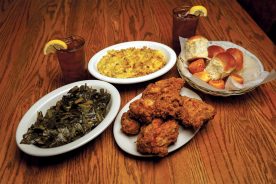
Several of the recipes used at The Hütte came from families in the community. From the umlaut in the name of the business to the sauerkraut served with a dill pickle slice on top, the menu strongly reflects the Swiss-German heritage of Helvetia.
The aroma of frying potatoes is ever-present in The Hütte’s kitchen as cooks prepare order after order of rösti, a Swiss potato dish fried in butter in one of those black-iron skillets.
Heidi and Clara buy fresh, lean pork shoulder sausage from the IGA store in Rock Cave, West Virginia, add nine spices to it, boil it and then cook it in a marinade of wine and tomato sauce.
“The smell envelops the whole restaurant,” says Heidi. “The meat we get from the Hawk family in Rock Cave is absolutely beautiful.”
Beef roasts marinate two days for sauerbraten, to be served in a sauce containing gingersnaps that is typical of central Europe.
The sauerkraut is served hot, and Heidi says, “We do a lot to make it wonderful. The applesauce is very unique and also served hot. We do a chicken marinated in white wine, baked, and served with curried pineapple, kiwi, grapes and lime. The curry reflects Mütter’s love of Asian flavors.”
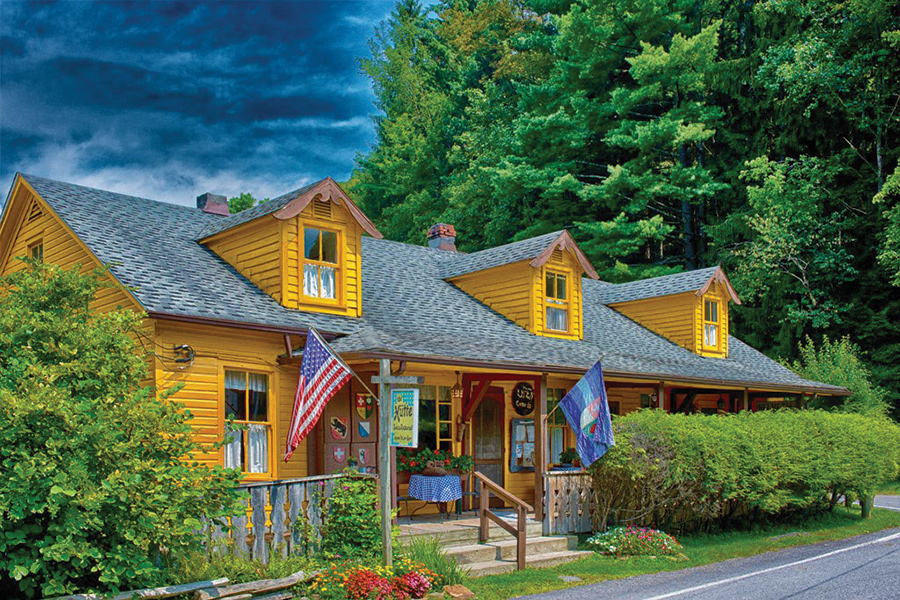
Eleanor liked to say that The Hütte is much more than a place to eat, and that remains true 11 years after her death. It’s an unofficial Randolph County history museum. Once functioning as a store, the building is well over 100 years old. An old hay rake is a reminder of the fact that the Swiss who came to Helvetia were not originally farmers but had to adapt there in order to survive. On the walls are Swiss primitive paintings done by the late Delores Baggerly, who helped Eleanor open the restaurant. And perhaps the most memorable antique is the community’s old telephone switchboard, which was in use until the 1970s.
“To reach another party in town, you had to call the operator, Stella Karlen, who would plug you in,” recalls Heidi. “Our ring was short-short-long. If you had a long-distance call, you had to go to Pickens.”
In February of 2006, we traveled to a small community near Buckhannon, West Virginia, to interview Roger and Donna Perry, in the wake of the Sago mine disaster that had occurred the previous month. Roger had been in the mine when the accident took place, but he and the men on his side of the wall made it out, covered in coal dust but alive. Of the 13 men on the other side of the wall that day, only one survived. One of those who perished was Roger’s brother-in-law, Donna’s brother, Alva Martin Bennett. Coal mining was the only job he ever had.
Among decades of interviews we have done, this one stands out as one of the most memorable and profound, as we talked with this brave couple about the unimaginable sadness they felt. They shared a scrapbook with us about eight inches thick, filled with newspaper clippings, documents, and family photographs.
During the interview, it had begun to snow. Roger and Donna told us we might want to rethink our plan to eat a late lunch in Helvetia, nearly an hour away. But we were determined to press on into the valley. After such an emotional interview, we needed the comfort of The Hütte. So in the middle of a snowstorm, we had a Swiss meal of sausage, rösti, sauerkraut, applesauce, cheese and peas. And we have never forgotten the special magic of The Hütte.
Fred and Jill Sauceman study and celebrate the foodways of Appalachia and beyond from their home base in Johnson City, Tennessee.
The story above first appeared in our July / August 2022 issue.