Skip to content


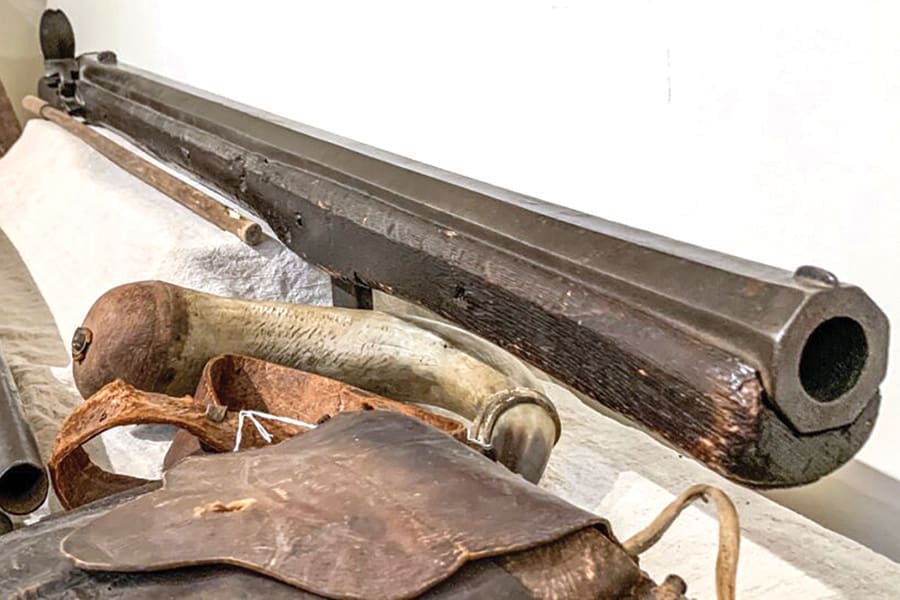
The huge German-barreled, and likely American-stocked, musket in the North House Museum in Lewisburg, West Virginia. The musket is thought by some to be the gun used by Dick Pointer during the attack on Donnally’s Fort.
Westward movement of settlers in the late 1700s resulted in grisly clashes with Shawnee Indians. An enslaved Black man was an unlikely and heroic participant in one clash.

The most celebrated war hero of Greenbrier County, West Virginia, is buried in an old African-American cemetery beside Carnegie Hall. On May 29, 1778, in the last significant Indian raid on the Greenbrier region, Dick Pointer almost single-handedly fought off a band of Shawnees attempting to storm Fort Donnally while the local militia slept upstairs.
Settlers who pushed into the Alleghenies in the 1700s took a deadly gamble. Those daring enough to settle in Indian lands felt the promise of land—beyond their reach back home in the British Isles—was worth the risk. That was the case with Col. Andrew Donnally, who left Tidewater Virginia with his family and servants, including Pointer, in 1771 and settled in northwestern Greenbrier County’s Rader Valley. Just a few years earlier, the Shawnees had tomahawked every man, woman and child in a nearby Muddy Creek settlement.
On the night in 1778 as the Shawnees battered the door of Fort Donnally with tomahawks and began to force it open, Pointer seized a musket. He fired through the cracked door into the crowd of Native Americans. They fell back, and Pointer was able to secure the log door with help from a white comrade.

Although all the men who slept upstairs when the fort was attacked were granted land as defenders of the country, Pointer continued to be enslaved for the next 23 years—until he was nearing 65. In 1795 he petitioned Virginia General Assembly for his freedom. It was denied.
Pointer was finally granted his greatest desire in 1801 when he was purchased by a sympathetic white man, James Rodgers, and freed. For his bravery, local citizens built him a cabin on a piece of farmland and granted him a life lease. Pointer lived there in Greenbrier County until his death at about age 89 in 1827.
He was buried in Lewisburg with full military honors. Volley after volley was fired over his grave in honor of the service he had rendered for the incipient country. A plaque and a large monument topped with a stone cannonball mark Pointer’s final resting place, and the huge musket he used to defend the fort is on permanent display a few hundred yards away at North House Museum.
One of the amazing things about Pointer’s deed—in addition to the strength required to hoist that 47-pound musket—was that enslaved people were almost never allowed to use firearms and therefore didn’t know how to fire them. Perhaps Pointer had been drafted into military service on the frontier by his master, or maybe he was a shrewd observer. Whatever his history with weaponry was, Pointer didn’t hesitate, but grabbed the nearest weapon as the Shawnees began shattering the door, according to oral histories.
Pointer was not alone, according to most reports. He was accompanied by two white men, a scout from the Ohio River Valley who had warned them of a possible attack, and a neighboring settler. The settler was reputedly standing at the door and first saw the Indians charging, but instead of firing his gun, he drawled out, “Yonder they come!” and pushed the door shut.
Whether Pointer decided when to fire or whether even in crisis he had to wait on the command of a white man is unknown. And the telling of the story was probably shaped by the culture of the era, a time in which a white man was supposed to be in charge. In the last year of Pointer’s life, pioneering journalist Anne Royall (see our piece on her in the July/August ‘22 issue) interviewed Pointer and several other men who were present in the fort and reported that Pointer quickly loaded the musket with old nails, pieces of iron and swan-grade buckshot and cocked the gun, but asked the two white men if he could shoot. They denied him twice, giving him the go-ahead the third time. He fired, killing three Shawnees and wounding several more.
Another report has Pointer being ordered to fire by the scout, while still others have him shooting through the gaps in the deteriorating door as soon as he loaded the gun. The recoil knocked him over, but he righted himself, and with the scout, secured the door with a large hogshead barrel. The shot awakened the people sleeping upstairs, and they ran downstairs and started firing, driving the Indians back to the forest. Troops from Camp Union commanded by Captain William Johnston arrived the next day and drove the Shawnees out of the Greenbrier region. Seventeen Indians were killed, and Pointer had the job of burying them all.
Though the details of the matter may forever be obscure, Pointer was always widely regarded as a hero throughout the Greenbrier Valley and beyond.
The story above first appeared in our November / December 2022 issue.