Skip to content

Courtesy: Ginny Neil
“The best way to pick apples is with a glass of last year’s cider in your belly.” —Unknown

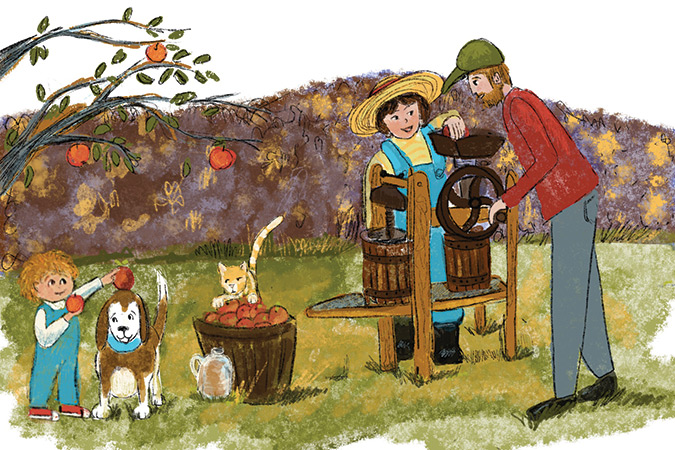
When every ditch is outlined with goldenrod and apple trees yield their fruit to a touch, then it’s time for our family’s annual Apple Day.
Wood is stacked and the cider press and copper kettle have been scoured clean. There are dishes of apple pandowdy, apple fritters, apple cake, apple bread, apple sauce and apple pie lining the tables in the shed. Conversation rises in steamy puffs as we wait for the morning’s work to begin.
When the fire burns down to coals, we place the stove around it and seat the copper kettle. Then we throw in a few new pennies and dump in the apple sauce. We hope to take the apple butter off by noon, but we know it has a mind of its own. We’ll just have to wait and see.
Twenty years ago, we made our apple butter from snits (peeled and sliced apples), but we have had good results using large cans of applesauce instead, and the amount of work is reduced to something we can handle without quitting our day jobs. Our fore-mothers, who peeled and snitted six bushels of apples for every kettle, were certainly made of sterner stuff.

I pull out the recipe that I copied when my mother-in-law taught us all she knew about making apple butter. It’s not a recipe in the ordinary sense of the word, but rather a list of proportions and things to look for as the apples cook down. The list is splattered and torn and getting harder and harder to read. The instructions for how much sugar and cinnamon to use per gallon of cooked apples were derived after years of tasting.
Apple butter should be neither as thick as peanut butter nor as thin as applesauce. So, there’s a test involving a plate and a spoon that lets us know when it is time to take it off the heat. It will thicken as it cools, so the spoon test is crucial to success.
While everyone is taking turns swirling the paddle through the kettle, we set up the cider press. The apples are washed and dropped in the hopper. Just like at an ice-cream social, everyone takes turns with the handle, and the apples tumble down through the grinding teeth until they are cut into little chunks which fall into a basket below. When it is full, the tallest and strongest of us push it under the press and do the hard work of turning. The rest of us keep empty jugs lined up to catch the flow of juice running out the spout.
The apples we use for cider were shaken out of old, untended trees on our property that produce small knotty fruit. The more varieties of apples in the mix, the better the taste, and we all sneak our cups into the dribbling stream for sips which improve each time apples are added.

After each pressing, the wooden basket is released and the pummies are dumped into buckets to be fed to the livestock. Pummies are what the locals call the mashed up remains after the juice has flowed. I suspect the word comes from “pomace.”
By mid-afternoon, the butter is jarred and the cider is bottled. Now we feast. Of course with a fire right there, we roast hotdogs and marshmallows and apples. We linger long after the work is done. The laughter and the sweet smell of smoke are hard to leave.
We started Apple Days as a way to bring our ever growing families together. My boys remember making apple butter with their grandmother who learned to make it from her mother. Our new family tradition is based on old family history.
We had to skip last year, for obvious reasons, so this year’s apple butter and cider will be especially sweet. In a world that’s been damaged by fear and loss, tradition is one glue that can help bind it all back together again.
The story above first appeared in our September / October 2021 issue.