Going Rural: Copperhead Confrontation

Cathy Hankla: “When I first moved from the suburbs, I was not capable of killing a mouse, 
let alone a snake.”

Cathryn Hankla is an intrepid traveler and the author of more than a dozen books. This excerpt is from her latest book, a memoir in essays, Lost Places: On Losing and Finding Home (Mercer University Press, 2018)

Picking up the last remnants of shriveled oak leaves wedged between the heat pump and the house, I had one of those very human moments when you find yourself alone, surrounded by nature. There’s a certain stillness I’ve come to recognize that means you are being watched. The human is object not subject; the gaze of nature turns back or the silence of nature is held in suspense as you stumble into it. Late autumn chilled the air, in the shadow of Virginia’s iconic McAfee Knob, and just past my left foot a young copperhead lazed on a warm orangey-brown slab of flagstone, perfect cover for the snake, as rock and snake share the same mottled color. The snake’s head tensed up, sensing in my direction. I glanced to check its pupils and confirmed that they were elliptical like a cat’s. There was no mistaking this narrow fellow for a non-poisonous variety. 
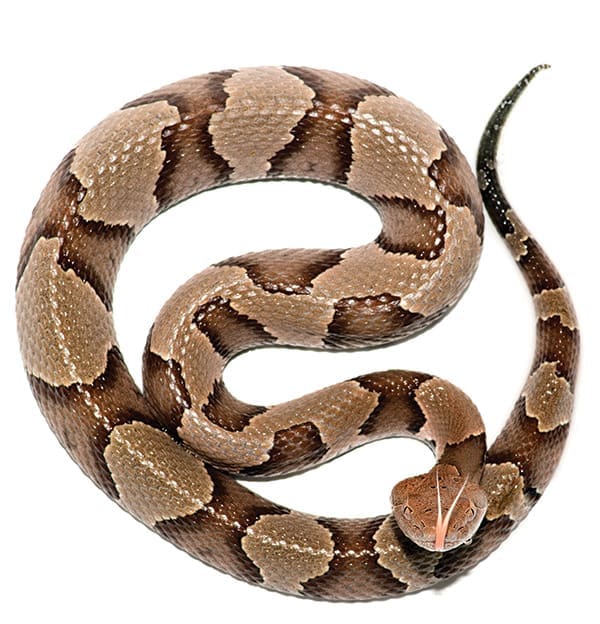
Copperheads are born live and emerge from a viscous pool of something akin to the primordial soup. Until I saw this, I thought they came out of eggs. 

The copperhead was very near, but I worked my way around it. Stealthy in my motions, I dashed inside for my largest kitchen knife, afraid the snake might slither too far if I trekked all the way to the shed for the hoe. The knife was one of those heavy cleaver jobs best wielded by professional chefs that amateurs keep in their kitchens for inspiration. My chef’s knife had come with a German-honed set and so far I’d only used the paring knife.

Leaving out the details, I used the big chopper on the copperhead, knowing they usually travel in pairs and hoping this one was still young enough to be dating around, but old enough to have wandered far from its nest. Seeing it so close to the foundation gave me a shiver. I wish I could say that I regret having done it. When I first moved from the suburbs, I was not capable of killing a mouse, let alone a snake. I carried all ladybugs and stinkbugs outside, leaving the spiders be and puzzling over the ants, large and small. 

Clearly, country living has not been the constant pastoral, the peaceable kingdom I once imagined. The first thing I saw when I moved to the Catawba Valley of Virginia was a bunch of slaughtered hogs hanging on big hooks at the side of a barn. My new neighbors smiled and waved as I drove by in my Honda Civic. I traded the sedan for a 4-wheel drive that bounced me around inside as if I were a pebble. It could nevertheless drive up a tree in a snowstorm, and a version of that option has saved me more than once. 

Excerpted from “LOST PLACES: On Losing and Finding Home,” by Cathryn Hankla, with permission of Mercer University Press.


The story above appears in our Sept./Oct. 2018 issue.


You Might Also Like:

Mia Hall: Executive Director of Penland School for Craft

The Mountain Q&A – Mia Hall: Executive Director of Penland School for Craft

She came from Sweden to America as an international student, and now leads one of the country’s oldest and most prestigious art schools.
Courtesy of Jeff Eastman

The Mountain Q&A – Jeff Eastman: CEO, Remote Area Medical

Remote Area Medical, with roots in the Southern Appalachians, has provided free health care since 1985 to over 1 million people through mobile pop-up clinics across the nation. “Free Is In Our DNA.”
b8c626fe-9f9c-11f0-88d9-1248ae80e59d-photo-of-Betty-and-Robert-Balentine

The Mountain Q&A – Betty & Robert Balentine: Founders of Southern Highlands Reserve

The 120-acre mountaintop property is the only high-elevation native plant garden in the eastern United States.
09723834-6e21-11f0-ba49-1248ae80e59d-portrait

The Mountain Q&A – Dolly Parton: The Nation’s Sweetheart, Among So Many Other Things

The award-winning songwriter, entertainer, global philanthropist and creator of Imagination Library is also celebrating the 40th anniversary of her theme park Dollywood.
Chattanooga Mayor, Tim Kelly

The Mountain Q&A – Tim Kelly: Mayor of Chattanooga, Tennessee

Mayor since 2021, Kelly led Chattanooga in becoming North America’s first National Park City in 2025 and a global destination. He calls his hometown “a city inside a park.”
Virginia State Parks Director, Dr. Melissa Baker

The Mountain Q&A – Dr. Melissa Baker: Director of Virginia State Parks

She leads Virginia State Parks, the first state in the nation to open a system of parks. “From the mountains to the piedmont, you can get just about anything you want in Virginia.”
Lindsey Gallaher

The Mountain Q&A – Lindsey Gallaher: President of The Museum of Appalachia

This granddaughter of Museum of Appalachia founder John Rice Irwin now leads the 54-year-old East Tennessee museum, keeping the stories alive and showing visitors how people of Southern Appalachia lived in the 1800s.
99cf05e8-cec5-11ef-b165-12163087a831-Blenko-Glass-President-John-Blenko

The Mountain Q&A – John Blenko: President of Blenko Glass in Milton, West Virginia

John Blenko is the fourth generation to lead this 131-year-old company in making hand-blown glass popular throughout the world.
44ca52dc-9879-11ef-9a5f-12163087a831-t

The Mountain Q&A – Tom Bailey: Executive Director of the Southern Highland Craft Guild

Tom Bailey is leading the second-oldest craft organization in America toward its 100th birthday with big dreams for its future in multiple locations.
1e7cab66-7137-11ef-aad4-12163087a831-Kasey-with-Leaf

The Mountain Q&A – Kasey Krouse: Tree Advocate Wears Many Hats

Knoxville’s urban forester since 2012 promotes the benefits of trees while growing the region’s tree canopy. He was educated at Purdue and, with his wife, Beth, is the father of two young daughters.

CALENDAR OF EVENTS