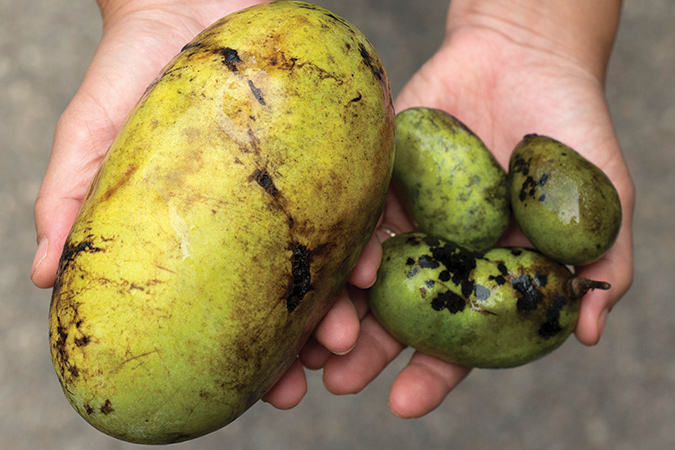
The fruit—called everything from “hillbilly mango” to “West Virginia banana”—seems to be getting more of the respect it deserves.
We’ll readily admit being newcomers to the pawpaw. Yes, we know the song. We know what happens “way down yonder” in the patch. But our first tastes of the fruit didn’t occur until later in life.

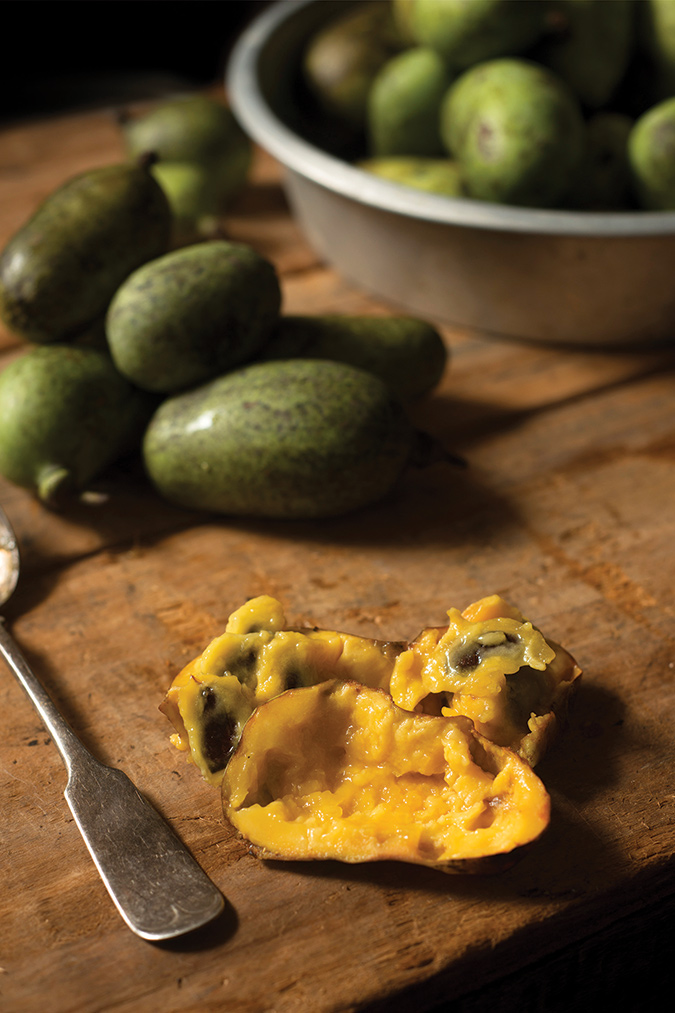
Apparently we’re not alone. “Mysterious” is a word often used to describe the largest edible fruit native to North America. But two food magazines, in articles three years apart, referred to the pawpaw as “magical.”
To make up for our woeful lack of knowledge about pawpaws, we consulted the experts, beginning where so much of our food in this region begins: with Native Americans.
According to the American Indian Health and Diet Project, “It is believed that the American Indians planted and cultivated the pawpaw. The Iroquois mashed the fruit into small, dried cakes or dried the fruit by itself. The dried cakes were sometimes soaked in water and used as a sauce or mixed with cornbread.”
Several sources we found mention the year 1541 as the time when Spanish explorer Hernando de Soto first encountered pawpaws. In “A Pawpaw Primer,” published in the anthology “Cornbread Nation 3,” Colleen Anderson describes de Soto seeing baskets Native Americans had woven from strips of pawpaw bark.
In an article for Smithsonian Gardens, Jessica Brode writes: “Native people in the Mississippi Valley and elsewhere planted and cultivated pawpaws in ways that are still visible in the landscape today.”
Brode theorizes that the Spanish could have named the fruit “papaya,” which evolved into the word pawpaw, or perhaps it’s a corrupted spelling of another Caribbean fruit. “What is known,” she continues, “is that the tree’s scientific name (Asimina triloba) comes from the Powhatan word Assimina, which a Jamestown settler transcribed in 1612 as ‘wheat plum.’”
The pawpaw sustained Lewis and Clark during their travels, and apparently George Washington had a passion for them.
“Like Lewis and Clark, the many settlers to follow, and the native peoples before him, Washington and his armies would have found this rich fruit a welcome blessing when provisions were low,” writes Andrew Moore in the Washington Post. Moore became so enthralled with the pawpaw that he wrote an entire book about it. “Pawpaw: In Search of America’s Forgotten Fruit” was published in 2017. Moore says there is a pawpaw patch growing near Washington’s tomb at Mount Vernon.
The shop at Monticello, Thomas Jefferson’s Virginia home, now sells pawpaw plants. Jefferson listed the pawpaw as an ornamental native in his “Notes on the State of Virginia.”
Described as both a large shrub and a deciduous tree, the pawpaw typically reaches 15 to 20 feet in height, but the University of Kentucky College of Agriculture, Food, and Environment notes that the Kentucky champion tree in Letcher County is over 30 feet tall. Pawpaws are found in some 26 U.S. states.
The pawpaw has spawned a variety of nicknames, including hillbilly mango, West Virginia banana, and custard apple. The flesh does have a custardy texture.
Writers in a Southeastern Naturalist article refer to the pawpaw as an “evolutionary anachronism,” part of the diet of giant sloths, mastodons and woolly mammoths, now extinct.
The pawpaw does seem strangely out of place, not just chronologically but also in its flavor. Or maybe the better word would be flavors. The dominant taste, most people say, resembles banana, with undertones of pineapple and mango. Elizabeth Matthews, a botanist with the National Park Service, says she detects hints of vanilla.
Others downplay the banana comparison. Interestingly, the importation of bananas into America may have been partially responsible for the pawpaw’s obscurity. “The banana was everything the pawpaw wasn’t: seedless, tough-skinned, easy to peel, able to travel well and ripen slowly,” asserts Anderson.
Even Burl Ives belting out “Way Down Yonder in the Pawpaw Patch” in the 1950s didn’t bring the fruit very far into the American dietary mainstream.
Pawpaws are often eaten raw. Their most common kitchen usages are in puddings and breads. The first pawpaws we ever tried were grown at Cantarroso Farm in Erwin, Tennessee. At Boone Street Market in Jonesborough, they were going one fall for $2 each, alongside samples of pawpaw pudding cake, baked by Chef Neal Smith. At Johnson City’s Gourmet and Company, Chef John Bryant has created a pawpaw crème brûlée. And as you might guess, pawpaw is now flavoring gelato.
In Morgantown, West Virginia, Chef Marion Ohlinger is wild about pawpaws. He and his wife Alegria created the Pawpaw Palooza, a series of specialty dinners held at their restaurant, Hill & Hollow. Consider some items from past menus: pawpaw ice cream, pawpaw flan, pawpaw semifreddo, pawpaw cheesecake with chipotle.
The Ohlingers live on the Big Bend of the Ohio River, on a farm that has been in Marion’s family since the 1700s. It’s a farm typically full of pawpaws in the fall. Marion says he enjoys reintroducing the pawpaw at the West Virginia Arboretum, where children are quite surprised to see a native fruit of this size with such an “exotic” taste.
As Native Americans discovered, pawpaws can be dehydrated. They can be preserved in jams and jellies. And they can be pressure-canned. Research is underway to explore the pawpaw’s potential role as an anticarcinogen.
Rediscovered and newly respected today, the pawpaw offers a true taste of American history.
Jill Sauceman, a native of Hiltons, Virginia, and her husband Fred celebrate and document the foodways of Appalachia and beyond from their home base in Johnson City, Tennessee.
The story above first appeared in our Nov. / Dec. 2021 issue.