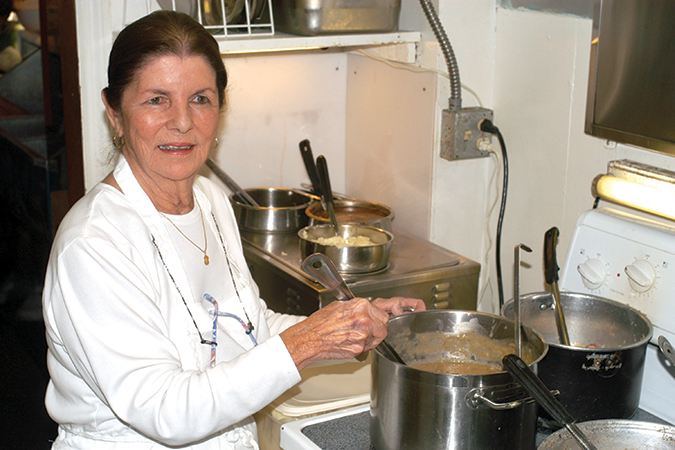
The late Shirley Fuller, the granddaughter of Charlie Zarzour, works in the Zarzour’s’s kitchen in 2007. Photo Courtesy: Fred Sauceman
Chattanooga restaurants and products tell the story of the city’s past and present.

Surviving a pandemic is nothing new for Zarzour’s in Chattanooga, Tennessee. The business has navigated COVID-19 with the same kind of determination that drove its original owner to keep the doors open when the influenza pandemic struck just weeks after the restaurant opened in 1918.
The year 2022 marks the 104th anniversary of this humble Chattanooga eatery. It has never closed. And it has remained in the same family throughout that entire time.
The architecture of Zarzour’s still clearly reflects its beginning as a home, and so do the casual, across-the-table conversations among customers, many of whom eat there every day.
To our knowledge, Zarzour’s is the oldest restaurant in Tennessee in continuous operation by the same family.
Nashville’s Varallo’s, a chili parlor, opened in 1907, but it has changed hands. The Arcade in Memphis is one year younger than Zarzour’s, having opened in 1919.
It’s worth noting that each of these restaurants was started by immigrant families: Varallo’s by Italians, The Arcade by Greeks, and Zarzour’s by a Lebanese pack-peddler.
In the early part of the 20th century, many Middle Eastern immigrants sold sundries door to door all across the South, bringing consumer goods and a view of the outside world to the most isolated of areas.
Charlie Zarzour and his wife Nazera led that kind of itinerant, unsettled life, peddling goods throughout Alabama and eventually making their way northeast, to the thriving river town of Chattanooga, Tennessee. Using the savings they had earned, Nazera bought the small house that is now occupied by the restaurant. It was all the young couple could afford. They and their five children settled in for what they hoped would be a happy future in Chattanooga.
But Nazera contracted what was known as the “Spanish flu,” and it killed her. The youngest of those five children was still in diapers.
Charlie soldiered on, converting the house to a business, first selling beer, Coca-Cola and hamburgers. Then came beef stew and chili. His naturalization certificate, dated November 13, 1946, occupies a sacred spot on the wall at Zarzour’s today.
“People, when they come through that door, feel the warmth in here,” said the late Shirley Fuller, Charlie’s granddaughter, as she took us through the restaurant back in 2007. Her son Joe, once road manager for the musical group Alabama, and his wife Shannon run the restaurant today, advertising handwritten daily specials on Facebook just as Joe’s great-grandfather posted them in his window a century ago.
Despite the family’s Middle Eastern heritage, Zarzour’s has never served cabbage rolls or kibbe. The stock in trade has always been pure southern: chicken and dumplings, pinto beans, butter beans, turnip greens and banana pudding.
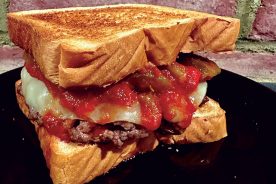
And it was the hamburger that first brought Zarzour’s to our attention years ago, when writer George Motz named it one of the best in America.
Southern cooking is also the theme at a downtown Chattanooga favorite of ours called The Public House. Chattanooga native Nathan Lindley opened the restaurant in 2009 after working with one of the South’s pre-eminent chefs, Frank Stitt, owner of Highlands Bar and Grill and other restaurants in Birmingham, Alabama.
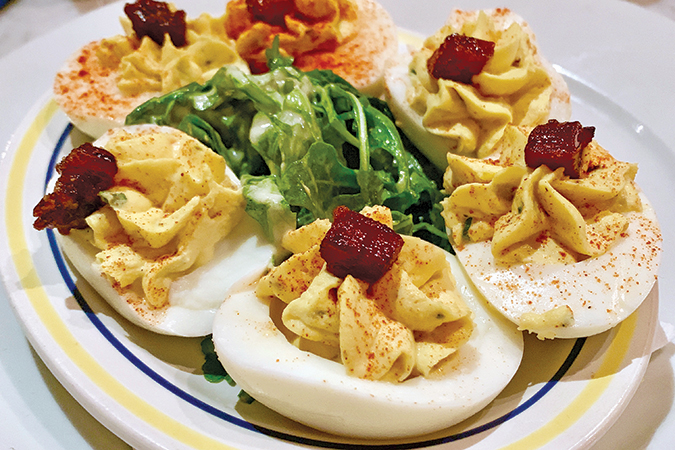
On its appetizer menu, this Market Street restaurant features some of the finest deviled eggs we’ve found, crowned with candied bacon from the smokehouse of Allan Benton, proprietor of Benton’s Smoky Mountain Country Hams, just up Highway 411 in Madisonville, Tennessee.
The Public House is one of the few restaurants where you can find Benedictine spread, a concoction of cream cheese, cucumbers, and onions, named not for monks but for Jennie Benedict, an early-20th-century caterer and tearoom operator who created the green-tinted spread in Louisville, Kentucky.
The practice of crumbling cornbread into a bowl of soup beans is one of the defining elements of southern eating. Though The Public House may be upscale in a sense, it’s possible to enjoy a blue-collar repast of soup beans and crumbled cornbread worthy of any elbow-polished, stainless steel lunch counter around.
We’ve had many memorable meals in Chattanooga, going back to the Sunday Brunch Era in the Green Room at The Read House Hotel up to the present day with plates of Mississippi Delta hot tamales and blues tunes at Champy’s World Famous Fried Chicken.
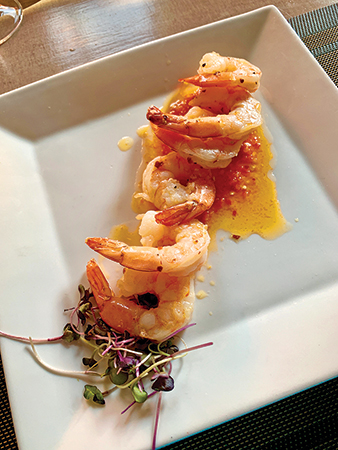
In the city’s NorthShore neighborhood exists a rarity for Tennessee: a restaurant specializing in Portuguese cooking. Cooks at Bela Lisboa make their own piri piri sauce—hot, sour, sweet, and a little salty—and serve it over shrimp as an appetizer. Shrimp Mozambique, named for the southern African nation that was once a Portuguese colony, is a lovely dish seasoned with turmeric, garlic and saffron and served over rice.
One of the national dishes of Portugal, combining land and sea, is pork and clams. Bela Lisboa serves it with a garlic sauce, alongside paprika-seasoned fried potatoes. The pork and clams entrée is often cooked in one of the world’s most ingenious vessels, a cataplana. Made of copper, it resembles two large woks, hinged together with two locks on the sides. It has been called “an ancient pressure cooker.”
Chattanooga claimed a prominent spot in Tennessee food history long ago. Just a few months before Charlie Zarzour converted his house into a restaurant, Earl Mitchell, general manager of the Mountain City Flour Mill in Chattanooga, returned to the city after a sales trip to Eastern Kentucky with an idea he’d picked up from a coal miner. The miner talked of his love for dipping graham crackers in melted marshmallow and covering them in chocolate.
Framing the moon with his hands, the miner is reported to have said, “Make it this big.” Mitchell pitched the idea to employees at the Chattanooga Bakery, which had been created a few years earlier to make use of excess flour from the mill. Someone at the bakery, whose identity has been lost to time, suggested that it be called a MoonPie, and in 1917, Chattanooga’s most far-reaching food was born.
Thanks to a song by Lonzo and Oscar, MoonPies have long been associated with R.C. Cola. But if you dig into Chattanooga history, you’ll discover a pairing that might make better sense. In 1933, the first bottle of Double Cola rolled off the line. It was so named because, at 12 ounces, it was twice the size of other colas on the market.
Double Cola is still headquartered in Chattanooga, and, like the MoonPie, it’s sold nationwide now, in every Cracker Barrel restaurant.
We can think of no better toast to this fascinating city than a swig of Double Cola and a lightly microwaved MoonPie.
Fred and Jill Sauceman study and celebrate the foodways of Appalachia and beyond from their home base in Johnson City, Tennessee.
The story above first appeared in our January / February 2022 issue.