Skip to content

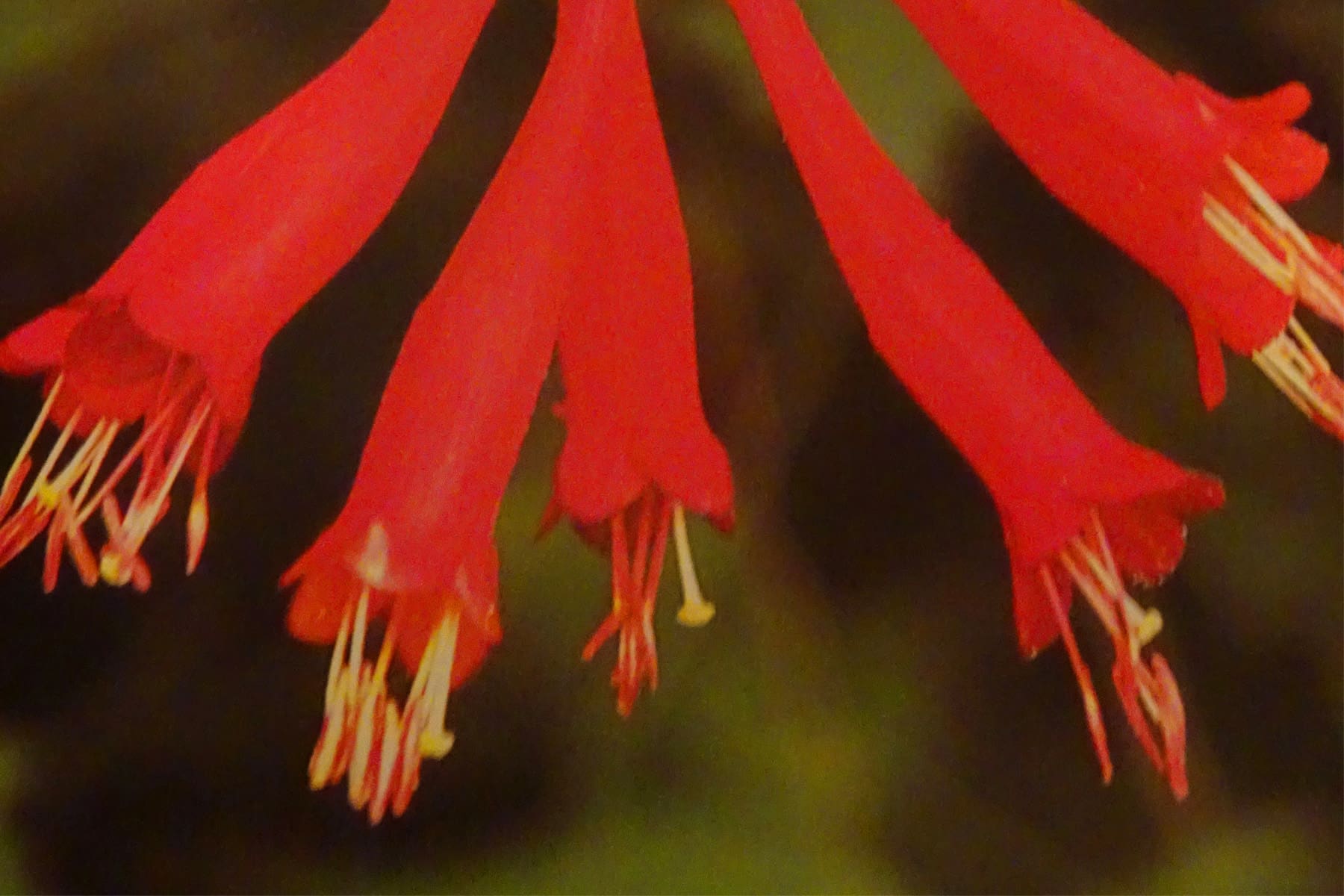
Like spotted jewelweed and trumpet tine, the flower’s deep throat and red color make it attractive to ruby-throated hummingbirds, who are its main pollinators.
Photo Credit Joe Cook
The trumpet honeysuckle (Lonicera sempervirens) is a hard flower to miss, its whorl of long floral tubes, bright red on the outside and yellow on the inside, loudly proclaiming their presence against the background of the vine’s rich green leaves. Like spotted jewelweed and trumpet tine, the flower’s deep throat and red color make it attractive to ruby-throated hummingbirds, who are its main pollinators.

Linnaeus gave it the genus name of Lonicera to honor Adam Lonicer (some references say Lonitzer), a 16th-century physician who published a book on natural history. The species name is from the Latin semper, for “ever” or “always,” and virens, meaning “green,” and refers to the plants evergreen leaves (although, the leaves do not stay green in the more northern parts of the United States).
Trumpet honeysuckle is a climbing vine that, while sometimes present in open forestlands, is most often found along woodland borders and thickets and growing upon fences and stonewalls. Unlike the invasive Japanese honeysuckle (Lonicera japonica), it is native to our area and not a pest plant. Other common names include woodbine, coral honeysuckle, and a very descriptive one, firecracker vine.
An interesting aspect of the plant is how the final upper leaves of the stalk (found just below the whorl of flowers) join together to appear to encircle the stem. This trait is shared with glaucus honeysuckle (Lonicera dioica), which has greenish yellow flowers, and yellow honeysuckle (Lonicera flava), with clusters of bright yellow flowers. All are found in the Blue Ridge region.
Flower Fast Facts
FLOWER: The 1- to 2-inch floral tubes have five short lobes and grow in whorls at the end of a stalk.
LEAVES AND STEM: The 1- to 3-inch, oblong leaves are dark green above, whitish underneath, and grow oppositely along the climbing vine.
BLOOM SEASON: April to early September
About This Series
“Mountain Wildflowers” features a wildflower from the Blue Ridge region each month from March to October. Leonard M. Adkins has written for Blue Ridge Country for more than two decades and is the author of 20 books about travel, hiking and nature. His Wildflowers of the Appalachian Trail, which received the prestigious National Outdoor Book Award, provides the photographs and some of the information he writes about in each “Mountain Wildflowers.” It and his other works may be obtained through his website.