Skip to content


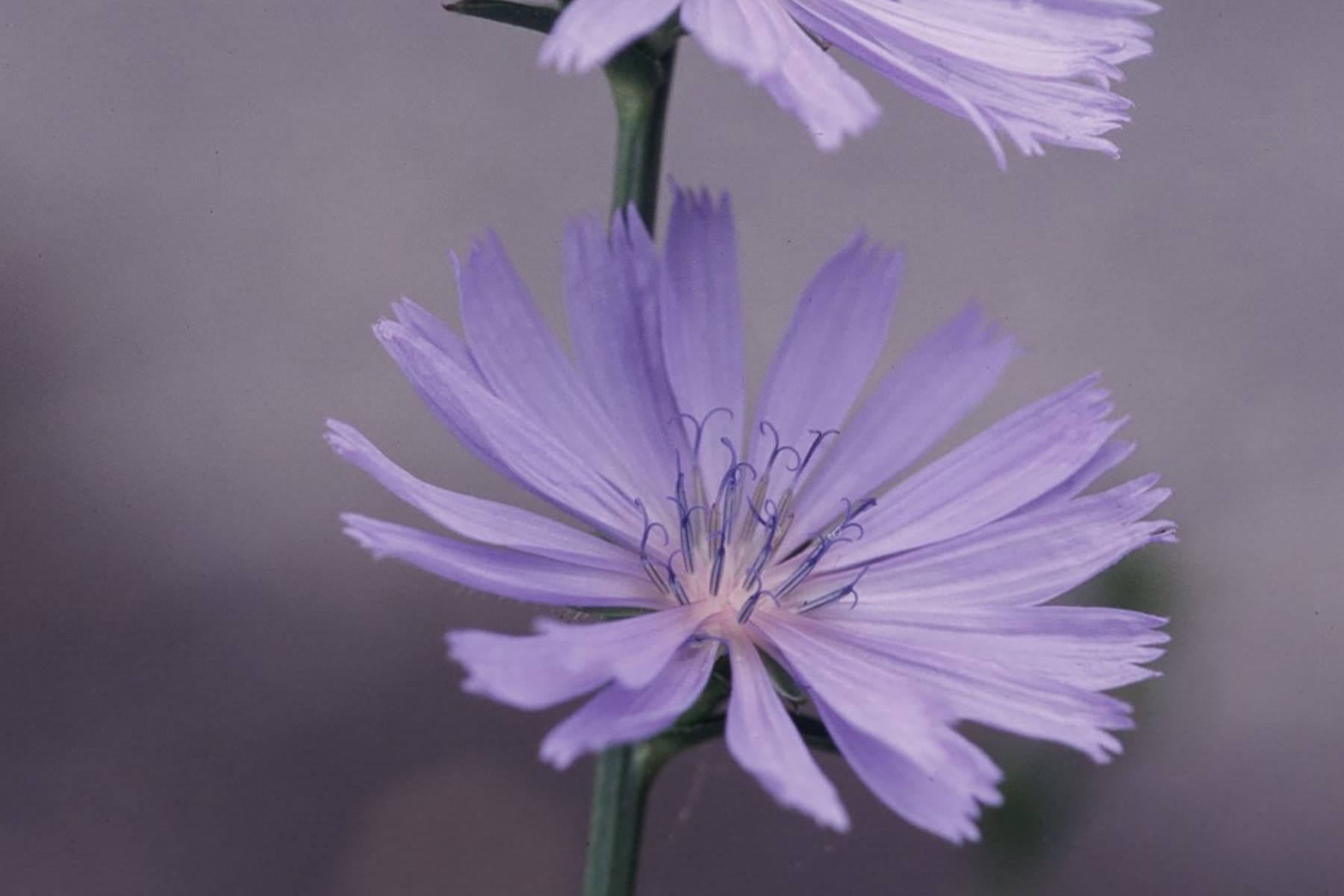
The blossoms grow at intervals along the upper portion of the stem, opening early in the morning to entice passing bees and other insects. Yet each flower lasts but a day.
Photo Credit Joe Cook and Monica Sheppard
Because it is such a common plant—often considered just a weed in its habitat along roadsides, in waste places, and in open fields—chicory (Cichorium intybus) is easy to overlook. Yet, of the plants found in our area, its flower possesses a blue of the clearest kind. In his book A Countryman’s Flowers, Hal Borland was moved to say the flower was as “blue as the innocent eyes of a six-year-old.”

The blossoms grow at intervals along the upper portion of the stem, opening early in the morning to entice passing bees and other insects. Yet each flower lasts but a day. By early afternoon the petals have begun to wither, and they will have completely fallen off by the time darkness approaches. New blossoms will appear at different spots along the stem the next morning.
The early colonists imported chicory from the Old World, where it had been cultivated as livestock feed for centuries. Turning it into a popular beverage, Egyptians harvested the plant from gardens along the Nile River more than 5,000 years ago, and the Greeks who were contemporaries of Christ used it for medicinal purposes. Recent investigations have found that the plant has antibacterial properties and that a substance in its roots can lower heart rates.
Chicory’s leaves have been added to salads, while its roots have been dried and roasted as a substitute for, or an additive to, coffee. You will find an abundance of references to people enjoying chicory coffee, but it is an acquired appreciation. The beverage is much stronger and quite a bit more bitter than the ground coffee most of us are used to buying in the supermarket.
Flower Fast Facts
FLOWER: The 1.5-inch-wide flowers have anywhere from 12 to 20 rays, whose square tips are finely fringed.
LEAVES AND STEM: Looking a bit like the leaves of dandelions or endive lettuce—to which chicory is related—the basal leaves are 3-6 inches long, while the ones along the 1- to 4-foot stem are shorter.
BLOOM SEASON: June-October
About This Series
“Mountain Wildflowers” features a wildflower from the Blue Ridge region each month from March to October. Leonard M. Adkins has written for Blue Ridge Country for more than two decades and is the author of 20 books about travel, hiking and nature. His Wildflowers of the Appalachian Trail, which received the prestigious National Outdoor Book Award, provides the photographs and some of the information he writes about in each “Mountain Wildflowers.” It and his other works may be obtained through his website.