April’s Wild Edible: Wild Onions

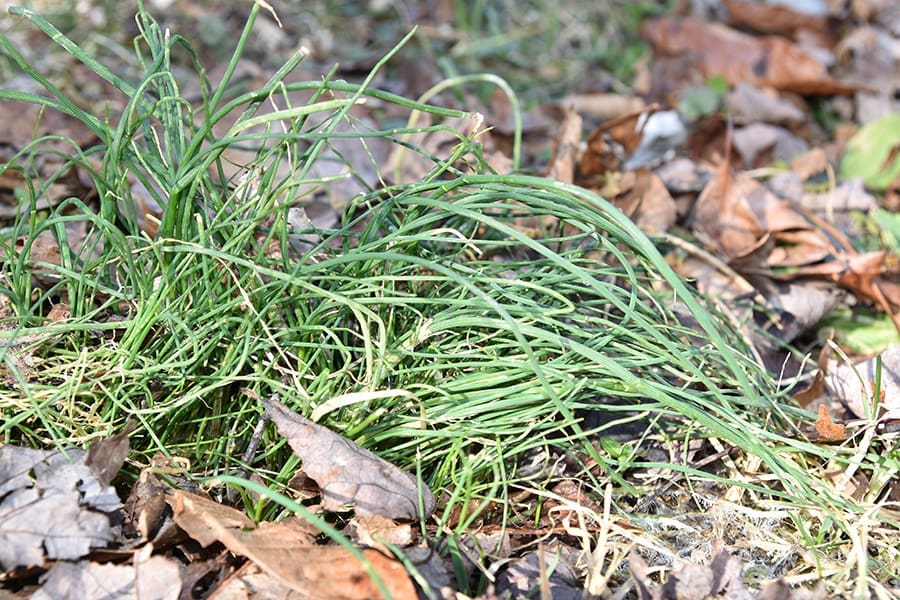
Wild onions growing in the author’s Botetourt County, Virginia front yard.

Early April is the time many folks in the Blue Ridge plant white onion sets, and justifiably so as their mild, sweet flavor can enliven any entrée. But if you’ve been hankering for fresh white onion flavor, there’s another option likely living in your own yard… the wild white version. Both the domestic and wild one are members of the Allium genus, as are, for that matter, ramps, shallots, and leeks.

Photo Above Wild onions growing in the author’s Botetourt County, Virginia front yard. ©Bruce Ingram.

I’ve found wild white onions as early as January during mild winters, but I’ve also discovered them in February peeping up through snow. But April is when they seem to explode in number, appearing not only in yards (and often unwanted in gardens) as well as fields, pastures, and forest edges.

Like the domestic version, both the stems and the bulbs are edible. Elaine and I’ve found the stems almost as mild in flavor as the domestic versions. However, the free-growing bulbs are considerably stronger than their garden counterparts, and I think the former is too “hot” to eat raw, say, in salads.

But wild onion bulbs and stems go well in any entrée where one might use cooked onions such as soups, casseroles, and egg dishes. So look for the clump growing wild onion this month, especially if you like onions with a little oomph to them.


Bruce and Elaine Ingram will profile a different wild edible every month. For more information on their book Living the Locavore Lifestyle, contact them at bruceingramoutdoors@gmail.com.

You Might Also Like:

White jelly snow fungus growing in the author’s Botetourt County, Virginia woodlot.

May’s Wild Edible: White Jelly Snow Fungus

“Pass the fungus,” is not common dinnertime conversation in the Blue Ridge Mountains region, but that’s because folks perhaps have not heard of the white jelly snow fungus.
Owner Jennifer Hughes is a constant and comforting presence at Elizabethton’s City Market.

Connecting a Community Through Chicken Salad and Chocolate Pie

City Market in East Tennessee has always stepped up to take care of its neighbors.
Wild garlic growing in Fayette County, West Virginia.

April’s Wild Edible: Wild Garlic

Fayette County, West Virginia’s Mitchell Dech is one of my foraging mentors, and when he wants me to try an edible new to me … I’m ready to learn about it.
The Giovanni is an Italian-American creation born in West Virginia.

Discovering the West Virginia Giovanni

This flavorful sandwich is a product of the rich Italian heritage of the Mountain State.
A May apple in bloom in Southwest Virginia.

March’s Wild Edible: May Apple

Sometime this month in the Blue Ridge Mountains, one of these highlands’ signature spring plants will ease from the soil … the May apple (Podophyllum peltatum).
e1b70596-05c8-11f1-92e0-1248ae80e59d-3-2026rueanemone--credit-Joe-Cook

March’s Mountain Wildflower: Rue Anemone

A member of the buttercup family and found in the open woodlands, rue anemone (Thalictrum thalictroides) has long, thin stems that tremble in the slightest of winds—prompting its other common name, windflower.
Pokeweed growing in Floyd County, Virginia.

January’s Wild Edible: Pokeweed

Pokeweed is one of the wild plants that is most associated with the Blue Ridge Region.
The pawpaw version of Ale-8-One debuted in the summer of 2025, in a limited edition.

Ale-8-One: Welcome to ‘Tropical’ Kentucky

This 124-year-old soft drink company continues to innovate and thrive.
Arkansas Black apples sport an attractive reddish black color.

December’s Blue Ridge Mountain Apple Profile: Arkansas Black

Originating in the 1870s in, obviously, The Natural State, this variety is reputed to be a part of the Winesap family, which includes such esteemed members as the Black Twig, Stayman, and, of course, the Old Fashioned Winesap.
A purple-spored puffball growing in a field in Botetourt County, VA.

December’s Wild Edible: Purple-Spored Puffball

The purple-spored typically grows in this region’s fields, often appearing from October through December and into early January.

CALENDAR OF EVENTS