Skip to content


Get more from from Joe Tennis’ journey to discover “Farms, Food & Fun” in the mountains of North Carolina, South Carolina and Georgia.
It’s Saturday night in Asheville, North Carolina, and I’m out on the town at Bhramari – a brewery with a farm-to-table food attitude.

Bhramari (bhramaribrewing.com) sits just a short drive from Franny’s Farm (frannysfarm.com), a retreat in Leicester, North Carolina, on the mountainous outskirts of Asheville.
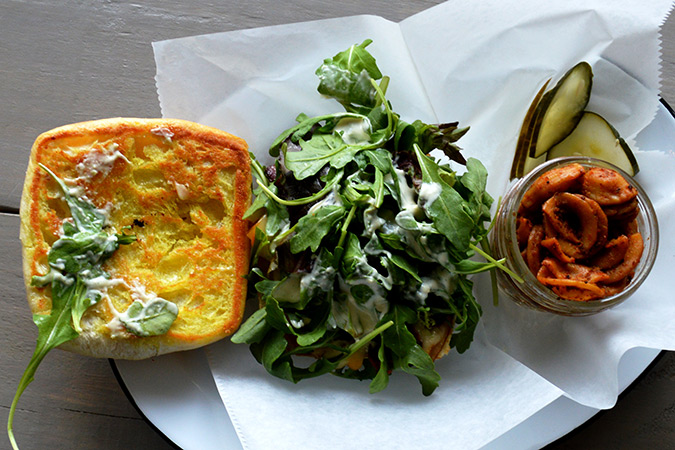
On this night, the farm’s Franny Tacy is touting the impending premiere of her new hemp-infused ale. I sip a tiny taste of an early batch, and it goes, oh, so well, with a smorgasbord of samples on the appetizer menu: arugula salad, chicken wings, pickled eggs, mushrooms and “Garbage Mac.”
Later, I get back to my home away from home – the apartment-like “Barn House” of Franny’s Farm, centered by a large table and loaded with creature comforts.
“The Barn House has satellite TV, internet, full kitchen, so you’re not roughing it,” says Franny’s husband, Jeff Tacy, 47. “But, you’re still kind of unplugged.”
Franny’s Farm also features five small cabins and several campsites. And here, says Franny Tacy, 49, city-folk are amazed by the dark skies of the countryside. “And you get to see the stars and fireflies.”
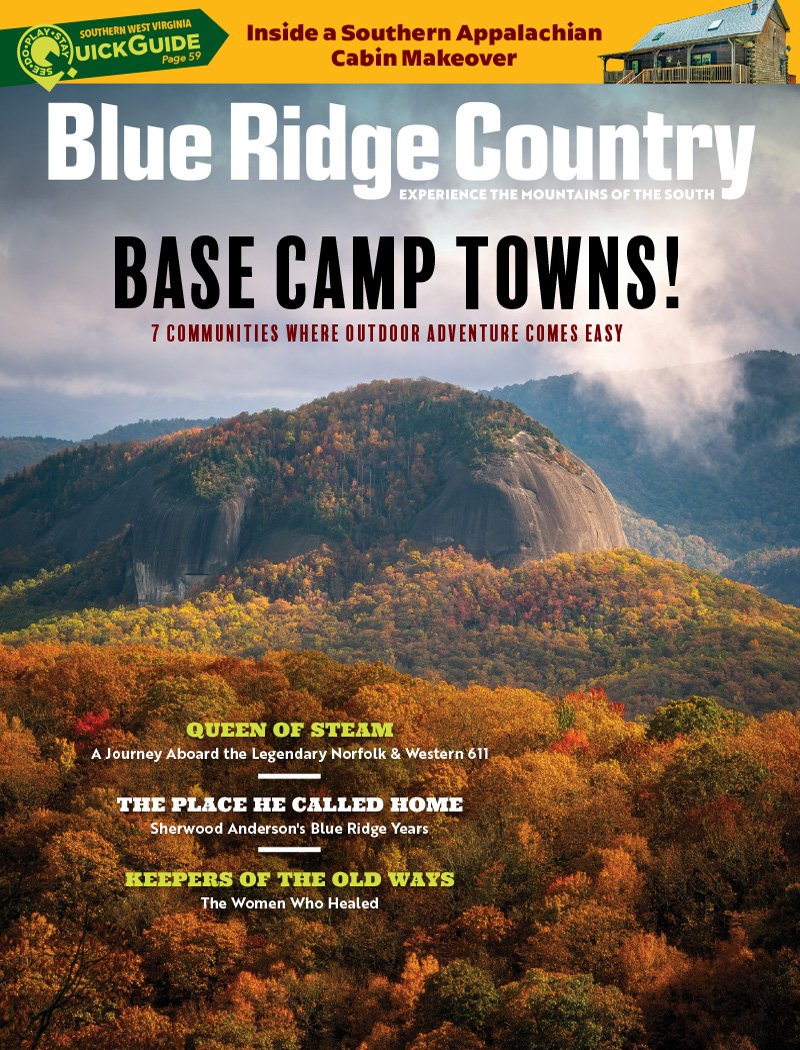
FRANNY’S FARM CONTAINS JUST ONE chapter of my “Farms, Food and Fun” adventures for Blue Ridge Country.
Over a four-month period, while researching a cover story for the magazine’s September/October 2019 issue, I ventured not only to Franny’s Farm but also – on a separate trip, with my 12-year-old son – to the mountains of South Carolina and Georgia for four days and four nights.
First, we headed to the Chattooga Belle Farm (chattoogabellefarm.com) to stay in a cabin-style mobile home at Long Creek, South Carolina. And, two days later, upon checkout, we were seriously talking about getting one of these for ourselves.
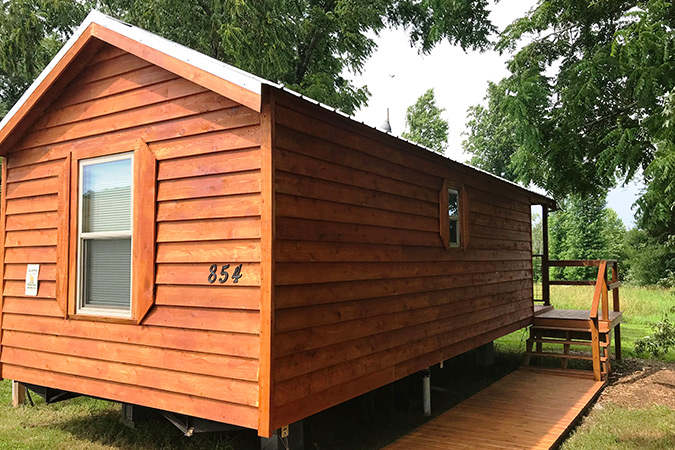
That tiny house had just about everything we needed – kitchen, full bath, bedroom, living room with pull-out sofa and a spacious deck overlooking a green field yielding to a hazy view of Horseshoe Lake.
In between our two nights at the Llama Lodge, we headed to the South Carolina-Georgia border for our first whitewater rafting trip with a company called Wildwater (wildwaterrafting.com).
This was also a huge step-up from our first father-son excursion to the Georgia mountains in 2013, when John had just turned 7, and tagged along while I researched “North Georgia: Food, Fun, Frolic Amid Rivers and Mountains” (Blue Ridge Country, March/April 2014).
On that first journey, John was way too little for most activities. Why, even tubing seemed like a grand adventure that would have to wait.
But, now, coming back to Helen, Clayton, Dillard and the Bull Sluice on the Georgia-South Carolina border, we retraced steps in search of new heights.
About the Bull Sluice: It’s a Class IV rapid that is an optional obstacle on the downriver half-day trip we booked with Wildwater.
For the record, on our 2019 journey, we followed our guide’s instructions well on the Class I-II rapids we encountered from the launch until we stopped ahead of the Bull Sluice.
We loved the large lunch served to us and about two-dozen other rafters on a small beach in Rabun County, Georgia.
Yet John made our decision: While we were good at getting downriver, we weren’t going to take any chances at banging a knee or simply falling out. So, we walked around the Bull Sluice, like a few others opted.
And you know what? We have absolutely no regrets, especially after watching how the four other guys and our guide – in our boat – nearly found themselves going down the Bull Sluice backwards. Fortunately, though, that gifted guide made a quick maneuver, and they sloshed through the Bull Sluice just fine.
THE NEXT DAY, we returned to Helen, Georgia, again retracing steps from our week in July 2013.
This is a Bavarian-style village that was actually fashioned from an artist’s dreams of making this tiny town more than a lumbering village.
Over time, folks have also frolicked in the Chattahoochee River: the perfect place to launch a tube.
“The river runs right through town, so it’s a big hit. People love the river,” says Terry Sims, co-owner of the Cool River Tubing Company (coolrivertubing.com).
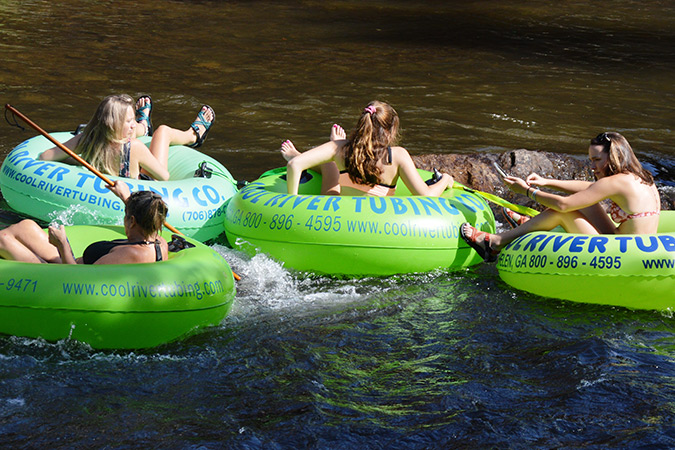
At summer’s peak, this is the biggest attraction in town, with Cool River launching thousands of tubes on the river in a theme park-like atmosphere.
Sims, 60, keeps the fun rolling on the road with a dozen shuttle buses used to transport tubers upriver for a two-hour float back to the base-camp.
What’s best: lack of deep waters and a mix of both rapids and slow, relaxing spans.
You get to see the decks of dream-houses, built at the edge of the riverbanks, while also casually and comically banging your tube into fellow tubers.
It may be crowded, but it’s nothing but fun – just like a new offshoot attraction of Cool River Tubing: the new Georgia Mountain Coaster, screeching down a hill at 27 miles an hour near the center of Helen.
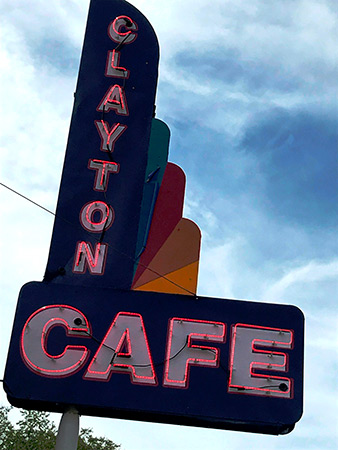
FOR LUNCH, we’re back in Rabun County, sampling a fish sandwich topped with fresh vegetables at the Clayton Cafe (claytoncafe.com).
“We’re getting everything that’s fresh that day, and we put it on the table,” says Lisa Shilling, the manager of the Clayton Cafe, an eatery open on Main Street since the early 1930s.
For another lunch on another day, we meet Scott Merkle, owner of Grapes & Beans (grapesandbeans.com), just about two blocks from the Clayton Cafe. On this day, I savor “The G&B,” loaded with turkey, bacon and avocado.
Then we cap our adventures with a trip to the same place where we had wrapped up our first trip in 2013 – the Dillard House (dillardhouse.com) at Dillard, Georgia.
Again, too, we meet Pam Thompson, operator of the Dillard House Stables (dillardhousestables.com).
On that first trip, John had little-to-no horse experience. And he didn’t get anywhere near the Little Tennessee River, where Thompson leads rides.
Thompson’s typical hour-long ride actually goes right into the Little Tennessee River. “And, as the summer goes along, our goal is to be in the river for half the ride,” Thompson says.
At first, I had to almost beg John to ride a horse here. That early trip with Thompson in 2013 was just fine, but, in 2014, an odd horse in the Great Smoky Mountains of Tennessee had left John a little saddle-shy.
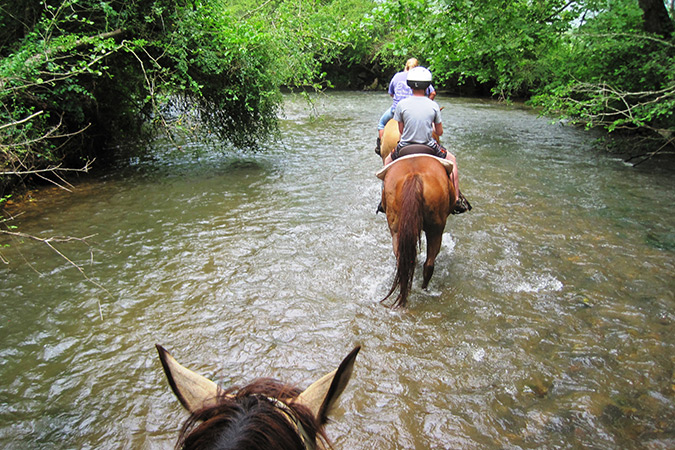
This time at Dillard, John started off with a lead rope connected to our guide, Lexie Parker. Hardly into this 2019 trip, however, he didn’t need that lead.
He took off on that horse like a regular cowboy.
And when it was over?
“Dad, I’ve changed my mind,” John says. “I like horses. In fact, now I want one!”
JOE TENNIS is a contributing editor for Blue Ridge Country magazine. His books include “Haunted Highlands: Ghosts & Legends of North Carolina, Tennessee and Virginia,” available on Amazon.