Skip to content

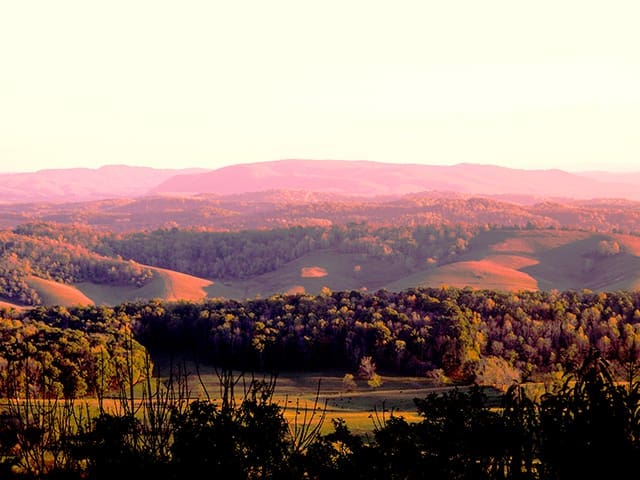
Casually cruising to Claytor Lake in southwest Virginia, I felt like I had come home – back to where it all began: my first assignment for Blue Ridge Country.
That was a 1997 story called “Sweet Virginia Breezes.” And now, 21 years after that initial assignment, I returned to the New River Valley to discover the charms of Pulaski and Wythe counties. That included where my first story began – at the Homestead Inn on Claytor Lake. This time, too, I was charged with checking out all that had changed since my first piece, “Sweet Virginia Breezes,” was published in May/June 1997.

The Homestead Inn on Claytor Lake now belongs to Tom and Diane Whitehead, along with another couple. And here, Diane Whitehead tells me, “We added a fire pit. We’ve done a lot of renovations on the cabana.”

Guests come to this century-old brick home in Pulaski County for the private beach on the lake plus the easy access to the 57-mile-long New River Trail State Park at Draper. You can also find the nearby Draper Mercantile, which opened in 2011 – years after my survey of the region. The Draper Mercantile has grown into a can’t-miss landmark, loaded with the best books on the region plus gifts and what’s good for your garden.
Just a few miles away, but on the western side of Draper Mountain, I pull into Pulaski, a courthouse town that has spent the past several years re-inventing itself. This is the terminus of the New River Trail – if you utilize an extension called the “Dora Trail” that leads to the restored, renovated and rebuilt Pulaski Train Station.

I did not grow up in Pulaski. But I sense some of my soul here. I actually first found this town in 1990 when I witnessed the view from the Draper Mountain overlook along U.S. 11. Then, at just barely 21, I returned a few weeks later to row a boat on Gatewood Lake.
On assignment for Blue Ridge Country, I met Michael McManus at Gatewood Park in 1997 on the outskirts of Pulaski. Here again, I discover McManus remains the manager at this park, where he lives with his wife, Margaret, and youngest son, Jackson.
The lake at Gatewood Park spans more than 150 acres. You can fish for largemouth bass, smallmouth bass, bluegill, crappie and yellow perch. “I like the remoteness of it,” says McManus. “And the water is crystal clear.”
Still in pursuit of those “Sweet Virginia Breezes,” I head south to the next courthouse town at Wytheville. And I meet again with James Green, the ageless owner of the Log House 1776 Restaurant.

During the 1970s, Green labored on the Log House with his own hands, uncovering what had been a log cabin. “It had been turned into an apartment house, and it was covered with weather-boarding,” Green says. “It had been closed for five or six years. And, I got to looking at it and realized it was log. And the neighbors didn’t even know it was log.”
Once the Log House opened as a restaurant in 1976 along U.S. 11, Green served as the chief cook for 10 years. Now, at 73, Green still oversees the Log House as a supervisor.
Regular diners spend Saturdays savoring squash and steak – or go outside to sample Scotch on the patio. It’s a charming scene, much like the Homestead Inn or virtually anywhere in Pulaski and Wythe counties – perfect places where you can feel the refreshing “Sweet Virginia Breezes.”
– JOE TENNIS is a contributing editor for Blue Ridge Country.