August’s Mountain Wildflower: Cardinal Flower

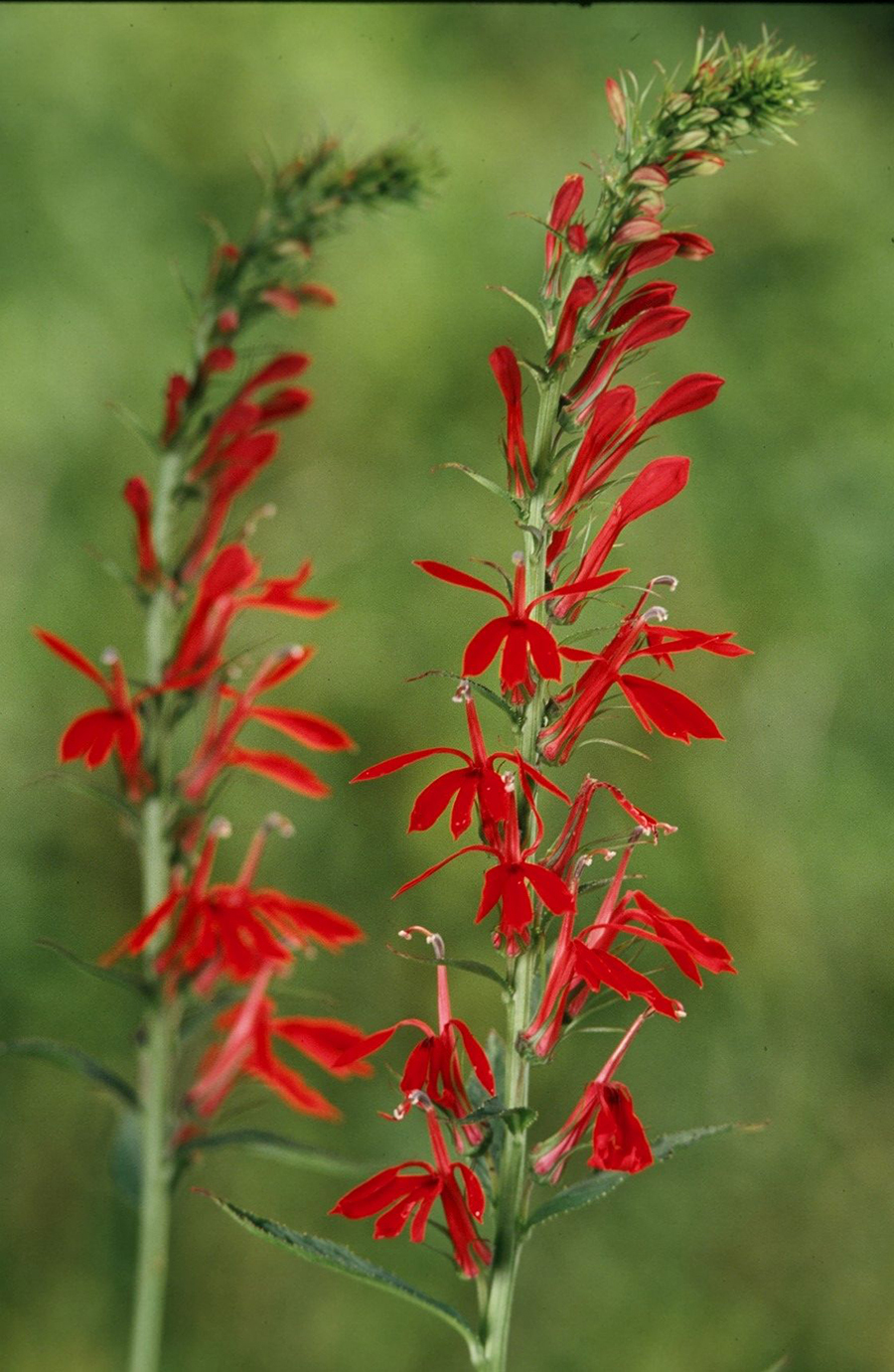
Found in the same type of habitat as bee balm (Monarda didyma)—moist areas and along water runs—cardinal flower is not named for the state bird of Virginia and West Virginia, but rather for the color of vestments worn by cardinals of the Roman Catholic Church. The genus name of Lobelia honors a Flemish herbalist who was the personal physician of James I of England.

It’s a plant that perfectly illustrates that the web of life is an amazing thing that seems to have no end to its number of strands. In addition to propagating by seeds, cardinal flower sends out shoots that rise above the ground as a rosette of leaves. The following year, this matures into a flowering plant that sends out its own shoots. To obtain the strength needed to accomplish this, the basal leaves stay green year-round, gathering nourishment through photosynthesis—and this is why cardinal flower grows close to streams. It depends on these waterways to overflow their banks every so often and clear away any litter or debris that has come to rest on the leaves, blocking the amount of sunlight that reaches them. So, whenever human beings change the natural flow of rivers and creeks, they affect the health and life of the cardinal flower.

Flower Fast Facts

FLOWER: The brilliant red flowers grow in a long cluster and are about one and a half inches long and have five petals that form two lips; the upper one has two lobes while the lower one has three spreading lobes. The stamens are united in a tube around the single pistil.

LEAVES AND STEM: The lanceolate leaves average six inches in length, are irregularly toothed and grow alternately on the stem of two to five feet in height.

AVERAGE BLOOM SEASON: July to September


About This Series

“Mountain Wildflowers” features a wildflower from the Blue Ridge region each month from March to October. Leonard M. Adkins has written for Blue Ridge Country for more than two decades and is the author of 20 books about travel, hiking and nature. His Wildflowers of the Appalachian Trail, which received the prestigious National Outdoor Book Award, provides the photographs and some of the information he writes about in each “Mountain Wildflowers.” It and his other works may be obtained through his website.

You Might Also Like:

e1b70596-05c8-11f1-92e0-1248ae80e59d-3-2026rueanemone--credit-Joe-Cook

March’s Mountain Wildflower: Rue Anemone

A member of the buttercup family and found in the open woodlands, rue anemone (Thalictrum thalictroides) has long, thin stems that tremble in the slightest of winds—prompting its other common name, windflower.
Pokeweed growing in Floyd County, Virginia.

January’s Wild Edible: Pokeweed

Pokeweed is one of the wild plants that is most associated with the Blue Ridge Region.
A purple-spored puffball growing in a field in Botetourt County, VA.

December’s Wild Edible: Purple-Spored Puffball

The purple-spored typically grows in this region’s fields, often appearing from October through December and into early January.
d289022c-696f-11f0-a179-1248ae80e59d-CGZ_0845-011

Ride the Rails, Explore Rockbridge County: Make a Weekend of the 611 in Goshen!

This fall, one of America’s most iconic steam locomotives is making tracks and memories.
The compound, lancelike leaflets of the bitternut are a good identifier.

November’s Wild Edible: Bitternut Hickory

Frankly, this native species to the Blue Ridge mountains comes by its name honestly.
Mullein growing in Ingram's backyard.

October’s Wild Edible: Mullein

Earlier, this year, a lone mullein plant appeared along the fence that encloses my garden, which made me curious about this plant.
An indigo milk cap growing in Botetourt County, Virginia.

September’s Wild Edible: Indigo Milk Caps

When young, indigo milk caps are one of the most stunningly beautiful mushrooms in the Blue Ridge Mountains.
ec3b964c-5201-11f0-968d-1248ae80e59d-9-2025spottedjewelweed--credit-Joe-Cook-and-Monica-Sheppard

September’s Mountain Wildflower: Spotted Jewelweed

Seek out spotted jewelweed growing beside a stream or along a moist area and you will have a good chance of getting to watch one or more ruby-throated hummingbirds flit from flower to flower.
A black staining polypore growing in Botetourt County, VA.

August’s Wild Edible: Black-Staining Polypore

The black-staining polypore is certainly one of the more fascinating wild edible mushrooms.
Northern Dewberry growing in Botetourt County, Virginia.

July’s Wild Edible: Northern Dewberry

For several reasons, the northern dewberry is often overlooked as a summer berry in the Blue Ridge.

CALENDAR OF EVENTS