July’s Mountain Wildflower: Bee Balm

Bee balm is an inhabitant of moist areas in woodlands and beside streams, ponds and lakes where it is often seen growing close to cardinal flower (Lobelia cardinalis).

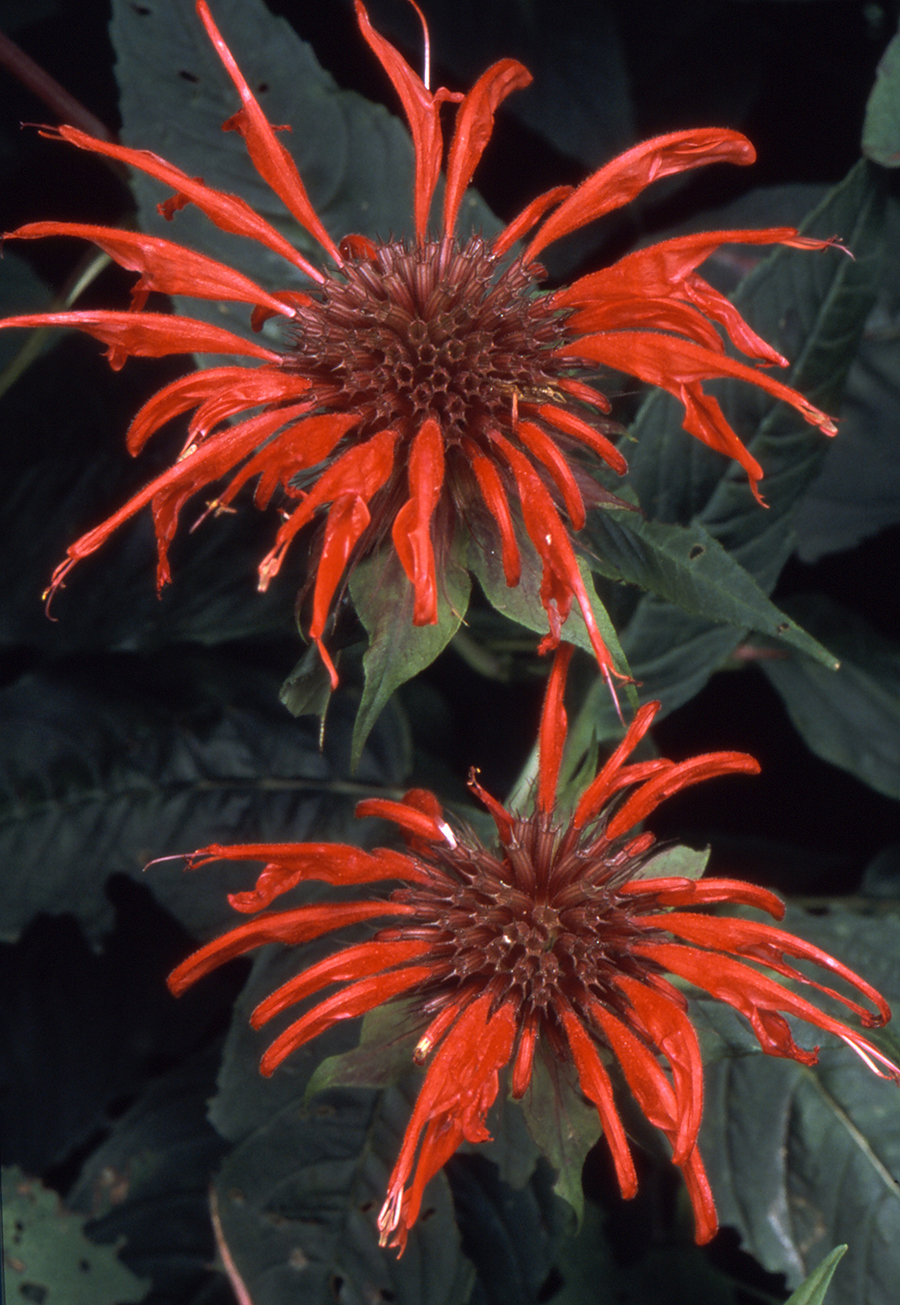
The rich, scarlet red of both blossoms, which last throughout much of the summer, attract ruby-throated hummingbirds, the only hummingbirds found within our Blue Ridge region. Although bees are attracted to the bee balm, the long floral tubes—which make it hard for insects to reach the nectar—are more suited to the narrow bills of the hummingbirds.

While studying the flower, you may notice its stem is different from those of most other plants. Run your fingers along it and you will find that the stem is not round, but square, a characteristic it shares with other members of the mint family.

As part of a group negotiating a treaty in 1743 with the Oswego Indians of New York, naturalist John Bratram learned that the Native Americans made a tea from bee balm that helped alleviate the discomforts of fevers or chills. The drink became popular with colonists who substituted it for imported tea, earning the plant another title, Oswego tea. Other common names include Indian plume, mountain mint and fragrant balm.

Flower Fast Facts

FLOWER: The individual bright red flowers are about 1.5 inches long and have an ascending upper lip with a broader, drooping lower lip. Although most books typically say the flowers grow in a dense terminal cluster, Roger Tory Peterson refers to it as a “ragged scarlet pompon of tubular flowers.”

LEAVES AND STEM: The 3- to 6-inch dark green leaves are quite toothed and grow in pairs along the length of the 2- to 4-foot stem.

AVERAGE BLOOM SEASON: July to September


About This Series

“Mountain Wildflowers” features a wildflower from the Blue Ridge region each month from March to October. Leonard M. Adkins has written for Blue Ridge Country for more than two decades and is the author of 20 books about travel, hiking and nature. His Wildflowers of the Appalachian Trail, which received the prestigious National Outdoor Book Award, provides the photographs and some of the information he writes about in each “Mountain Wildflowers.” It and his other works may be obtained through his website.

You Might Also Like:

e1b70596-05c8-11f1-92e0-1248ae80e59d-3-2026rueanemone--credit-Joe-Cook

March’s Mountain Wildflower: Rue Anemone

A member of the buttercup family and found in the open woodlands, rue anemone (Thalictrum thalictroides) has long, thin stems that tremble in the slightest of winds—prompting its other common name, windflower.
Pokeweed growing in Floyd County, Virginia.

January’s Wild Edible: Pokeweed

Pokeweed is one of the wild plants that is most associated with the Blue Ridge Region.
A purple-spored puffball growing in a field in Botetourt County, VA.

December’s Wild Edible: Purple-Spored Puffball

The purple-spored typically grows in this region’s fields, often appearing from October through December and into early January.
d289022c-696f-11f0-a179-1248ae80e59d-CGZ_0845-011

Ride the Rails, Explore Rockbridge County: Make a Weekend of the 611 in Goshen!

This fall, one of America’s most iconic steam locomotives is making tracks and memories.
The compound, lancelike leaflets of the bitternut are a good identifier.

November’s Wild Edible: Bitternut Hickory

Frankly, this native species to the Blue Ridge mountains comes by its name honestly.
Mullein growing in Ingram's backyard.

October’s Wild Edible: Mullein

Earlier, this year, a lone mullein plant appeared along the fence that encloses my garden, which made me curious about this plant.
An indigo milk cap growing in Botetourt County, Virginia.

September’s Wild Edible: Indigo Milk Caps

When young, indigo milk caps are one of the most stunningly beautiful mushrooms in the Blue Ridge Mountains.
ec3b964c-5201-11f0-968d-1248ae80e59d-9-2025spottedjewelweed--credit-Joe-Cook-and-Monica-Sheppard

September’s Mountain Wildflower: Spotted Jewelweed

Seek out spotted jewelweed growing beside a stream or along a moist area and you will have a good chance of getting to watch one or more ruby-throated hummingbirds flit from flower to flower.
A black staining polypore growing in Botetourt County, VA.

August’s Wild Edible: Black-Staining Polypore

The black-staining polypore is certainly one of the more fascinating wild edible mushrooms.
Northern Dewberry growing in Botetourt County, Virginia.

July’s Wild Edible: Northern Dewberry

For several reasons, the northern dewberry is often overlooked as a summer berry in the Blue Ridge.

CALENDAR OF EVENTS