Skip to content


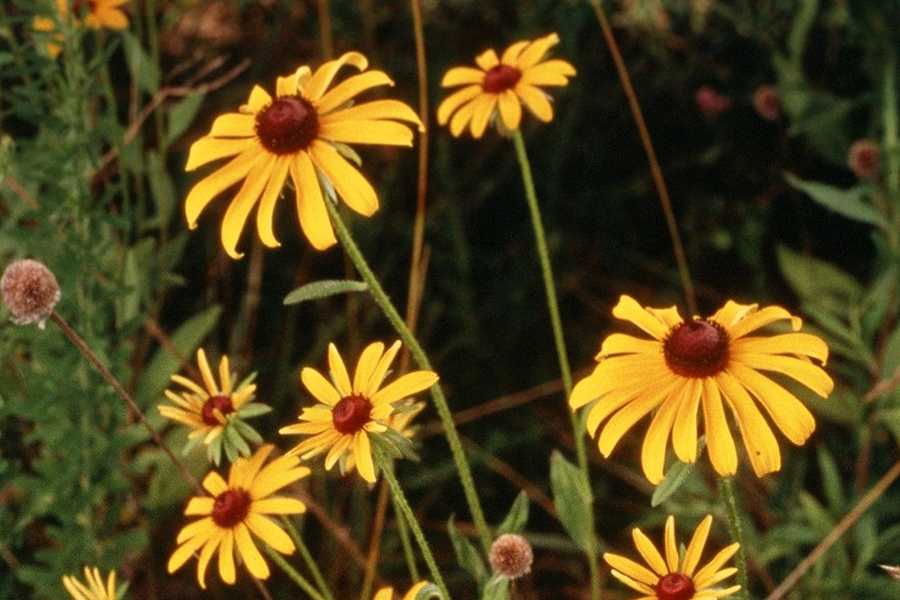
Lightly run your fingers up and down the stem of a black-eyed Susan (Rudbeckia hirta) and you will feel the small barbs that the plant has developed through evolution to keep unwanted insects and other creatures from crawling up and stealing its abundant nectar and pollen. The plant does reward flying visitors who possess tongues long enough to reach inside the florets to sip the nectar, while those with short tongues may access the yellow pollen.
In an example of how humans affect the makeup of the natural world, black-eyed Susans are not native to the eastern United States, but, rather, were originally found only in the plains and prairie lands of North America. It is believed the flower made its way eastward in the 1830s when its seeds became mixed with shipments of red clover seeds—which eastern farmers were eager to plant in their fields. Today the plant is found in nearly every state in the U.S. and in many Canadian provinces. Favoring dry fields, open woods, waste areas and roadsides, the individual blossoms are long-lasting, staying healthy and blooming for nearly a month when conditions are right.

Early settlers used the plant as a diuretic, while some Native American tribes made a yellow dye from the flowers and a tea from the root to relieve the symptoms of a cold. Modern herbalists state that the root extracts stimulate the immune system, and some doctors are now studying the plant to see if it may be useful in treating AIDS.
Flower Fast Facts
FLOWER: The flower of the black-eyed Susan is quite complex. The blossom grows at the end of a single stem, and its center cone is made up hundreds of small florets which produce seeds and bloom in a ring around the cone. Connected to the cone and radiating outward are ten to twenty, long, orange-yellow rays.
LEAVES AND STEM: The two to seven-inch leaves are lance-shaped (but may be a bit ovate), have distinct veins and grow alternately on a stem of one to three feet in height. Both the leaves and the stem are slightly hairy.
AVERAGE BLOOM SEASON: June to October
About This Series
“Mountain Wildflowers” features a wildflower from the Blue Ridge region each month from March to October. Leonard M. Adkins has written for Blue Ridge Country for more than two decades and is the author of 20 books about travel, hiking and nature. His Wildflowers of the Appalachian Trail, which received the prestigious National Outdoor Book Award, provides the photographs and some of the information he writes about in each “Mountain Wildflowers.” It and his other works may be obtained through his website.