Skip to content

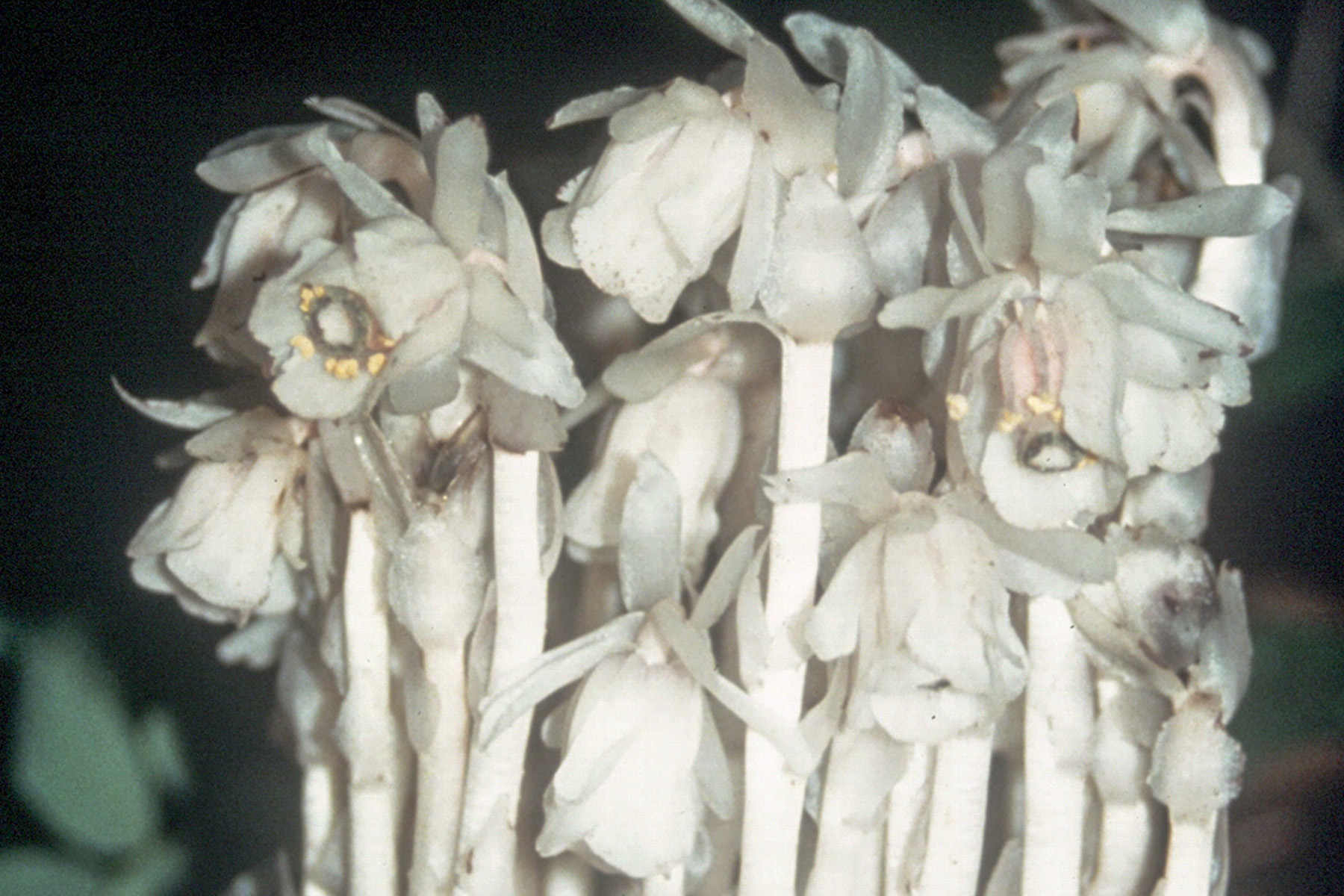
Containing no chlorophyll, this plant rises from the soil on translucent, waxy-looking stems, and the pinkish-white flower nods back toward the ground, giving the whole plant the appearance of a fancily carved soapstone pipe.
Photo Credit Joe Cook and Monica Sheppard
From June into September (and sometimes even into October), search out and stop to study the unique ghost pipe (Monotropa uniflora), which grows in heavily shaded areas. Containing no chlorophyll (the substance that gives plants their green color), this plant rises from the soil on translucent, waxy-looking stems, and the pinkish-white flower nods back toward the ground, giving the whole plant the appearance of a fancily carved soapstone pipe.

The genus name of Monotropa, meaning “once-turned,” refers to the plant’s proclivity of lifting its head upright after producing seeds. Ghost pipe’s ghostly color, its tendency to feel cold and turn black when touched, and the viscous fluid oozes when its flesh has been broken, has given rise to a number of other common names such as ghost flower, corpse plant, ice plant, and fairy smoke.
Ghost pipe has a long blooming season, but each individual plant blooms for just a short while. Surviving most of the year underground, the plant does not send up a shoot until it is ready to bloom, and once it has become fertilized and produced seeds, its above ground part turns black, wilts, and disappears.
Though it contains a poisonous substance, ghost pipe has been used to treat eye problems, fainting spells, fevers, and more.
Pinesap (Monotropa hypopitys or Hypopitys monotropa) is similar to ghost pipe, but it has a reddish-yellow tinge with several nodding flowers per stem. Sweet pinesap (Monotropsis odorata) is much smaller, very fragrant and often hidden under forest litter.
Flower Fast Facts
FLOWER: Usually growing in small clumps, the nodding, nearly translucent flower is most often white, but it can also be pale shades of pink, yellow, or even blue.
BLOOM SEASON: June-September
LEAVES AND STEM: The leaves are nearly unnoticeable and are scalelike on a 3- to 10-inch stem. Both the leaves and stem are the same color as the flower.
About This Series
“Mountain Wildflowers” features a wildflower from the Blue Ridge region each month from March to October. Leonard M. Adkins has written for Blue Ridge Country for more than two decades and is the author of 20 books about travel, hiking and nature. His Wildflowers of the Appalachian Trail, which received the prestigious National Outdoor Book Award, provides the photographs and some of the information he writes about in each “Mountain Wildflowers.” It and his other works may be obtained through his website.