November’s Wild Edible: Bitternut Hickory

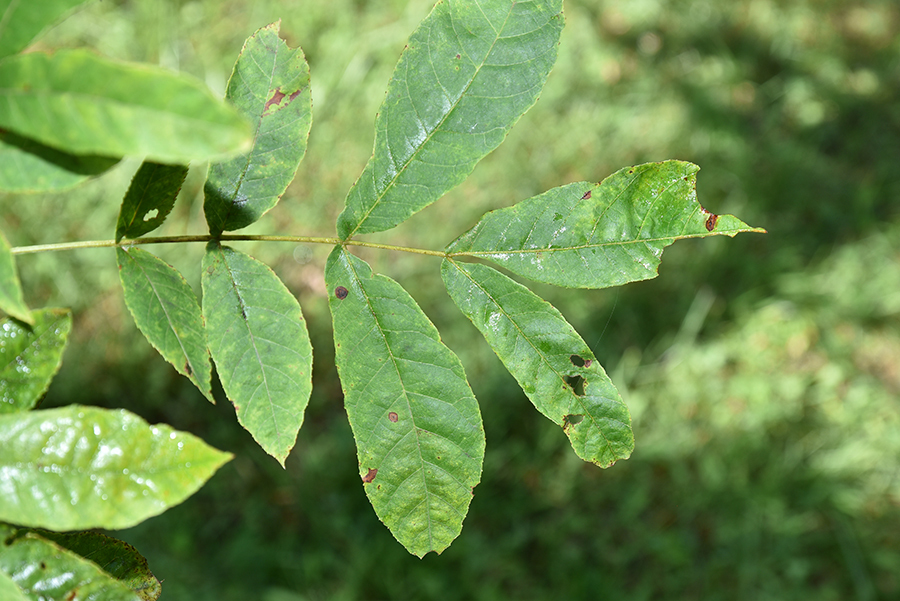
The compound, lancelike leaflets of the bitternut are a good identifier.

One day at school, fellow Lord Botetourt H.S. teacher Brady Price brought me a hickory nut that he wanted me to identify. The thin yellowish, green husk seemed to indicate that it might be a Carya cordiformis, a bitternut, the wood of which is renown for hickory smoked meats, and the nuts themselves can be made into an oil.

Photo Above: The compound, lancelike leaflets of the bitternut are a good identifier. © Bruce Ingram.

To confirm its identity, I told Brady we would have to remove the outer covering, which splits easily into four sections when ripe, and sample the nutmeat. Our tasting of the nut sent us both scurrying for water as, well, the bitterness of the bitternut was quite apparent. Frankly, this native species to the Blue Ridge mountains comes by its name honestly. I would eat the bitternut in a survival situation, but all other times it is best left to squirrels and mice which apparently do not have discerning palates.

Other identifying characteristics are the long, straight trunk with a short crown, the 7 to 11 compound lancelike leaflets, and the long, yellow buds which are quite evident in spring. So if you’re curious this month about what a bitternut hickory nut tastes like, give it a try. Consider having a generous supply of water nearby, though.


Bruce and Elaine Ingram wrote Living the Locavore Lifestyle about living off the land. For more information: bruceingramoutdoors@gmail.com.

You Might Also Like:

Wild garlic growing in Fayette County, West Virginia.

April’s Wild Edible: Wild Garlic

Fayette County, West Virginia’s Mitchell Dech is one of my foraging mentors, and when he wants me to try an edible new to me … I’m ready to learn about it.
The Giovanni is an Italian-American creation born in West Virginia.

Discovering the West Virginia Giovanni

This flavorful sandwich is a product of the rich Italian heritage of the Mountain State.
A May apple in bloom in Southwest Virginia.

March’s Wild Edible: May Apple

Sometime this month in the Blue Ridge Mountains, one of these highlands’ signature spring plants will ease from the soil … the May apple (Podophyllum peltatum).
e1b70596-05c8-11f1-92e0-1248ae80e59d-3-2026rueanemone--credit-Joe-Cook

March’s Mountain Wildflower: Rue Anemone

A member of the buttercup family and found in the open woodlands, rue anemone (Thalictrum thalictroides) has long, thin stems that tremble in the slightest of winds—prompting its other common name, windflower.
Pokeweed growing in Floyd County, Virginia.

January’s Wild Edible: Pokeweed

Pokeweed is one of the wild plants that is most associated with the Blue Ridge Region.
The pawpaw version of Ale-8-One debuted in the summer of 2025, in a limited edition.

Ale-8-One: Welcome to ‘Tropical’ Kentucky

This 124-year-old soft drink company continues to innovate and thrive.
Arkansas Black apples sport an attractive reddish black color.

December’s Blue Ridge Mountain Apple Profile: Arkansas Black

Originating in the 1870s in, obviously, The Natural State, this variety is reputed to be a part of the Winesap family, which includes such esteemed members as the Black Twig, Stayman, and, of course, the Old Fashioned Winesap.
A purple-spored puffball growing in a field in Botetourt County, VA.

December’s Wild Edible: Purple-Spored Puffball

The purple-spored typically grows in this region’s fields, often appearing from October through December and into early January.
The Fork and Plough name reflects the professions of the owners — chef and farmer.

Fork and Plough: Neighborly and Nimble

At this Greenville, South Carolina, eatery, the menu changes literally every day, based on what’s available locally.
d289022c-696f-11f0-a179-1248ae80e59d-CGZ_0845-011

Ride the Rails, Explore Rockbridge County: Make a Weekend of the 611 in Goshen!

This fall, one of America’s most iconic steam locomotives is making tracks and memories.

CALENDAR OF EVENTS