In 1885 on the Tennessee/North Carolina border atop Roan Mountain, there opened a luxury resort that drew the likes of Henry Ford.
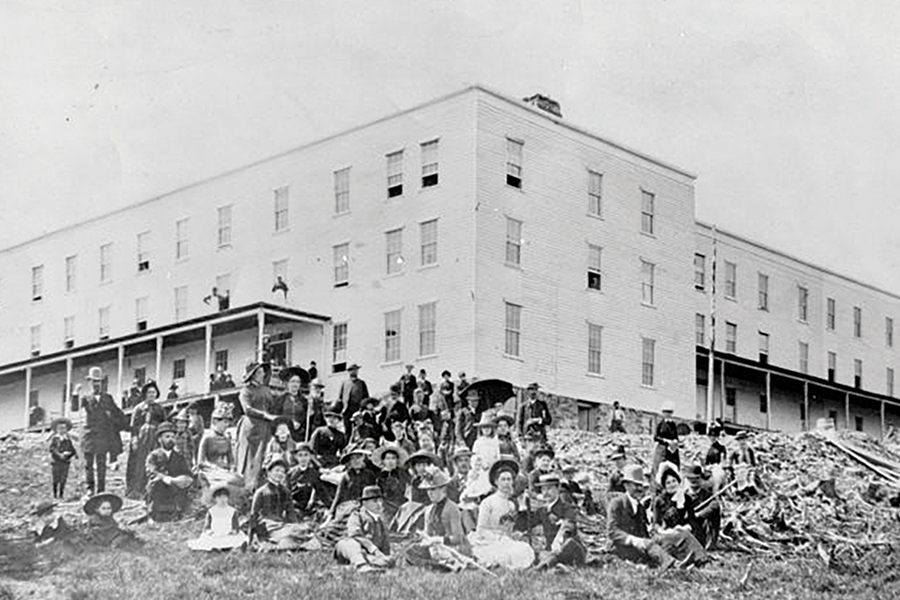
Photo Above: The Cloudland was a 166-room resort.
After the Civil War, the part of the southern Appalachians along the Tennessee-North Carolina border became home to numerous inns, spas and hotels, all touting the health, recreational and educational benefits of a visit to the mountains.

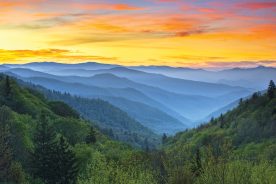
Among the most ambitious and at the highest elevation of any was the Cloudland Hotel, opened in 1885 on top of Roan Mountain, on the border between Carter County, Tennessee, and Mitchell County, North Carolina. Its 6,391-foot elevation allowed for one of its key promotions: Spectacular views into five states (Virginia, West Virginia, Georgia, Tennessee and North Carolina) and of about 100 peaks of more than 4,000 feet.
The man behind the Cloudland, General John T. Wilder, was born in New York state in 1830, lived in Ohio has a child and in 1857 moved to Indiana to open a foundry, which he closed in 1861 to enlist in the Union Army during the Civil War.
His brigade, known as Wilder’s Brigade, fought most notably in the Battle of Chickamauga, for which he was commended. There is a monument to Wilder’s Brigade at Chickamauga and Chattanooga National Military Park. He was promoted to general in 1864.
After the Civil War ended, Wilder settled in Rockwood, Tennessee; then he moved to Chattanooga where he organized the Roane Iron Company in 1867. He also established a company to manufacture railroad rails. He was elected mayor of Chattanooga in 1871 but resigned a year later to attend to his business interests.
He moved to Johnson City in the mid 1870s where he helped to promote and build the Charleston, Cincinnati and Chicago Railroad. He also established a foundry there, using iron ore shipped to Johnson City from mines he had invested in at Cranberry, North Carolina, on the East Tennessee and Western North Carolina (ET&WNC) Railroad, known popularly as the Tweetsie Railroad, so nicknamed for its “tweet, tweet” train whistles that echoed through the hills.
In 1877 Wilder built his first hotel atop Roan Mountain, a small lodge of 20 rooms made from balsam logs and named the Cloudland Hotel, in deference to pervasive cloud cover both at and below the site.
A combination of factors led Wilder to build a much larger hotel on the mountaintop: A better road up the mountain; the Tweetsie bringing people much closer to the road, along with sociological factors including a growing wealth class with keen interest in the idea of geography-based spots for health, recreation and affirming their social status.
The result was a 166-room luxury resort with maple floors and cherry furniture, a resident doctor, butcher, baker and even a barber. Guests could golf (with weighted balls due the elevation), bowl, hike, fish and play croquet to their heart’s content.
But if you needed to use the bathroom, you might have to get in line because those 166 rooms had only one bathroom among them (though some sources say four).
The grand dining room was built with intention precisely on the border between Mitchell County, North Carolina, and Carter County, Tennessee. On the floor of the dining room was a white line, painted along the border, because it was legal to serve alcohol in the state of Tennessee, but was illegal in the state of North Carolina. Take your drink across that white line and you risked being arrested by the sheriff of Mitchell County or his deputies who often sat in Mitchell County waiting to arrest anyone with a drink who crossed the line.
The Cloudland, like other Appalachian Mountain hotels of the time, touted the health benefits of a visit, especially for sufferers from hay-fever, which was a bit of a fixation in late 19th-century America.
The hotel was popular—visited by the likes of Henry Ford, Harvey Firestone and John Muir—but the costs of maintaining a building atop one of the highest peaks east of the Mississippi River became too much to bear for Wilder. The economic panic of 1893 threatened his finances and he fell behind on taxes due to both host states. Wilder lost interest in the property and tried, unsuccessfully, to sell it.
A caretaker couple stayed on for several years after the Cloudland closed in 1910. By 1915, the remains were collapsing into ruin, yielding to the combined forces of neglect, harsh weather and vandalism.
Wilder died in 1917 in Jacksonville, Florida, and by 1919 his heirs were selling off the former grand hotel in pieces, hastening its full ruin.
Today the only thing left of the hotel is a historical marker commemorating where it sat at the turn of the 20th century atop Roan Mountain.
About This Story
This history of General John T. Wilder and his Cloudland Hotel is adapted with permission from the podcast “Stories, A History of Appalachia,” hosted by Steve Gilly and Rod Mullins. It is just one of scores of fascinating stories from the southern Appalachians—all told in a relaxed conversational style by the two. The “Stories” podcast is available on Apple Podcasts, Stitcher, Google Play, Spotify, Deezer, iHeartRadio and elsewhere.
Want to Know More?
A few details in this piece are from “Resorts in the Southern Appalachians: A Microcosm of American Resorts in the Nineteenth and Early Twentieth Centuries” (East Tennessee State University, 2004), a Master’s dissertation by Mary F. Fanslow. Her work provides deep discovery and insight into the social, economic, sociological and industrial aspects of the phenomenon of health resorts in the U.S. during the period. Her chapter on the Cloudland is replete with eminently detailed information on those aspects as well as on General John T. Wilder, the construction processes, the Cloudland’s surrounding communities and inhabitants and countless other details. View it at dc.etsu.edu/etd/961/
The story above first appeared in our March / April 2023 issue.