Birds of the Blue Ridge: Carolina Wren

And the winner of the Adaptable Bird Award goes to… the Carolina Wren!

While some reports say that this bird species is shy, they seem to go about their lives unperturbed by humans. Whether this is because they have an affinity for us or simply abide us is open for debate. Regardless, they have adapted in ways other birds have not. For example, wrens often choose to make their nests and raise their young in the most unlikely places – flower pots, carports and garages, abandoned cars, mailboxes and even the pockets of shirts hanging on a clothesline.

Pair bonding can occur any time of year and they mate for life. Amongst Carolina Wrens, the males sing the loudest and the females accompany the songs. For those lucky enough to have nests close by, a bit of eavesdropping will be rewarded – soft conversations in secret bird language between the parents. As a lifelong bird nerd and Star Trek fan, I’ll be first in line for that “universal translator!”
Fun Facts

Wrens sing from sunup to sundown. One individual was counted singing 3,000 times in one day.

How to Identify a Carolina Wren

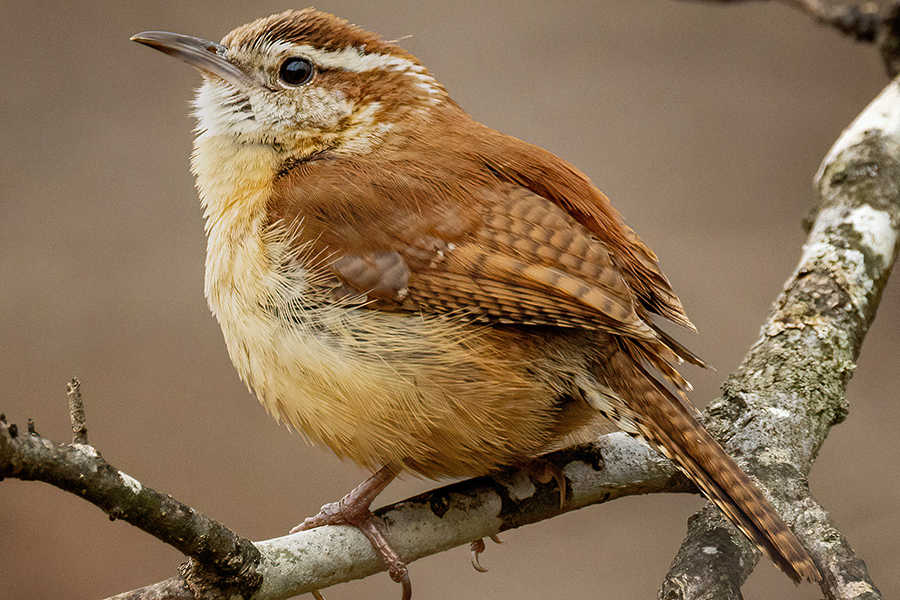
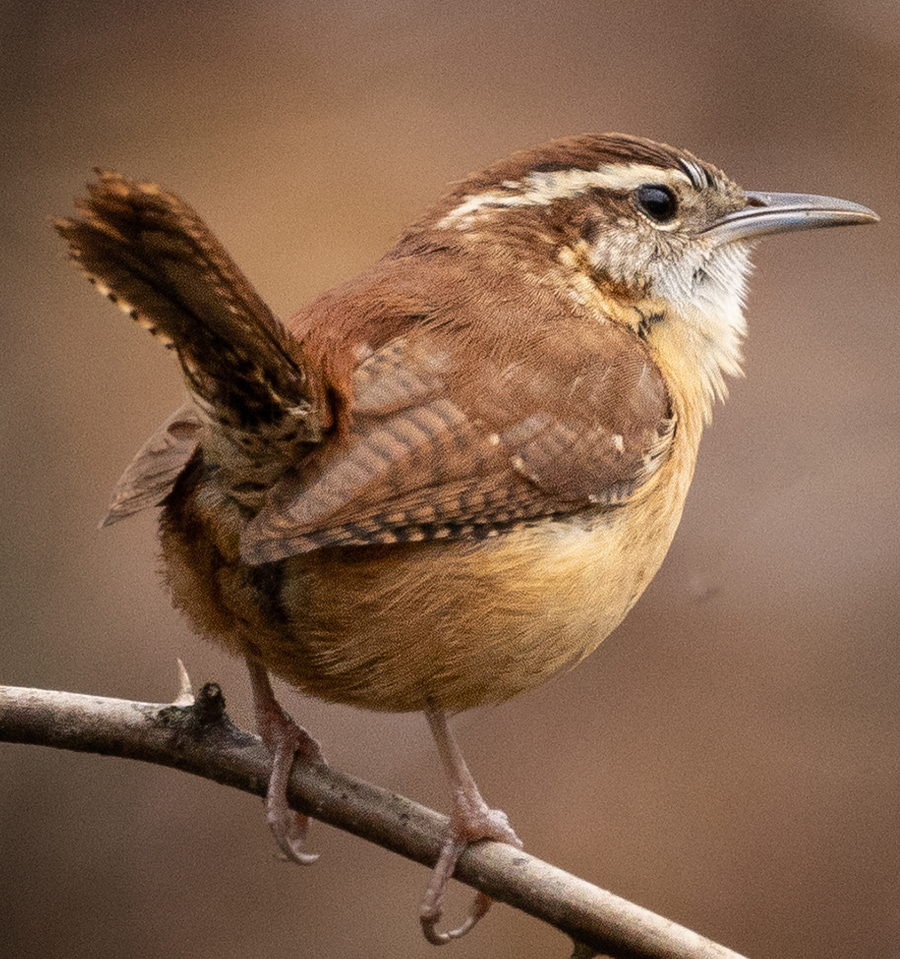
This little bird with a round body and jaunty tail is a reddish, chestnut color above and a tan, butterscotch underneath with a distinctive white eyebrow stripe. Males and females are quite similar with only slight differences in a larger size and longer bills, wings and tails for the males.

Carolina Wren Habitat

Tangled undergrowth, brush piles and dense vines and bushes in the forest and in the suburbs. Leave an “untended” edge on your property and the wrens will find it.

Conservation Note

The numbers and ranges of our year-round resident wren are increasing.


ABOUT THIS SERIES:

“Birds of the Blue Ridge” showcases frequently seen and rare birds across the southern Appalachian region. For over four decades, Angela Minor has traveled with binoculars and field guides across the continental U.S., Alaska, the Caribbean and seven European countries. She is a contributing editor with BRC magazine and a freelance writer, penning travel and nature feature articles for several regional and national print publications. Angela created and authored the state park birding series for Bird Watcher’s Digest.

Read More by Angela Minor: BlueRidgeCountry.com/AngelaMinor

You Might Also Like:

e1b70596-05c8-11f1-92e0-1248ae80e59d-3-2026rueanemone--credit-Joe-Cook

March’s Mountain Wildflower: Rue Anemone

A member of the buttercup family and found in the open woodlands, rue anemone (Thalictrum thalictroides) has long, thin stems that tremble in the slightest of winds—prompting its other common name, windflower.
Pokeweed growing in Floyd County, Virginia.

January’s Wild Edible: Pokeweed

Pokeweed is one of the wild plants that is most associated with the Blue Ridge Region.
A purple-spored puffball growing in a field in Botetourt County, VA.

December’s Wild Edible: Purple-Spored Puffball

The purple-spored typically grows in this region’s fields, often appearing from October through December and into early January.
d289022c-696f-11f0-a179-1248ae80e59d-CGZ_0845-011

Ride the Rails, Explore Rockbridge County: Make a Weekend of the 611 in Goshen!

This fall, one of America’s most iconic steam locomotives is making tracks and memories.
The compound, lancelike leaflets of the bitternut are a good identifier.

November’s Wild Edible: Bitternut Hickory

Frankly, this native species to the Blue Ridge mountains comes by its name honestly.
Mullein growing in Ingram's backyard.

October’s Wild Edible: Mullein

Earlier, this year, a lone mullein plant appeared along the fence that encloses my garden, which made me curious about this plant.
An indigo milk cap growing in Botetourt County, Virginia.

September’s Wild Edible: Indigo Milk Caps

When young, indigo milk caps are one of the most stunningly beautiful mushrooms in the Blue Ridge Mountains.
ec3b964c-5201-11f0-968d-1248ae80e59d-9-2025spottedjewelweed--credit-Joe-Cook-and-Monica-Sheppard

September’s Mountain Wildflower: Spotted Jewelweed

Seek out spotted jewelweed growing beside a stream or along a moist area and you will have a good chance of getting to watch one or more ruby-throated hummingbirds flit from flower to flower.
A black staining polypore growing in Botetourt County, VA.

August’s Wild Edible: Black-Staining Polypore

The black-staining polypore is certainly one of the more fascinating wild edible mushrooms.
Northern Dewberry growing in Botetourt County, Virginia.

July’s Wild Edible: Northern Dewberry

For several reasons, the northern dewberry is often overlooked as a summer berry in the Blue Ridge.

CALENDAR OF EVENTS